First in India
Claim Support Guarantee, otherwise your money back.
Buy through nyvo and we get your claim passed, otherwise refund your premium. We are putting our money on our claim service.
Where to Buy Health Insurance: Direct, Online, Bank or Advisor
The same health policy can be bought from the insurer, an online platform, a bank or an advisor. Who holds which IRDAI licence, who decides your claim, what each one must do for you, and when buying direct is the sensible choice.

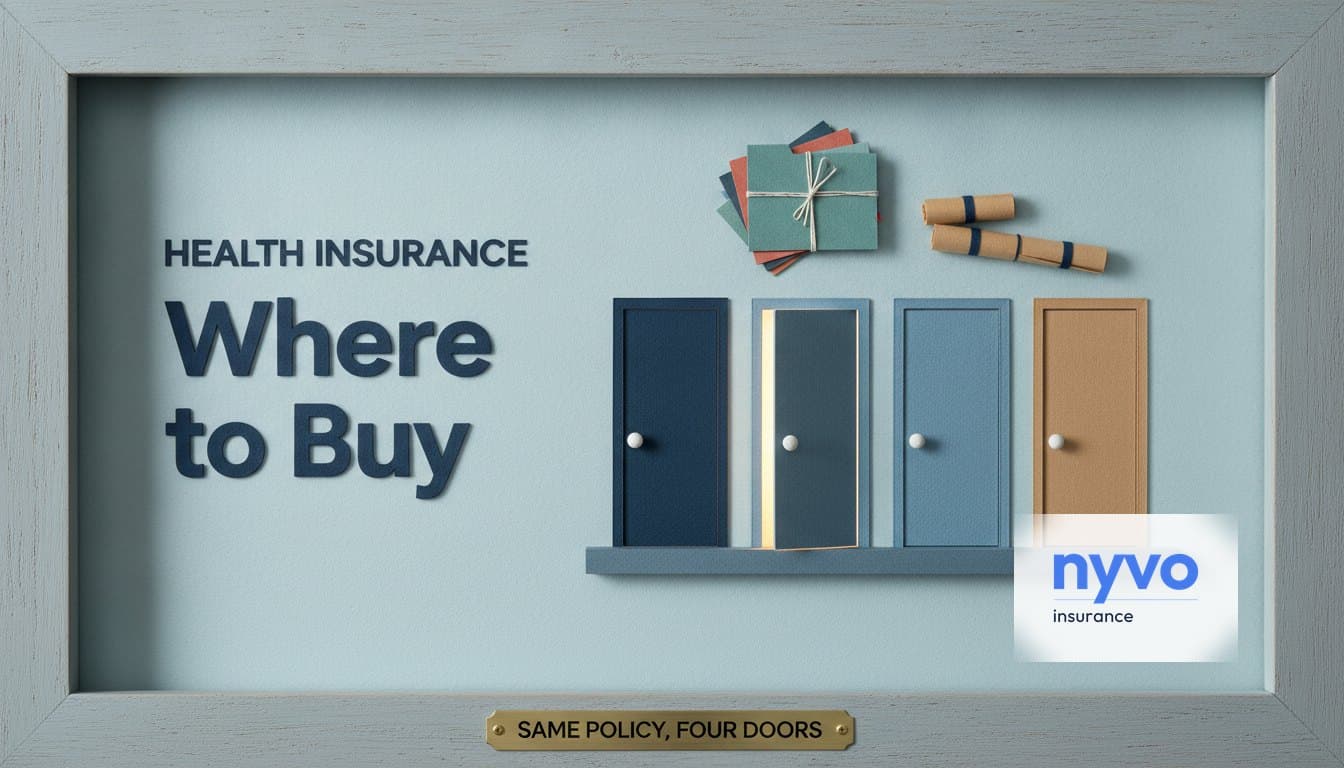
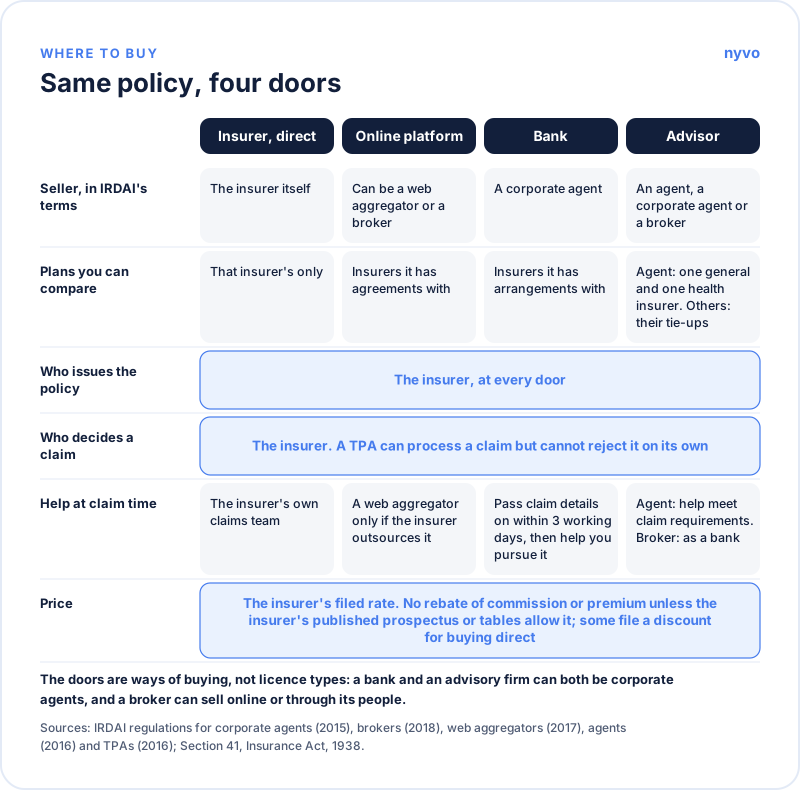
You can buy the same health policy four ways: directly from the insurer, through an online platform, at your bank, or through an advisor. Whichever door you use, the insurer issues the policy and the insurer decides every claim, and the premium is the insurer's filed rate. What the door changes is who helps you choose, who helps you at claim and renewal time, and, where the insurer's published prospectus or tables allow one, a discount for buying direct.
That makes the order of decisions simple. Choose the plan on its wording first, then choose where to buy it.
Does it matter where you buy health insurance?
Where you buy health insurance does not change the contract: the same plan, sum insured and add-ons give you the same policy wording, issued by the same insurer, whether you buy direct, online, at a bank or through an advisor. It changes the help you get choosing and claiming, how many insurers you can compare in one place, and occasionally the price, when the insurer files a discount for direct purchase.
Three things stay fixed at every door. The insurer issues the policy. The insurer decides the claim. And nobody selling it may offer you a rebate of their commission or of the premium, unless the insurer's published prospectus or tables allow it (Section 41 of the Insurance Act, 1938). The rest of this guide covers what does change.
Who is selling you the policy at each door?
The four doors are ways of buying, not IRDAI licence categories. Buying direct means dealing with the insurer itself; every other door is an intermediary regulated by IRDAI. A bank sells as a corporate agent, an advisor may be an individual agent, a corporate agent or a broker, and a comparison website may be a web aggregator or a broker. Check the seller's own registration, not the door.
The categories overlap across doors: a bank and an independent advisory firm can both be corporate agents, and a broker can sell online or through its own people. What the registration decides is whose plans the seller can show you and what IRDAI's code of conduct requires of it.
| Where you buy | Who you deal with, in IRDAI's terms | Whose plans you can compare | How the seller is paid |
|---|---|---|---|
| The insurer, direct | The insurer itself, on its website, at a branch or through its own staff | That insurer's plans only | No intermediary; the insurer's board-approved policy must say how savings from direct business reach policyholders as lower premiums |
| An online platform | Can be a web aggregator, which runs a price-comparison website, or an insurance broker | Insurers it has agreements with; a web aggregator must name them on its home page | A web aggregator earns remuneration from the insurer when a lead from its site becomes a policy |
| A bank | A corporate agent; a banking company is one of the entities that can register as one | Insurers it has arrangements with; if it works with more than one in a line, it must give you the list | Commission from the insurer |
| An advisor | An individual agent, a corporate agent or an insurance broker | An agent: at most one life, one general and one health insurer; a corporate agent or broker: the insurers it works with | Commission or remuneration from the insurer |
Sources: IRDAI (Insurance Web Aggregators) Regulations, 2017 (regulation 30 and Form V); IRDAI (Registration of Corporate Agents) Regulations, 2015 (regulations 2 and 21); IRDAI (Appointment of Insurance Agents) Regulations, 2016 (regulation 17); IRDAI (Insurance Brokers) Regulations, 2018; IRDAI (Expenses of Management, including Commission, of Insurers) Regulations, 2024 (regulation 3).
For a deeper look at the licence categories and how to check a registration, read how to choose a health insurance advisor.
Who decides your claim, whichever door you use?
The insurer decides every health claim, whichever door you bought through. A third party administrator (TPA) can process a claim and authorise cashless treatment, but it "shall not reject or repudiate the claim" on its own, and a rejection letter must come from the insurer (IRDAI (Third Party Administrators – Health Services) Regulations, 2016). No intermediary can approve or reject a claim.
Inside the insurer, the decision is made at a set level. Under the Master Circular on Health Insurance Business, 29 May 2024, no claim may be repudiated without the approval of the insurer's Product Management Committee or its three-member Claims Review Committee, and a claim cut in part must come with the specific policy terms it relies on.
The sellers say so themselves. A corporate agent, including a bank, must make clear that it does not underwrite the risk or act as an insurer (code of conduct, IRDAI (Registration of Corporate Agents) Regulations, 2015). So no door buys you a softer claim decision on the same wording. What a good intermediary can change is everything around the decision: a complete proposal form with every condition disclosed, papers that reach the insurer quickly, and someone who reads a rejection against the wording with you.
What must each one do for you at claim and renewal time?
At claim time, IRDAI's codes of conduct oblige corporate agents and brokers to pass your claim information to the insurer within three working days, tell you the insurer's decision without delay and help you pursue the claim, and oblige an individual agent to help you meet the insurer's claim requirements. A web aggregator services policies only where the insurer outsources that work to it. Buying direct, you deal with the insurer's own teams.
| Door | What the rules require at claim time |
|---|---|
| The insurer, direct | You deal with the insurer's claims team or its TPA yourself |
| Online platform (web aggregator) | Servicing of the policies it sold only as an outsourced activity, at the insurer's discretion and under a written contract with the insurer |
| Online platform (broker) | Forward claim information to the insurer within three working days, give prompt advice on what the claim needs, tell you the decision without delay and give all reasonable help in pursuing the claim |
| Bank or other corporate agent | Help with all claim formalities and documents, forward claim information within three working days, tell you the decision without delay and give reasonable help in pursuing the claim; never take a share of the claim money |
| Individual agent | Help you meet the insurer's requirements for settling a claim |
Sources: IRDAI (Registration of Corporate Agents) Regulations, 2015 (code of conduct and regulation 24); IRDAI (Insurance Brokers) Regulations, 2018 (code of conduct); IRDAI (Appointment of Insurance Agents) Regulations, 2016 (code of conduct); IRDAI (Insurance Web Aggregators) Regulations, 2017 (Form U).
A corporate agent, including a bank, also has duties at renewal: it must give you notice, orally and in writing, to pay the premium on time, and make sure you know when your cover expires, and it must service your policy for the whole period of the contract.
Two more rules protect you if the relationship ends. If an insurer ends its arrangement with a corporate agent, the insurer takes on servicing the policies that agent sold; if the corporate agent ends it, the agent must keep servicing those policies until they expire or for six months, whichever comes first (IRDAI (Registration of Corporate Agents) Regulations, 2015, regulation 23). Your cover itself is not affected.
The complaint route is the same at every door: the insurer's grievance team first, then the Insurance Ombudsman, whose contact details must be in the insurer's reply (Master Circular on Health Insurance Business, 29 May 2024).
Is it cheaper to buy health insurance direct?
Sometimes, and only when the insurer's own filing makes it so. Through any intermediary, you should be quoted the insurer's filed premium: Section 41 of the Insurance Act, 1938 bars any rebate of commission or premium as an inducement, except as allowed in the insurer's published prospectus or tables. Buying direct can be cheaper where the insurer's published prospectus or tables carry a discount for direct or online purchase.
Three rules sit behind that answer:
- No cut of the commission. Under Section 41, nobody may offer you a rebate of "the whole or part of the commission payable" to win your business, and you may not accept one, unless the insurer's published prospectus or tables allow it. So an offer to pass you part of the seller's commission, in cash or otherwise, is not allowed unless the insurer's published documents provide for it.
- No different rates. A corporate agent, which includes a bank, must indicate the premium the insurer charges and may not offer rates, advantages or terms other than the insurer's (code of conduct, IRDAI (Registration of Corporate Agents) Regulations, 2015).
- Direct savings belong to policyholders. Every insurer's board-approved policy must set out how savings from directly sourced business are passed to policyholders through lower premiums (IRDAI (Expenses of Management, including Commission, of Insurers) Regulations, 2024, in force from 1 April 2024). Some insurers do this through a discount filed in the product's prospectus that applies only when you buy online or without an intermediary.
nyvo is paid commission by the insurer, so a discount that applies only when no intermediary is involved is not available through nyvo. If a plan you want carries one, the insurer's own website is the place to get it.
To compare prices fairly, line up the same plan and variant (the UIN on the quote should match), the same sum insured, the same add-ons, the same deductible or co-pay and the same policy term. A gap on a mismatched quote is usually a different policy, not a different price.
Do riders and add-ons change with where you buy?
Add-ons do not change with the door: each is an optional cover filed by the insurer, often with its own UIN, and priced by the insurer. What changes is which add-ons end up on your quote. A corporate agent must make sure no prospect is forced to buy an insurance product, and cannot compel you, when you buy a loan or another product from it, to buy the insurance through it as well (IRDAI (Registration of Corporate Agents) Regulations, 2015).
HDFC ERGO's my:Optima Secure prospectus, for example, lists its add-ons, such as Unlimited Restore and Limitless, each with a separate UIN (prospectus, UIN HDFHLIP26058V082526). Before you pay:
- Read the add-on lines on the quote. Ask what each one pays for and when you would use it. Remove anything you did not ask for.
- Check the ones you cannot add later. Some optional benefits can only be chosen at the start. Care Supreme's Unlimited Care, for instance, can be opted only at inception and must then be kept for five continuous policy years (Care Supreme prospectus, UIN CHIHLIP27061V032627).
- Check the ones you lose if you drop them. Drop Care Supreme's Cumulative Bonus Super at a renewal and the bonus built up under it is forfeited (same prospectus).
- Read the Customer Information Sheet. The insurer must give one with every policy, setting out the cover, a summary of exclusions, sub-limits, deductibles, waiting periods and the claims procedure in one place (Master Circular on Health Insurance Business, 29 May 2024). It is the same document whichever door you used.
When is buying direct the right choice?
Buying direct is a sound choice when you have already picked the plan and variant, read the policy wording and the Customer Information Sheet, can fill the proposal form completely yourself, and are comfortable dealing with the insurer's claims team. It is also where you get any discount the insurer files for direct purchase.
An intermediary earns its place in other situations:
- You want several insurers compared on their wording, not on premium alone. Room rent, co-pay, sub-limits and waiting periods decide more claims than the price does. See how to compare plans on room rent.
- Someone in the family has a condition to disclose. Until a policy has run 60 months without a break, an insurer can contest a claim for non-disclosure; after that, only for established fraud (Master Circular on Health Insurance Business, 29 May 2024). See how the five-year moratorium works.
- You are buying for parents, where entry ages, co-pays and the option of a super top-up when the insurer will not raise their cover need checking plan by plan.
- You want someone obliged to help at claim and renewal time, under the codes of conduct in the table above.
Neither choice is permanent. Whichever door you used, you can later port the policy to another insurer and carry across the waiting-period, moratorium and no-claim-bonus credit you have built, to the extent of the sum insured (Master Circular on Health Insurance Business, 29 May 2024).
Does the same apply to term insurance?
Yes. A term policy bought direct, online, at a bank or through an advisor is issued by the life insurer, and the life insurer decides the death claim: within 15 days of intimation, or 45 days where the claim warrants investigation (Master Circular on Protection of Policyholders' Interests, 5 September 2024). Section 41's ban on rebates and the corporate agents' code of conduct apply to life insurance too.
Two things differ in practice:
- An agent shows you one company. An individual agent can act for at most one life insurer (IRDAI (Appointment of Insurance Agents) Regulations, 2016), so an agent's term quotes come from one insurer, while a corporate agent or broker can compare the insurers it works with.
- Your family makes the claim. The help that matters most comes after you are gone, so tell your nominee where the policy is and whom to call.
When you compare term quotes, check that the plan name, the UIN, the cover, the policy term and every rider match, and whether a benefit you want is built into the variant you are quoted or sold as a separate rider. The term insurance guide covers how much cover to buy.
Where does nyvo fit?
nyvo insurance Services LLP is an IRDAI-registered corporate agent (composite), licence number CA1085, valid from 4 November 2025 to 3 November 2028. As a corporate agent, nyvo arranges policies only with the insurers it has arrangements with. When you buy through nyvo, the insurer pays nyvo a commission; you pay the insurer's premium and no fee to nyvo.
nyvo's advisors are salaried rather than paid per sale. The corporate agents' code of conduct described above applies to nyvo as it does to any bank. You are free to buy any plan directly from the insurer instead. You can check the registration on nyvo's IRDAI licence page and read how nyvo picks plans and how it is paid.
If a second opinion on a quote you already hold would help, an IRDAI-certified nyvo advisor will read it with you.
FAQs
Is the policy different if I buy it through an online platform?
No. The same plan, variant, sum insured and add-ons give you the same policy wording from the same insurer, which also decides any claim. An online platform that sells insurance is an intermediary, for example a web aggregator or a broker, and it can only show you plans from the insurers it works with.
Can my bank make me buy its health insurance to get a loan?
No. Under the IRDAI (Registration of Corporate Agents) Regulations, 2015, a corporate agent selling insurance alongside another product, such as a loan, must not compel you to buy the insurance through it, and must ensure no prospect is forced to buy an insurance product.
Can an advisor or platform give me a cashback or discount?
Not out of their commission. Section 41 of the Insurance Act, 1938 bars any rebate of commission or premium as an inducement to buy, except as allowed in the insurer's published prospectus or tables. Any discount has to be one those documents allow.
Who decides my claim if I bought through an advisor?
The insurer. A TPA can process the claim but cannot reject it on its own, and no claim can be repudiated without approval from the insurer's Product Management Committee or Claims Review Committee (Master Circular on Health Insurance Business, 29 May 2024). The advisor's job is to help with the papers and the follow-up.
What happens to my policy if my bank or agent stops selling for that insurer?
Your cover continues unchanged. If the insurer ends the arrangement, it takes on servicing the policies; if the corporate agent ends it, the agent must keep servicing them until they expire or for six months, whichever is earlier (IRDAI (Registration of Corporate Agents) Regulations, 2015).
Is health insurance cheaper if I buy direct from the insurer?
Sometimes. Each insurer must pass savings from direct business to policyholders through lower premiums, under the IRDAI (Expenses of Management, including Commission, of Insurers) Regulations, 2024, and some prospectuses file a discount for buying online or direct. Compare the same plan, variant and add-ons on the insurer's website before you pay.
Related guides:
Sources:
- Insurance Act, 1938, Section 41 (prohibition of rebates), as published by IRDAI
- IRDAI (Registration of Corporate Agents) Regulations, 2015: regulations 2, 21, 23 and 24, and the code of conduct
- IRDAI (Insurance Brokers) Regulations, 2018, notified 12 January 2018: functions of a direct broker and the code of conduct
- IRDAI (Insurance Web Aggregators) Regulations, 2017: regulation 30, Form U and Form V
- IRDAI (Appointment of Insurance Agents) Regulations, 2016: regulation 17 and the code of conduct
- IRDAI (Third Party Administrators – Health Services) Regulations, 2016, as amended in 2019: regulations 3 and 21
- IRDAI (Expenses of Management, including Commission, of Insurers) Regulations, 2024, in force 1 April 2024: regulation 3
- Master Circular on Health Insurance Business, Ref. IRDAI/HLT/CIR/PRO/84/5/2024, 29 May 2024
- Master Circular on Protection of Policyholders' Interests, Ref. IRDAI/PP&GR/CIR/MISC/117/9/2024, 5 September 2024
- nyvo's licence details: IRDAI licence page
Four ways to buy, at a glance
| Who issues the policy | The insurer, whichever way you buy |
|---|---|
| Who decides a claim | The insurer; a TPA may process a claim but cannot reject it on its own (IRDAI (Third Party Administrators – Health Services) Regulations, 2016) |
| Who must approve a rejection | The insurer's Product Management Committee or its Claims Review Committee (Master Circular on Health Insurance Business, 29 May 2024) |
| Banks | Sell as corporate agents and cannot compel a customer buying a loan or other product from them to buy the insurance through them (IRDAI (Registration of Corporate Agents) Regulations, 2015) |
| Price | No rebate of commission or premium except as the insurer's published prospectus or tables allow (Section 41, Insurance Act, 1938) |
| Buying direct | Each insurer's board-approved policy must say how savings from direct business reach policyholders as lower premiums (IRDAI (Expenses of Management, including Commission, of Insurers) Regulations, 2024) |
| At claim time | Corporate agents and brokers must pass your claim information to the insurer within three working days and help you pursue the claim (codes of conduct, IRDAI (Registration of Corporate Agents) Regulations, 2015 and IRDAI (Insurance Brokers) Regulations, 2018) |
Rules as published by IRDAI and read on irdai.gov.in on 19 October 2026. An amendment can change a rule, so check the current regulation before relying on one.
Book a call for advice on the best policy for you and your family
A salaried, IRDAI-certified nyvo advisor will look at your cover, flag the gaps that matter, and tell you plainly what to fix. No commission, no pressure.
A first in India
Buy policy from nyvo insurance with Claim Support Guarantee, otherwise money back.

16+ years in financial services. Former investment banker at Bank of America, Kotak Investment Banking, and SBICaps, and ex-CFO of slice. Founder of nyvo and Principal Officer – IRDAI Certified.