First in India
Claim Support Guarantee, otherwise your money back.
Buy through nyvo and we get your claim passed, otherwise refund your premium. We are putting our money on our claim service.
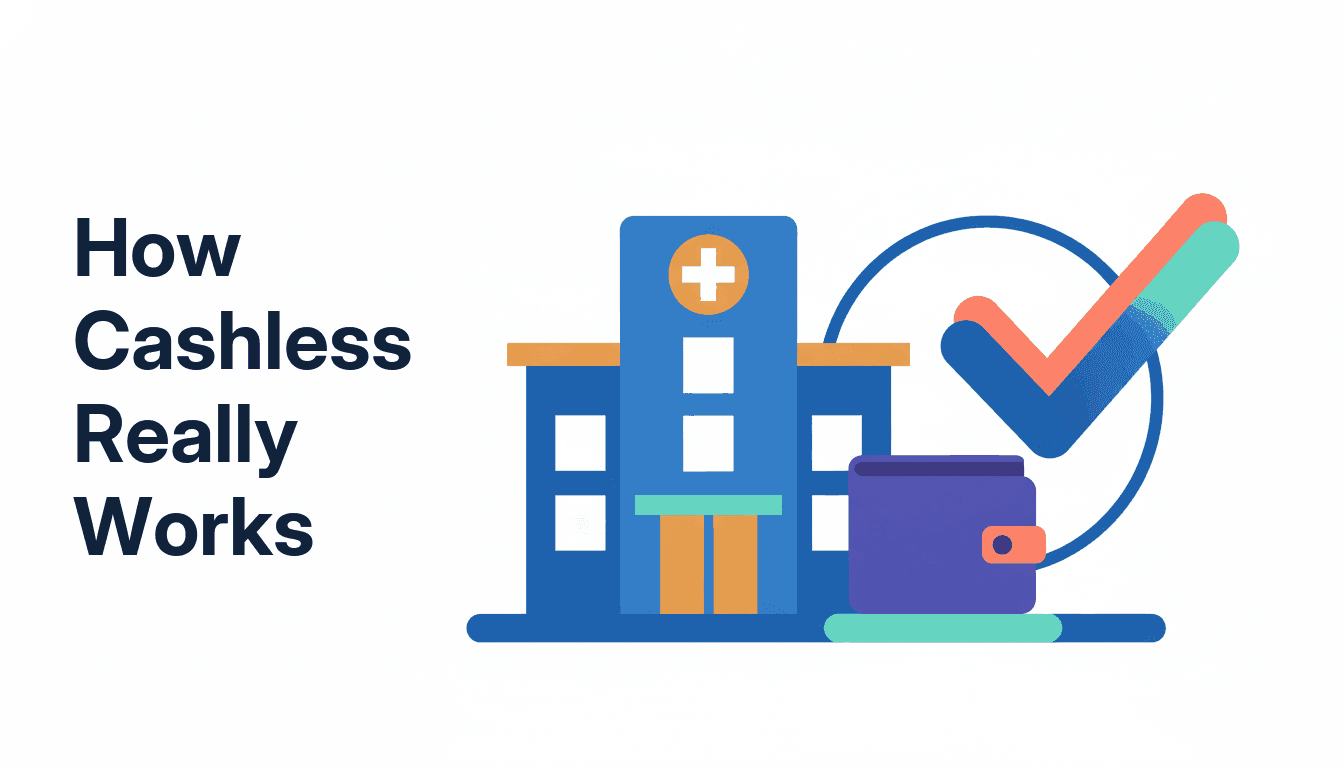
Cashless Hospital Claims: How They Really Work (2026)
How a cashless claim actually works: pre-authorisation, co-pay, room-rent impact, and network vs non-network reality. Avoid the surprises at the hospital desk.


Written by Harsh SoniReviewed by Shadab SayeedUpdated nyvo insurance Services LLP, IRDAI Corporate Agent (Composite) CA1085Salaried advisors, no commission-based ranking
Networks change without notice. If a hospital has come off your insurer's panel, what to do about a delisted network hospital covers verifying status and what it costs you.
What is Cashless Health Insurance and How Do Network Hospitals Work?
Cashless health insurance means that when you are hospitalized at a network hospital (a hospital that has a tie-up with your insurer or TPA), the insurance company settles the bill directly with the hospital – you don't need to pay upfront and then wait for reimbursement. However, "cashless" does not mean zero payment: you may still pay deductibles, co-pay percentages, non-payable items (consumables, personal care), and any amounts exceeding the pre-authorized limit.
According to industry data, approximately 65–70% of health insurance claims in India are now processed as cashless at network hospitals, up from less than 40% a decade ago. IRDAI requires the approval decision within 1 hour of the request, for a planned or an emergency admission, and final authorisation at discharge within 3 hours (IRDAI Master Circular on Health Insurance Business, 29 May 2024). Well-managed hospitals meet it; many do not, and a breach is grounds to escalate rather than to wait. The most common reasons for cashless claim surprises are: room rent proportionate deductions (affecting up to 30% of claims), non-payable items (₹10,000–₹50,000 on a typical surgery), and co-pay clauses. The safest approach is to treat cashless as paperwork reduction, not a promise of full coverage.
Back to: Health Insurance guide
Quick checklist
- Goal: use in-network hospitals to get actual cashless benefits without balance billing.
- Avoid: out-of-network hospitals or unknown providers outside the insurer's network list.
- Prefer: selecting from the official network list, confirming cashless registration before admission.
- Claims-first: ensure hospital submits pre-auth request and shares approval amount before treatment.
Quick myths vs reality table
| Myth | Reality |
|---|---|
| Cashless = ₹0 bill | You often pay co-pay/deductibles/non-payables |
| Network hospital = guaranteed cashless | Cashless can be temporarily unavailable or restricted |
| Pre-auth approval = final approval | Final settlement can still have deductions |
| Any hospital bill will be covered | Exclusions, waiting periods, room limits matter |
What is a “network hospital”?
A hospital tied up with your insurer/TPA for cashless processing.
Important: Network status can differ by insurer and can change. Always confirm before admission.
How to find and check a cashless hospital, insurer by insurer: Star Health network hospital list · Niva Bupa network hospital list · Care Health network hospital list · Aditya Birla Health network hospital list · Tata AIG network hospital list · SBI General network hospital list · ManipalCigna network hospital list · ICICI Lombard network hospital list · Bajaj General network hospital list · New India Assurance network hospital list · HDFC ERGO network hospital list.
Why cashless claims still create payments
Common reasons:
- Room rent limit → proportionate deduction
- Co-pay clause
- Non-medical items/consumables
- Deductibles (especially with super top-ups)
- Treatments not covered/excluded
Related:
The admission-time actions that prevent most problems
- Choose the TPA/insurance desk at the hospital
- Ensure pre-auth submission has clear diagnosis + reports
- Track approval and ask for enhancement early
FAQs – Network Hospitals & Cashless Claims
Should I always choose a network hospital?
If feasible, yes for reduced paperwork. But prioritize medical quality and urgency.
Can cashless be denied at a network hospital?
Yes – due to policy conditions, waiting periods, exclusions, or operational issues.
What is pre-auth?
Pre-authorization is the insurer/TPA’s preliminary approval for treatment costs.
Is pre-auth final approval?
No. Final settlement depends on documents and policy terms.
What if the hospital says “cashless not available”?
Ask the reason and call insurer/TPA; consider reimbursement if needed.
How do I confirm network status?
Check insurer/TPA website/app and take screenshots.
Do super top-ups work in cashless?
Often yes, but deductible logic and coordination matter.
What is the biggest cashless claim mistake?
Ignoring room eligibility and not tracking approvals/enhancements.
Disclaimer: Educational content. Processes vary by insurer/TPA and hospital.
Related Guides
Our editorial principles
- Salaried advisors, not commission-linked: we focus on clarity and suitability, not product hype.
- No spam: we don't sell your data; we keep advice simple and actionable.
- Claims-first: policy features are evaluated by how they behave during claims.
- Education-first: this content is for informational purposes only.
Book a call for advice on the best policy for you and your family
A salaried, IRDAI-certified nyvo advisor will look at your cover, flag the gaps that matter, and tell you plainly what to fix. No commission, no pressure.
A first in India
Buy policy from nyvo insurance with Claim Support Guarantee, otherwise money back.

16+ years in financial services. Former investment banker at Bank of America, Kotak Investment Banking, and SBICaps, and ex-CFO of slice. Founder of nyvo and Principal Officer – IRDAI Certified.