Term Insurance Death Claim: Documents & Nominee Checklist
The complete term insurance death claim checklist for nominees: documents, filing timeline, what triggers investigation, and how to avoid rejection. IRDAI deadline: 15 days, or 45 if investigated.

Written by Harsh SoniUpdated nyvo insurance Services LLP, IRDAI Corporate Agent (Composite) CA1085Salaried advisors, no commission-based ranking
What is a Term Insurance Death Claim and How to File One in India?
A term insurance death claim is the process by which the nominee (or legal heir) of a deceased policyholder requests the insurance company to pay out the sum assured under a term life insurance policy. The process involves: (1) intimating the insurer immediately (call + written within 24–48 hours), (2) collecting required documents (death certificate, policy copy, nominee KYC, medical records), (3) submitting a complete claim form, and (4) responding quickly to any investigation queries.
Across the life insurers nyvo holds a figure for, the claim settlement ratio for individual death claims runs from 96.9% to 99.6% by claim count, with LIC at 98.3% (IRDAI's published data, a weighted average of the last three financial years, latest available as of March 2026). The insurer must settle a death claim within 15 days of intimation, or within 45 days of intimation where it investigates (IRDAI Master Circular on Protection of Policyholders' Interests, 5 September 2024). However, claims filed within the first 2–3 years of policy inception are subject to enhanced scrutiny, and in nyvo's research (September 2026) the most common rejection reasons remain non-disclosure of smoking/tobacco use (accounting for ~30% of rejections), undisclosed pre-existing health conditions (~25%), and policy lapse due to unpaid premiums (~15%). Preparing a "claim kit" in advance dramatically reduces stress and delays for the family.
Back to: Term Insurance Claim Process
Quick checklist
- Goal: ensure smooth claim payout for family when needed most.
- Avoid: delays in intimation, incomplete documents, and withholding medical history.
- Prefer: organized document storage, clear nominee details, and honest disclosures.
- Claims-first: prepare a "claim kit" now so family isn't scrambling later.
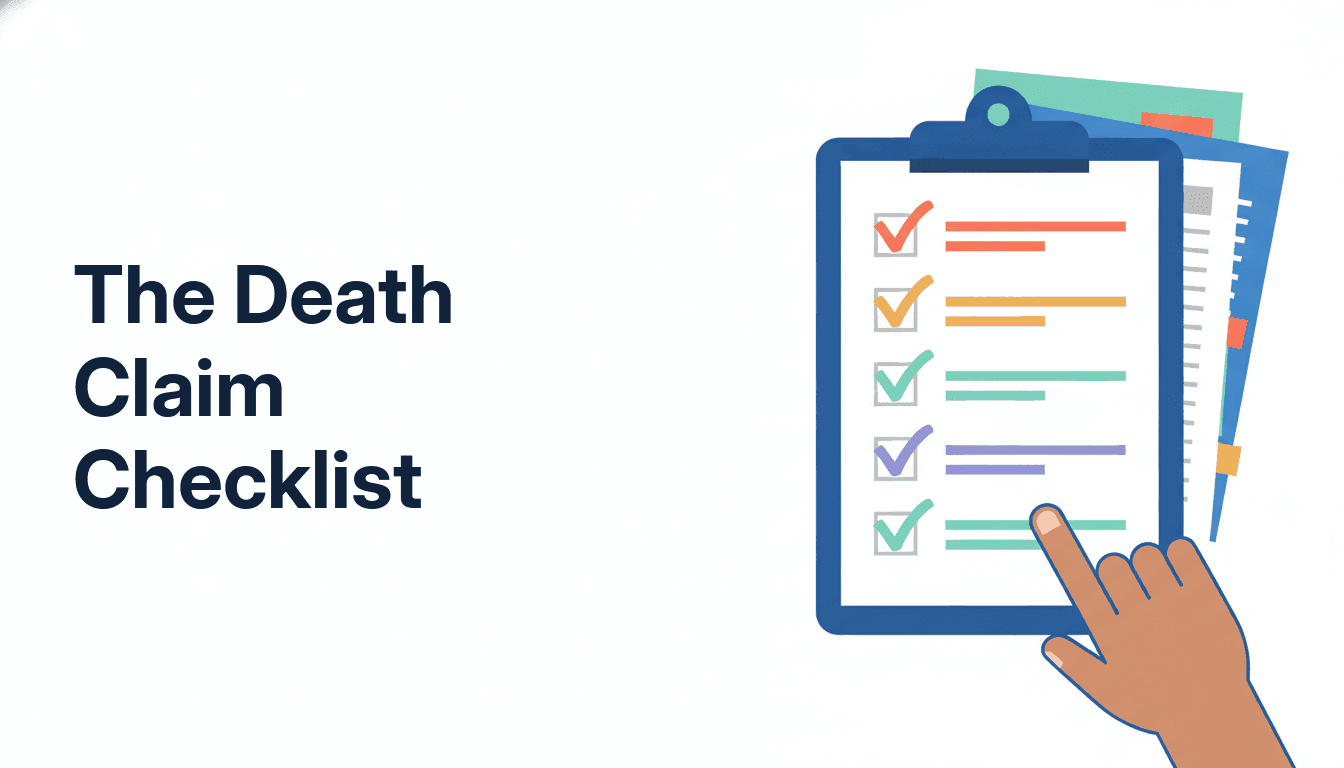
Complete document checklist (printable)
Essential documents (always required)
| Document | Notes |
|---|---|
| Claim form | Insurer-specific; download or get from branch |
| Original/certified death certificate | From municipal authority |
| Policy document copy | Original if available |
| Nominee's ID proof | Aadhaar/PAN/Passport |
| Nominee's address proof | Aadhaar/utility bill |
| Cancelled cheque of nominee | For claim payout |
| Bank account details | As per claim form |
Medical documents (if death was due to illness)
| Document | Notes |
|---|---|
| Hospital discharge summary | If hospitalized |
| Hospital admission records | Including date of admission |
| Doctor's certificate | Cause of death |
| Treatment records | All relevant prescriptions, reports |
| Diagnostic reports | Blood tests, scans, etc. |
| Pharmacy bills | Medicines prescribed |
Additional documents (for accidental/unnatural death)
| Document | Notes |
|---|---|
| FIR copy | From police station |
| Panchnama | Inquest report |
| Post-mortem report | From government hospital |
| Newspaper clipping | If accident was reported |
| Driving license | If accident while driving |
| Vehicle RC | If vehicle accident |
Special situations
| Situation | Additional documents |
|---|---|
| Minor nominee | Appointee's KYC + relationship proof |
| No nominee | Succession certificate / Legal heir certificate |
| Multiple nominees | All nominees' KYC and bank details |
| Policyholder was NRI | Consulate death certificate, passport copy |
| Death abroad | Embassy attested documents, translation if needed |
Step-by-step claim process
Step 1: Immediate intimation (within 24-48 hours)
- Call the insurer helpline
- Note the claim reference number
- Send written intimation, by email and registered post
- Keep the acknowledgement
What to communicate:
- Policyholder name and policy number
- Date of death
- Brief description of cause
- Nominee/claimant contact details
Step 2: Document collection (Week 1-2)
- Obtain death certificate from municipal authority
- Collect all medical/hospital records
- If accidental: get FIR, post-mortem
- Organize chronologically
Step 3: Claim form submission (Week 2-3)
- Download claim form from insurer website/app
- Fill completely – no blanks
- Cross-check all details
- Attach all documents (keep copies)
- Submit via:
- Online portal (preferred)
- Branch office
- Registered post
Step 4: Track and respond (until settlement)
- Track status on insurer portal
- Respond to queries within 7 days
- Provide additional documents if requested
- Keep written trail of all communication
Step 5: Settlement (15 days from intimation, or 45 if investigated)
- No investigation: the insurer must settle within 15 days of intimation
- Investigated claim: the insurer must settle within 45 days of intimation
- Payment via NEFT to nominee's account
Claim timeline: what IRDAI requires
| Stage | Deadline |
|---|---|
| Intimation | Day 0 – both clocks start here |
| Claim settled, no investigation | Within 15 days of intimation |
| Claim settled, investigation ordered | Within 45 days of intimation |
| Either deadline missed | Interest at the bank rate plus 2% |
IRDAI guideline: Insurers must settle a death claim within 15 days of intimation, or within 45 days where the claim is investigated (Master Circular on Protection of Policyholders' Interests, 5 September 2024). Both are measured from intimation, not from the last document, so a delay in asking for papers does not buy the insurer time. Miss either deadline and the insurer owes interest at the bank rate plus 2%, paid automatically.
When investigation is triggered
Insurers may investigate if:
| Trigger | What happens |
|---|---|
| Death within 2-3 years of policy | Standard investigation |
| Death within first year | Detailed investigation |
| High sum assured | Additional verification |
| Non-disclosure suspected | Medical record verification |
| Cause of death unclear | Hospital/doctor interviews |
| Accidental death | Police report verification |
What you can do:
- Cooperate fully with investigators
- Provide documents promptly
- Be available for interviews
- Don't sign blank papers
Common reasons for claim rejection
| Reason | How to avoid |
|---|---|
| Non-disclosure of pre-existing conditions | Disclose everything at proposal stage |
| Smoking/alcohol misrepresentation | Be honest even about "occasional" use |
| Policy lapsed (premium not paid) | Set up auto-debit; check status periodically |
| Suicide within exclusion period | Most policies: 12-month exclusion |
| Incorrect age/identity | Verify details at purchase |
| Documents incomplete | Use checklist; submit everything together |
Related: Smoker/Non-smoker Declarations
What to do if claim is rejected
- Get written rejection with specific reason and clause reference
- Review the reason against policy terms
- Gather counter-evidence if you believe rejection is wrong
- File grievance with insurer GRO
- Escalate to Ombudsman if insurer doesn't resolve
- Guide: Insurer Grievance Process
- Guide: Insurance Ombudsman
Preparing now (while policyholder is alive)
Create a "claim kit" folder
| Item | Location |
|---|---|
| Policy document PDF | Cloud storage + physical |
| Insurer contact details | Helpline, email, branch |
| Nominee details verified | As per policy |
| Premium payment proof | Last 2-3 receipts |
| Policyholder medical records | Organized by date |
Inform your family
- Who the nominee is
- Where documents are stored
- Insurer contact details
- This checklist
Insurer-Specific Death Claim Guides
Step-by-step death claim guides for each major life insurer – helpline, document checklist, claim settlement ratio, and escalation path:
FAQs
What if the policyholder didn't disclose a health condition?
The insurer may reject or reduce the claim based on non-disclosure. The impact depends on whether the undisclosed condition was related to death and how material the non-disclosure was.
Can a claim be filed without the original policy document?
Yes. Policy copy, e-policy, or even policy number works. Insurers can trace records. But having the original speeds things up.
What if there is no nominee mentioned in the policy?
The insurer will require a succession certificate or legal heir certificate from court. This delays settlement significantly. Always ensure nomination is updated.
Does the cause of death matter for term insurance claims?
Yes and no. Term insurance covers most causes of death except specific exclusions (suicide within exclusion period, hazardous activities if excluded, etc.). However, cause determines documentation requirements.
What happens if death occurs outside India?
Claim is still valid. You'll need death certificate from the country of death (embassy/consulate attested), along with standard documents. Some insurers require translated documents.
Can the insurer reject a claim after 3 years?
After 3 years (the contestability period under Section 45), a policy cannot be called in question on any ground whatsoever – fraud included. Fraud and material misstatement are available to the insurer only within those first 3 years.
What if the policyholder committed suicide?
Most policies have a 12-month suicide exclusion. If suicide occurs after this period, the claim is valid. Within the period, only premiums may be refunded.
How is the claim amount paid?
Via NEFT/bank transfer to the nominee's bank account as mentioned in the claim form. Insurers don't issue cheques anymore for large amounts.
What should I do if the insurer keeps asking for more documents?
Respond promptly to legitimate requests. If requests seem unreasonable or repetitive, escalate to insurer grievance cell with a written complaint.
Related Guides
- Related: Term Claim Process Checklist
- Related: Nominee vs Legal Heir
- Related: Smoker/Non-smoker + Medicals
Disclaimer: This is educational content. Specific requirements vary by insurer and policy. Always follow your insurer's claim process and IRDAI guidelines.
Our editorial principles
- Salaried advisors, not commission-linked: we focus on clarity and suitability, not product hype.
- No spam: we don't sell your data; we keep advice simple and actionable.
- Claims-first: policy features are evaluated by how they behave during claims.
- Education-first: this content is for informational purposes only.

16+ years in financial services. Former investment banker at Bank of America, Kotak Investment Banking, and SBICaps, and ex-CFO of slice. Founder of nyvo and Principal Officer – IRDAI Certified.