First in India
Claim Support Guarantee, otherwise your money back.
Buy through nyvo and we get your claim passed, otherwise refund your premium. We are putting our money on our claim service.
Smoker vs Non-Smoker Term Insurance: What to Declare
Smokers pay a separate, higher term insurance rate in India. How insurers' own forms define a smoker, whether occasional or social smoking counts, how the nicotine test works, whether you can move to non-smoker rates later, and why a wrong answer is the bigger risk.

Written by Kshitij JainUpdated nyvo insurance Services LLP, IRDAI Corporate Agent (Composite) CA1085Salaried advisors, no commission-based ranking

Should you declare smoking for term insurance?
Yes. If you have used tobacco or nicotine in any form within the period your proposal form asks about, answer yes, even if you smoke only occasionally. Insurers price tobacco users on a separate, higher smoker rate, and their own forms define tobacco widely: Kotak Life's proposal form lists cigarettes, beedi, cigar, hookah, chewing tobacco, gutkha, pan masala and e-cigarettes. A wrong answer in the policy's first three years lets the insurer question the policy and refuse the claim (Section 45 of the Insurance Act, 1938).
There is no single definition: the forms we checked ask about periods from 12 months to 5 years, and some ask about quantity or past use instead, so answer the exact question printed on yours. For comparison, a 30-year-old non-smoking man pays ₹8,856–₹10,440 a year for ₹1 crore of cover till 60 across the five plans nyvo rates (nyvo's own premium data, May 2026). That data does not cover smokers, so ask for a smoker quote on the plan you want. Individual life insurance has carried no GST since 22 September 2025, so the quote is what you pay.
Back to: Term Insurance guide
Quick checklist
- Goal: answer every tobacco, alcohol and health question exactly as it is asked.
- Avoid: answering "no" because you smoke only at parties, or because you have stopped for a few weeks.
- Prefer: declaring, and asking the insurer how it rates your pattern of use.
- Claims-first: the proposal form is the document your family's claim is checked against.
How do insurers define a smoker?
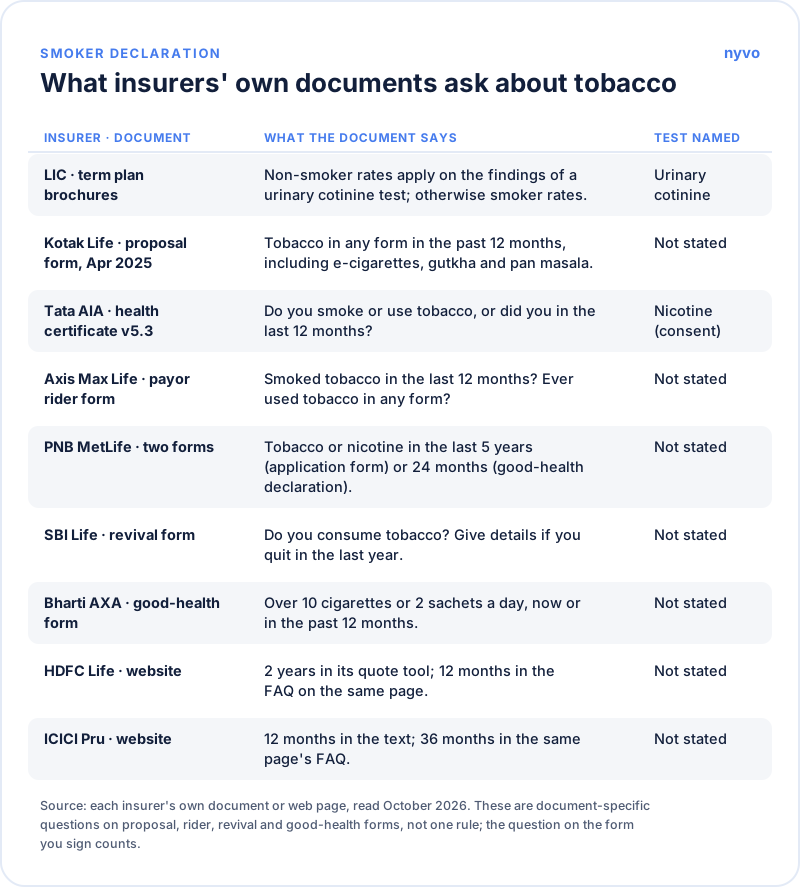
There is no single definition: the insurer documents we checked ask different tobacco questions. Some ask about any use within a period, from 12 months to 5 years; Bharti AXA's asks about quantity; others ask whether you have ever used tobacco or when you quit. They include proposal, rider, revival and good-health forms, so they are not interchangeable pricing rules. Answer every question on your own application exactly as asked.
| Insurer and document | What the document asks or says | Test named |
|---|---|---|
| LIC, sales brochures of New Tech-Term, New Jeevan Amar, Digi-Term and Yuva Term | Non-smoker rates apply on the findings of a urinary cotinine test; in all other cases smoker rates apply | Urinary cotinine |
| Kotak Life, online proposal form (version 1.10, April 2025) | "Have you consumed tobacco in any form in the past 12 months?", including e-cigarettes, gutkha and pan masala | Not stated |
| Tata AIA, health certificate for revivals and changes (version 5.3) | Do you smoke or use tobacco, or have you done so in the last 12 months? | Consent to tests for nicotine or its metabolites |
| Axis Max Life, payor rider form (2025) | Have you smoked tobacco in the last 12 months? Have you ever consumed tobacco in any form, including gutka or pan masala? | Not stated |
| PNB MetLife, application form (version 3.2) and declaration of good health (version 4.1, May 2025) | Tobacco or nicotine in any form in the last 5 years (application form); in the last 24 months (declaration) | Not stated |
| SBI Life, revival declaration of good health (version 28, 2024) | Do you consume tobacco? If you quit in the last year, give full details | Not stated |
| Bharti AXA, declaration of good health (2023) | More than 10 cigarettes or 2 sachets a day, now or in the past twelve months | Not stated |
| HDFC Life, term insurance web page | Its quote tool says 2 years; the FAQ on the same page says 12 months | Not stated |
| ICICI Pru, term insurance for smokers web page | 12 months in the text; 36 months in the page's FAQ | Not stated |
Source: each insurer's own document or web page, read October 2026. Where an insurer's own pages disagree, the question on the form you sign is the one that counts.
Do occasional or social smokers have to declare?
Yes, if the use falls inside the period the form asks about. A question such as Kotak Life's, "Have you consumed tobacco in any form in the past 12 months?", has no exception for a few cigarettes at weekends, a hookah at a party or a pan masala with tobacco. If the honest answer is yes, tick yes and give the quantity and frequency the form asks for.
Two things help an occasional smoker:
- The form asks how much. Several forms ask for the quantity: Kotak Life's asks for quantity and frequency, SBI Life's for sticks or packets a day and since when. The underwriter sees your real pattern rather than a bare yes.
- Quitting counts, but only once the period has passed. If you stopped 14 months ago and the form asks about 12 months, the honest answer is no; but some forms also ask whether you have ever used tobacco, or when you quit, and those need a true answer too. SBI Life's revival form, for one, asks for details if you quit in the last year.
Waiting out the period can make sense if you have genuinely quit and are close to the line. Weigh it against being uncovered meanwhile, and against the premium rising with age: on the median of the five plans nyvo rates, each year of waiting adds about 2% in your late twenties (nyvo's premium data, May 2026).
What is a cotinine test, and can it catch occasional smoking?
A cotinine test checks your urine or blood for the substance the body makes when it breaks down nicotine. LIC's term plan brochures say non-smoker rates are applied on the findings of a urinary cotinine test, and Tata AIA's health certificate asks your consent to test for nicotine or its metabolites. Cotinine is the primary metabolite of nicotine and can be detected for days after exposure to tobacco smoke (Molecules, 2024).
That window matters in both directions. A smoker who stopped a day or two before the test may still test positive. An occasional smoker who has not smoked for a fortnight may test negative, but the form's question looks back 12 months or more, so a clean test does not make a "no" true.
Other tests at application depend on your age and cover. HDFC Life's own guide lists blood and urine tests, a treadmill test (CTMT) and an ECG, with special tests if required, and says tests are almost always required for cover of ₹50 lakh or more or for buyers over 40. The insurer arranges them.
Can you switch to non-smoker rates after you quit?
Only if your insurer offers a route, and few say they do. Axis Max Life's policy amendment form includes a "Policy Reconsideration" request for "Disclosure of smoking status", and says any change is subject to an underwriting decision. We found no equivalent in the other insurers' documents. Bajaj Life's website says the smoker rating applied at issue ordinarily continues, and HDFC Life's guide says most insurers do not allow a change from smoker to non-smoker.
So do not buy as a smoker counting on a cheaper rate later; price the policy as it will be. If you quit and your insurer offers reconsideration, ask in writing and expect fresh questions or tests.
If you start smoking after the policy is issued, the answers you gave at purchase were true when you gave them. Insurers' own guides differ on whether to tell them: HDFC Life's says you do not have to inform your insurer, while Kotak Life's non-tobacco declaration for e-Term also states that you have no intention of using tobacco in the future. Read the declaration you sign.
Why is a wrong answer the bigger risk?
Because in the policy's first three years, a material misstatement lets the insurer question the policy and refuse the claim (Section 45 of the Insurance Act, 1938). Tobacco use is material, because it is priced. If the insurer repudiates for misstatement rather than fraud, it refunds the premiums collected, within 90 days, but your family loses the cover it was counting on. After three years, counted from the latest of the policy's issue, the start of risk cover, its revival or the addition of a rider, the policy cannot be questioned on any ground.
Some forms make the stakes explicit. Kotak Life's proposal form says "any false statement regarding my use of tobacco would render the contract void". Canara HSBC Life's term proposal form (version 1.3, June 2026) warns that non-disclosure "may even lead to repudiation of the claim".
| Answer honestly | Answer "no" when it is "yes" |
|---|---|
| Pay the smoker rate | Pay the non-smoker rate |
| The claim is checked against true answers | In the first three years, the claim can be refused for misstatement |
| Nothing to explain at claim time | Your answers can be questioned for three years from the latest of issue, start of risk, revival or a rider |
The premium you save by answering wrongly is a fraction of the cover your family can lose.
What else should you check before you apply?
Check that every tobacco, alcohol and health answer responds to the exact question on your proposal form, and that it matches your medical records. Take the medical tests the insurer asks for and keep the reports. Read the completed application before you sign it, and if a question is unclear, ask the insurer in writing how to answer it.
| Item | What to do |
|---|---|
| Tobacco | Declare cigarettes, beedi, cigars, hookah, chewing tobacco, gutkha, pan masala and e-cigarettes as the form asks |
| Alcohol | Answer exactly as asked, with quantity |
| Past conditions | Disclose diagnoses, medicines, surgeries and tests |
| Medicals | Take the tests the insurer asks for and keep the reports |
| Consistency | Make sure your answers match your medical records |
If you have a health condition as well, our guide to term insurance with pre-existing conditions covers what to prepare.
FAQs
Should I declare smoking if I only smoke occasionally?
Yes, if any use falls inside the period your form asks about. A question such as "Have you consumed tobacco in any form in the past 12 months?" has no exception for occasional or social use, and a wrong answer can cost the claim in the policy's first three years.
How many months without tobacco make me a non-smoker for term insurance?
There is no single rule. The forms we checked ask about periods from 12 months (Kotak Life's proposal form) to 5 years (PNB MetLife's application form), and some ask about quantity or past use instead. Answer the exact question printed on your form.
Does chewing tobacco, gutkha or vaping count as smoking?
Yes. Kotak Life's proposal form counts chewable tobacco, gutkha, pan masala and e-cigarettes as tobacco, and other insurers' forms list chewing tobacco and gutka. They are priced on the smoker rate.
What is a cotinine test in term insurance?
A urine or blood test for cotinine, which the body makes from nicotine and which can be detected for days after tobacco exposure. LIC applies non-smoker rates on the findings of a urinary cotinine test.
Can I change from smoker to non-smoker after buying term insurance?
Rarely. Axis Max Life's policy amendment form allows a reconsideration request for smoking status, subject to underwriting. Bajaj Life says the smoker rating at issue ordinarily continues, and HDFC Life says most insurers do not allow the change.
What happens if I hide smoking on my term insurance application?
In the policy's first three years, the insurer can question the policy and refuse the claim for a material misstatement under Section 45 of the Insurance Act, 1938. If it repudiates for misstatement rather than fraud, it refunds the premiums within 90 days, but the cover is lost.
Are medical tests mandatory for term insurance?
Often. HDFC Life's guide says tests are almost always required for cover of ₹50 lakh or more or for buyers over 40. The insurer decides the tests by age and cover and arranges them.
Related Guides
Sources:
- Section 45 of the Insurance Act, 1938, as amended by the Insurance Laws (Amendment) Act, 2015, as reproduced in Tata AIA Maha Raksha Supreme Select's policy document (UIN 110N171V15), Annexure 3
- LIC's sales brochures: New Tech-Term (UIN 512N351V02), New Jeevan Amar (512N350V02), Digi-Term (512N356V02), Yuva Term (512N355V02)
- Insurers' forms: Kotak Life online proposal form V1.10 (April 2025) and common proposal form; Tata AIA health certificate L&C/Misc/2021/Jan/0023 version 5.3; Axis Max Life payor rider form and policy amendment form; PNB MetLife application form Gen/07/2020 version 3.2 and declaration of good health version 4.1 (May 2025); SBI Life revival declaration RCR-03 version 28; Bharti AXA declaration of good health (October 2023); Canara HSBC Life term proposal form
- Insurers' web pages, read October 2026: HDFC Life (term insurance plans; medical tests; starting to smoke after buying), ICICI Pru (term insurance for smokers), Bajaj Life (term insurance plans)
- Szumska M. et al., "Determination of Cotinine, 3′-Hydroxycotinine and Nicotine 1′-Oxide in Urine of Passive and Active Young Smokers", Molecules, 2024
- nyvo's premium data, May 2026: ₹1 crore cover till 60, non-smoker, five plans
Disclaimer: Educational content. Underwriting definitions vary across insurers and forms; the question on your own proposal form governs.
Our editorial principles
- Salaried advisors, not commission-linked: we focus on clarity and suitability, not product hype.
- No spam: we don't sell your data; we keep advice simple and actionable.
- Claims-first: policy features are evaluated by how they behave during claims.
- Education-first: this content is for informational purposes only.
Smoker declaration at a glance
| What counts as tobacco | Cigarettes, beedi, cigar, hookah, chewing tobacco, gutkha, pan masala and e-cigarettes (Kotak Life proposal form v1.10, April 2025) |
|---|---|
| Examples of look-back questions | 12 months on Kotak Life's proposal form (v1.10, April 2025); 5 years on PNB MetLife's application form (v3.2, 2020) and 24 months on its good-health declaration (v4.1, May 2025); document-specific, not one rule |
| Nicotine test | LIC applies non-smoker rates on the findings of a urinary cotinine test (LIC term plan brochures, UIN V02 filings, read October 2026) |
| Moving to non-smoker rates | Axis Max Life's policy amendment form lists disclosure of smoking status, subject to underwriting (form dated July 2026); no other insurer document we read offers a route |
| First three years | A material misstatement lets the insurer question the policy and refuse the claim (Section 45, Insurance Act, 1938, as amended in 2015) |
| After three years | Counted from the latest of issue, start of risk, revival or a rider, the policy cannot be questioned on any ground (Section 45, as amended in 2015) |
Each insurer sets its own definition and its own period; the question printed on your form is the one that counts. Documents read October 2026.
Book a call for advice on the best policy for you and your family
A salaried, IRDAI-certified nyvo advisor will look at your cover, flag the gaps that matter, and tell you plainly what to fix. No commission, no pressure.
A first in India
Buy policy from nyvo insurance with Claim Support Guarantee, otherwise money back.

Alumni of IIT Delhi and IIM Ahmedabad. Former consultant at BCG and part of the strategy team of slice. Founder of nyvo and IRDAI Certified Insurance Advisor.