First in India
Claim Support Guarantee, otherwise your money back.
Buy through nyvo and we get your claim passed, otherwise refund your premium. We are putting our money on our claim service.
Term Insurance with Pre-existing Conditions India
Term insurance with diabetes, BP, or thyroid is possible with full disclosure. Expect 15-30% premium loading. Non-disclosure risks claim rejection.

Written by Kshitij JainUpdated nyvo insurance Services LLP, IRDAI Corporate Agent (Composite) CA1085Salaried advisors, no commission-based ranking
Can You Buy Term Insurance with Pre-Existing Conditions?
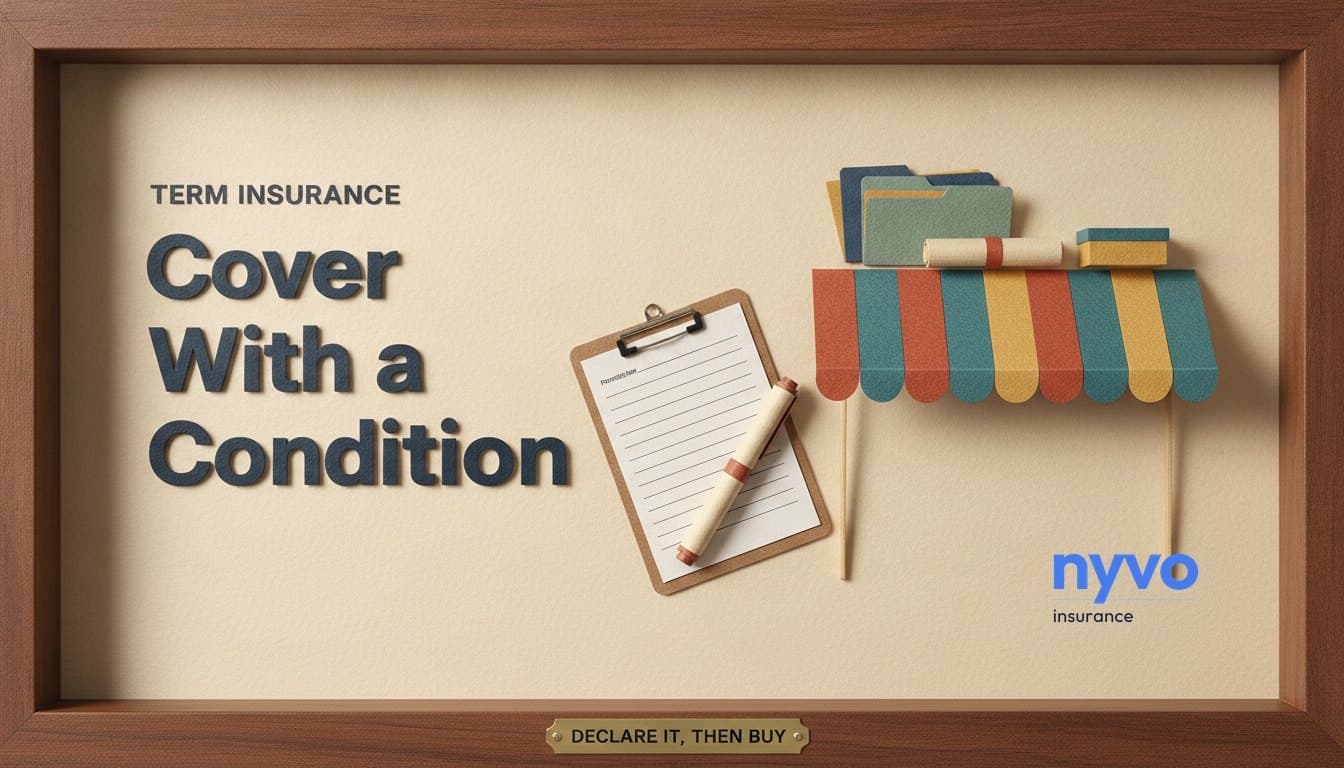
Term insurance with pre-existing conditions refers to buying a life insurance policy when you already have a diagnosed medical condition such as diabetes, hypertension or thyroid disorders. Yes, most Indian insurers will issue a term policy to applicants with pre-existing conditions – but with full medical disclosure and likely a premium loading of 15–50% depending on the severity and control of the condition.
According to IRDAI annual reports, non-disclosure of medical history is the #1 reason for term insurance claim rejections in India, accounting for a significant share of disputed claims. For example, a 35-year-old diabetic male with controlled HbA1c levels (below 7%) can typically get approved with a premium loading of just 15–25%, while uncontrolled diabetes may result in a 30–50% loading or even a postponement. The key principle is simple: honest disclosure = valid claim.
Back to: Term Insurance guide
Quick checklist
- Goal: disclose pre-existing conditions upfront; higher premium is acceptable if condition is disclosed.
- Avoid: hiding conditions to get standard premium; misrepresentation voids entire claim.
- Prefer: standard underwriting with full disclosure; claim will be valid after disclosure period.
- Claims-first: keep medical reports and prescriptions from diagnosis date; prove pre-existing status for claim.
Quick approval checklist
| What helps approval | Examples |
|---|---|
| Stable condition control | Regular follow-ups, controlled HbA1c/BP |
| Clean documentation | Recent reports, prescriptions, discharge summaries |
| Honest disclosure | Matches medical records |
| Willingness for medicals | Faster underwriting decisions |
What underwriting may do
- Approve at standard rates (sometimes)
- Approve with premium loading
- Approve with exclusions (less common in pure term; varies)
- Postpone/decline in higher-risk cases
How to apply safely
- Make a list of conditions, meds, tests, surgeries, hospitalizations
- Keep recent reports ready
- Don’t guess – write “as per doctor records” when needed
Related: Smoker/non-smoker + medicals
FAQs
Is it okay to hide a minor condition?
No. Non-disclosure is a common claim-risk.
Will premium loading reduce claim amount?
Usually no – loading affects premium, not sum assured.
Do term plans exclude pre-existing conditions?
Pure term usually doesn’t exclude specific illnesses for death benefit, but underwriting can vary.
Do I need to do medical tests?
Often yes. Tests help underwriting and reduce future disputes.
Can I buy term later after my condition improves?
You can try, but age increases premium; delaying can be costlier.
Should I apply to multiple insurers?
You can, but ensure consistent disclosures across applications.
What documents should my family keep for claim?
Keep policy docs and your medical disclosure trail. See: Term claim checklist
Disclaimer: Educational content. Underwriting decisions vary by insurer and individual health profile.
Related Guides
Our editorial principles
- Salaried advisors, not commission-linked: we focus on clarity and suitability, not product hype.
- No spam: we don't sell your data; we keep advice simple and actionable.
- Claims-first: policy features are evaluated by how they behave during claims.
- Education-first: this content is for informational purposes only.
Book a call for advice on the best policy for you and your family
A salaried, IRDAI-certified nyvo advisor will look at your cover, flag the gaps that matter, and tell you plainly what to fix. No commission, no pressure.
A first in India
Buy policy from nyvo insurance with Claim Support Guarantee, otherwise money back.

Alumni of IIT Delhi and IIM Ahmedabad. Former consultant at BCG and part of the strategy team of slice. Founder of nyvo and IRDAI Certified Insurance Advisor.