First in India
Claim Support Guarantee, otherwise your money back.
Buy through nyvo and we get your claim passed, otherwise refund your premium. We are putting our money on our claim service.
Health Insurance Porting in India: What Carries Over and the 2026 Rules
Health insurance portability lets you move your policy to a new insurer at renewal and keep the waiting-period time, moratorium years and no-claim bonus you have built up. Apply at least 30 and no more than 60 days before renewal, and pay no fee for it (IRDAI Master Circular on Protection of Policyholders' Interests, 5 September 2024).


Written by Harsh SoniReviewed by Shadab SayeedUpdated nyvo insurance Services LLP, IRDAI Corporate Agent (Composite) CA1085Salaried advisors, no commission-based ranking
Porting at a glance
| What carries over | credits to the extent of the sum insured, no-claim bonus, specific waiting periods, pre-existing disease waiting period and moratorium period (IRDAI Master Circular on Health Insurance Business, 29 May 2024, Chapter I, para 12) |
|---|---|
| When to apply | at least 30 days and not earlier than 60 days before the renewal date; an insurer may still consider a request within 15 days of renewal (IRDAI Master Circular on Protection of Policyholders' Interests, 5 September 2024, para 24.2) |
| Deadlines | the old insurer shares your data within 72 hours through the Insurance Information Bureau; the new insurer decides within 5 days of receiving it (IRDAI health circular, 29 May 2024, para 12) |
| Fee | none for porting in or out (IRDAI policyholder-protection circular, 5 September 2024, para 24.7) |
| Who can port | individual, family floater and group health policies, at renewal (same circular, para 24.1) |
| Moratorium | years under ported and migrated policies count towards the 60 months (IRDAI health circular, 29 May 2024, para 13) |
| Cover you add | fresh waiting periods and a fresh five-year moratorium on the added amount only (same circular, Annexure 1) |
Credits carry only when there is no break in cover, and pre-existing credit only for conditions you declared. Check the new policy schedule before you pay.
What is health insurance porting?
Health insurance porting moves your policy from one insurer to another at renewal while carrying the credits you have already earned: waiting-period time, moratorium years and your no-claim bonus. Under the IRDAI Master Circular on Health Insurance Business (29 May 2024, Chapter I, para 12), a policyholder has the choice to port, and is entitled to transfer those credits from the existing insurer to the acquiring one.
The easiest way to think about it: porting your policy is like porting your mobile number. You keep the number (your credits) and change only the network (the insurer). If you have served 3 years of a pre-existing disease waiting period with Insurer A and port to Insurer B, those 3 years count at Insurer B too. You do not start from zero.
If a sharp renewal premium has you looking at the door, compare porting with the alternatives first: why premiums rise at renewal, and what you can do short of moving, is in premium increase at renewal. Porting is the answer when the problem is the insurer itself; walking through it carelessly can cost you more than the premium hike would.
Who can port? IRDAI's Master Circular on Protection of Policyholders' Interests (5 September 2024, para 24.1) tells insurers to allow portability for all individual, family floater and group health insurance policies at the time of renewal. The health circular's portability clause is written for indemnity policies, the kind that pay your hospital bill.
If you would rather have someone check what will carry over before you apply, a nyvo advisor will go through your current policy with you, free.
What carries over when you port, migrate or buy fresh?
When you port to a new insurer or migrate to a new plan with the same insurer, the time you have served on waiting periods and your moratorium years carry over, and your no-claim bonus is on the same list of credits you are entitled to transfer (IRDAI Master Circular on Health Insurance Business, 29 May 2024, Chapter I, paras 11 and 12). Buying a fresh policy carries none of them, so every clock starts again.
| What you have built up | Port to a new insurer | Migrate to a new plan, same insurer | Buy a fresh policy |
|---|---|---|---|
| 30-day initial wait | Not served again once you have more than 12 months of continuous cover | Same as porting | Applies: it is a first policy |
| Specific-illness waits (commonly 24 months) | Time served carries over | Time served carries over | Start again |
| Pre-existing disease wait | Time served carries over, for conditions you declared | Time served carries over, for conditions you declared | Starts again |
| Five-year moratorium clock | Years count | Years count | Starts again |
| No-claim or cumulative bonus | Listed among the credits you can transfer | Listed among the credits you can transfer | Not carried |
| Cover you add on top | Fresh waits and a fresh five-year clock on the added amount | Fresh waits and a fresh five-year clock on the added amount | All cover is new |
| Loading, co-pay or deductible | Not on the circular's list: the new policy's terms apply | Not on the circular's list: the new plan's terms apply | The new policy's terms apply |
Credits: IRDAI Master Circular on Health Insurance Business, 29 May 2024, Chapter I, paras 11 (migration), 12 (portability) and 13 (moratorium), and the Customer Information Sheet format in its Annexure 1 (enhanced sum insured). Waiting-period mechanics: the standard exclusions (Excl01, Excl02, Excl03) in insurer wordings such as Care Supreme, Aditya Birla Activ One and Niva Bupa ReAssure 3.0, read October 2026.
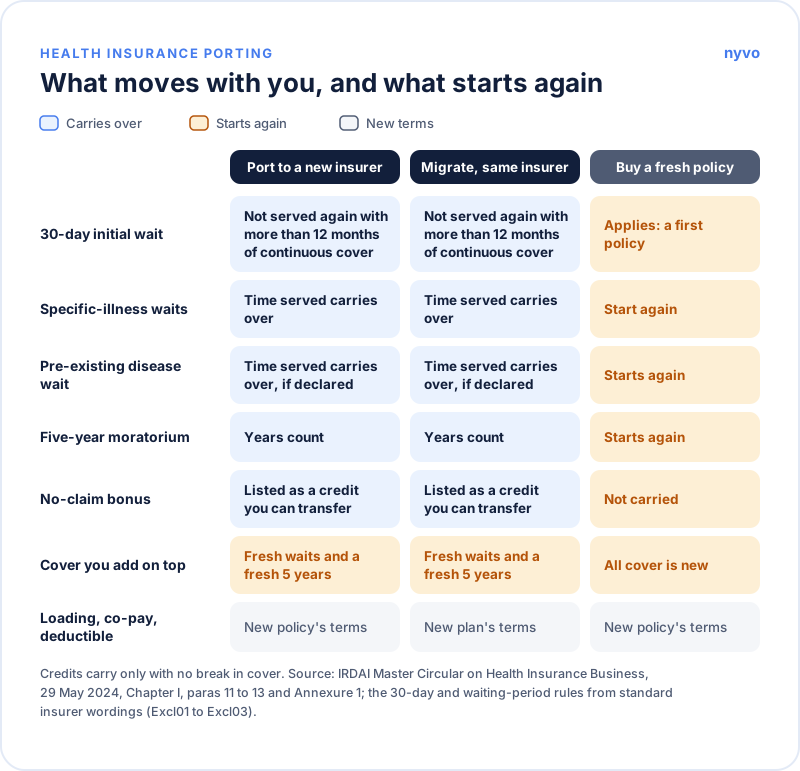
Row by row, here is where each rule comes from:
- The 30-day initial wait. The standard 30-day exclusion in Care Supreme, Activ One MAX and ReAssure 3.0 wordings says it does not apply to anyone with continuous coverage for more than twelve months.
- Specific-illness and pre-existing waits. Each wording reduces its own wait "to the extent of prior coverage" for someone continuously covered under the portability norms. That is the time you served, not the wait your old plan had: port after 12 months from a plan with a 12-month wait into one with a 36-month wait, and on that wording's terms the balance still runs. Pre-existing credit also covers only what you declared, because every wording pays for a pre-existing disease after the wait only if it was declared and accepted. How each clock runs is in waiting periods explained.
- The moratorium. The health circular counts accrued credits under ported and migrated policies towards the 60 months of continuous cover (Chapter I, para 13). See the five-year moratorium.
- Cover you add. The circular's own Customer Information Sheet format says that for an increase in sum insured the waiting periods start afresh only for the enhanced portion, and that the moratorium runs on the first policy's sum insured, with five fresh years from the date of enhancement on the enhanced limits.
- Loading, co-pay and deductible. None of these is on the circular's list of transferable credits. They are terms of the policy the new insurer issues after it underwrites you.
Does your no-claim bonus move when you port?
Yes, on the circular's wording. The IRDAI Master Circular on Health Insurance Business (29 May 2024, Chapter I, para 12(d)) says the policyholder is entitled to transfer "the credits gained to the extent of the Sum Insured, No Claim Bonus, specific waiting periods, waiting period for pre-existing disease, Moratorium period etc." from the existing insurer to the acquiring one. The migration clause (para 11) carries the same list.
The circular stops there: it does not set out how the new insurer must show a transferred bonus on its own policy schedule. The same circular (para 14) describes a no-claim bonus as either an addition to the sum insured with no extra premium, or a discount on the renewal premium. So before you pay, ask the new insurer to state in writing the sum insured and the bonus it is recognising, and match the figures to your current schedule.
Should you port just before the five-year moratorium?
Porting does not restart the moratorium on the cover you carry over. The IRDAI Master Circular on Health Insurance Business (29 May 2024, Chapter I, para 13) counts credits gained under ported and migrated policies towards the 60 months of continuous cover, so porting after four full years leaves about a year to run on that cover, not five.
Three things can still cost you, and all three are within your control:
- Added cover gets its own five years. Any sum insured above what you carry over starts its own moratorium from the date of enhancement, under the circular's Customer Information Sheet format. Close to the finish line, keep the sum insured the same and add height later, or through a super top-up.
- The port is a fresh proposal. The new insurer decides on your proposal (para 12(c)) and can decline. Answer its health questions in full; a decline leaves you exactly where you were, provided you renew.
- A break ends everything. Renew the old policy, within the grace period at the latest, if the new one is not issued in time. The circular protects all credits on a renewal made within the grace period (para 8).
A port made months before the moratorium is still a sound move if your insurer is the problem. If the insurer is fine and the plan is dated, migration carries the same credits with less to go wrong.
How do you apply for health insurance portability?
Porting runs on a clock. You can port only at renewal, and IRDAI's Master Circular on Protection of Policyholders' Interests (5 September 2024, para 24.2) asks you to apply to the new insurer at least 30 days before, but not earlier than 60 days from, the renewal date. An insurer may still consider a request made within 15 days of renewal, but must then make sure there is no break in cover. nyvo research (September 2026): aim for 45 to 60 days, so underwriting has room for medical tests.
| When | What happens | Who acts |
|---|---|---|
| 60 to 30 days before renewal (aim for 45 to 60) | Shortlist the new plan, then submit the new insurer's proposal form and portability form | You |
| Within 72 hours | Old insurer shares your policy and claim data with the new insurer through the Insurance Information Bureau (IIB) | Old insurer |
| Within 5 days of receiving that data | New insurer decides on your proposal and tells you | New insurer |
| Renewal date | If approved, the new policy starts as the old one ends, with your credits carried over and no break in cover | New insurer |
| If the port is declined | Renew the existing policy with your current insurer; your cover and credits continue | You |
The 72-hour and 5-day deadlines are in the IRDAI Master Circular on Health Insurance Business (29 May 2024, Chapter I, para 12) and repeated in para 24.5 of the policyholder-protection circular. The portability form, which authorises the new insurer to fetch your policy and claim history from your old one through the IIB portal, is set out in paras 24.3 and 24.4. Several insurers' own wordings repeat the 30-to-60-day window: Care Supreme, Aditya Birla Activ One, HDFC ERGO my: Optima Secure and Star Red Carpet among them.
The new insurer fetches your history through the IIB, but keep your own copies of past policy schedules, any endorsements (members added, cover raised) and claim papers to hand, along with recent medical reports. Depending on age, sum insured and health history, the new insurer may also ask for medical tests.
A few rules of the road that save people real grief:
- Never let the old policy lapse until the new one is issued. If the port is declined, renewing the existing policy keeps every credit intact; a lapse ends the continuity the port depends on.
- Port the whole policy. The circular asks you to port the entire policy along with all the members of the family on it (para 24.2).
- Expect no fee. No charge may be levied on you for porting in or porting out (para 24.7).
- Keep the sum insured decision separate. Any increase you take while porting is fresh cover with fresh waiting periods, so raise it only if you can live with that on the extra slice.
- Get the decision in writing. An insurer that does not accept a proposal must tell you its decision, with reasons, within 7 days (IRDAI Master Circular on Protection of Policyholders' Interests, 5 September 2024), so you know what to fix before the next renewal.
The same circular also bars the new insurer from paying commission or incentive to its own employees or distribution channel on a ported-in policy during the port-in year (para 24.7).
When does porting get rejected?
Portability is a right to apply, not a right to be accepted. The new insurer underwrites you as it would a new customer, under its own underwriting policy, and it can accept the port, accept it on terms of its own, or decline it. Niva Bupa's ReAssure 3.0 wording puts it plainly: a policyholder can port an individual or group policy subject to the insurer's board-approved underwriting policy.
Port requests can fail for these reasons:
- A health profile the new insurer will not price. It underwrites you afresh, so a pre-existing condition, a recent claim or a test result that changes the risk picture can bring a loading, an exclusion or a refusal.
- Age or sum insured outside the plan's rules. Some products set entry-age bands or fixed sum insured options, and a port cannot override them: Niva Bupa Senior First, for example, takes new entrants only from 61 to 75.
- A break in continuity. A lapsed policy ends the continuous cover that the credits depend on.
- A request that comes too late. Outside the 30-to-60-day window, acceptance is at the insurer's discretion, and a file still open on the renewal date means renewing the old policy and trying again next year.
If you are rejected, nothing is lost, provided your old policy is still alive. Renew it, keep your credits ticking, read the reasons the new insurer gives, and revisit porting at the next renewal, possibly with a different insurer.
Porting vs migration: which switch do you actually need?
Porting moves your policy to a different insurer; migration moves you to a different plan with the same insurer. IRDAI's health circular gives both the same list of transferable credits, so the choice turns on who the problem is: the insurer, or the plan.
| Porting | Migration | |
|---|---|---|
| Who you switch to | A different insurer | A different plan, same insurer |
| Credits that carry over | Sum insured, no-claim bonus, specific waits, pre-existing wait, moratorium (para 12(d)) | The same list (para 11) |
| Group policies | Portable at renewal (para 24.1, policyholder-protection circular) | Members of group policies included (para 11) |
| When to apply | 30 to 60 days before renewal (para 24.2) | At renewal; the circular sets no window. HDFC ERGO's my: Optima Secure wording, for example, asks for at least 30 days before renewal |
| Decision deadlines | 72 hours for the old insurer, 5 days for the new one | Not set by the circular |
| Charges | None for porting in or out (para 24.7) | Not addressed by the circular |
Paragraph numbers refer to Chapter I of the IRDAI Master Circular on Health Insurance Business (29 May 2024) unless marked as the Master Circular on Protection of Policyholders' Interests (5 September 2024).
The decision rule is one question: is your problem with the insurer, or with the plan? Repeated claim disputes, a weak hospital network in your city, or pricing far above the market: that is an insurer problem, and porting fixes it. Outdated features, a room-rent cap, a sum insured that no longer matches hospital bills: that is a plan problem, and migrating to a better plan with your existing insurer keeps the same credits with the insurer that already holds your history. Try migration first when the insurer itself has treated you well.
What happens if your plan is discontinued?
If an insurer withdraws your plan, you keep a choice, and your credits travel with it. Under the IRDAI Master Circular on Health Insurance Business (29 May 2024, Chapter II, section D), existing customers of a withdrawn product get a one-time option to renew it if renewal falls within 90 days of the withdrawal, or can migrate to another suitable product of the insurer, existing or modified, as the policyholder chooses.
The pieces around that rule:
- A policy stays renewable unless the product is withdrawn, or for established fraud, non-disclosure or misrepresentation; on withdrawal the insurer must offer suitable options to migrate (Chapter I, para 10).
- Migration carries the credits. Para 11 transfers the sum insured, no-claim bonus, specific waits, the pre-existing wait and the moratorium to the migrated policy.
- The policy document warns you in advance. It must say that a product may be withdrawn and what options you would get (Chapter II, section D). Care Supreme's prospectus, for example, promises notice 90 days before the policy expires and migration with accrued continuity benefits such as cumulative bonus and waiver of waiting period.
- Plans revised for the 2024 rules kept their credits. Products that did not comply with the 2024 regulations had to be modified by 30 September 2024, and the circular told each insurer's product management committee to make sure waiting-period and moratorium credits carried forward to the new policy.
If your plan is old and renewal notices now name a different product, ask the insurer in writing which of these routes you are on, and check that the new schedule shows your original start date.
Can you port from an employer's group policy to your own?
Yes, at the group policy's renewal; on leaving a job, the route the circulars give is migration. IRDAI's Master Circular on Protection of Policyholders' Interests (5 September 2024, para 24.1) tells insurers to allow portability of group health insurance policies at the time of renewal, as for individual and floater ones, and the health circular's migration clause expressly includes members of group insurance policies (Chapter I, para 11). A new insurer still underwrites a port before it accepts.
Two practical points. Ask the group insurer about migrating to one of its individual policies before your membership ends, because the credits depend on continuous cover with no break, and do not count on your exit date as a porting point; several individual wordings, Care Supreme, HDFC ERGO my: Optima Secure and Aditya Birla Activ One among them, credit continuous cover under any health insurance policy with an Indian general or health insurer. And expect the individual policy to be priced and underwritten on your own age and health, not your employer's group terms.
Leaving a parent's floater rather than an employer's plan? The circular asks you to port the entire policy with all its members, so a single member does not port alone. The usual route is a policy of your own with the same insurer first: HDFC ERGO's my: Optima Secure and Aditya Birla's Activ One wordings move a child who reaches 25 to their own policy at renewal with continuity benefits intact. From there, your own policy can be ported at its renewal.
Should you port, or just buy a fresh policy?
Porting wins whenever your waiting-period credit is worth protecting. If you have served two or more years of waiting periods, or you have any pre-existing condition on record, that credit is the most valuable thing you own in health insurance: buying fresh means restarting a 3-year pre-existing clock and a 5-year moratorium from zero, while a port carries both.
Buying fresh makes sense in narrower cases: you are young and healthy with no meaningful waiting periods served, your old policy has already lapsed, or you want to keep the old policy and add a second one alongside it. A healthy 27-year-old one year into their first policy loses little by simply buying the plan they actually want.
And sometimes the right answer is to do nothing. If you are past the 5-year moratorium with a decent insurer, a fresh policy would put you back to year one; a port could carry the moratorium, but only on the cover you bring and only if the new insurer accepts you. Port for genuine problems: repeated claim disputes, a hospital network that does not exist where you live, or premiums far beyond what the market charges for equivalent cover. Do not port for a ₹1,500 saving.
Get your port checked before you commit. A nyvo advisor will compare your current policy with the plan you want to move to, from the credit you will carry to the exclusions and the real premium after underwriting, and tell you honestly if staying put is the smarter move.
FAQs
Can I port my health insurance policy any time during the year?
No. Porting happens only at renewal. IRDAI's Master Circular on Protection of Policyholders' Interests (5 September 2024) asks you to apply at least 30 days before, and not earlier than 60 days from, the renewal date; an insurer may still consider a request within 15 days of renewal. If you leave it too late, renew your existing policy and port at the next renewal.
Is there a fee for porting health insurance?
No. IRDAI's Master Circular on Protection of Policyholders' Interests (5 September 2024, para 24.7) says no charges shall be levied on the policyholder for porting in or porting out. Your premium can still change, because the new insurer prices its own plan and underwrites you afresh.
Does my no-claim bonus transfer when I port?
Yes, under the IRDAI Master Circular on Health Insurance Business (29 May 2024), which entitles you to transfer credits to the extent of the sum insured, no-claim bonus, waiting periods and moratorium. The circular does not say how the new insurer must show the bonus on its schedule, so get the sum insured and bonus it recognises in writing before you pay.
Does porting restart the five-year moratorium?
No, not on the cover you carry over. The IRDAI Master Circular on Health Insurance Business (29 May 2024) counts credits under ported and migrated policies towards the 60 months. Only cover you add while porting starts its own five-year clock.
What happens if my porting request is rejected?
Your existing policy stays intact. Renew it with your current insurer so there is no break in coverage, and all your waiting-period credit and moratorium years continue. The new insurer must give you its reasons within 7 days, so you can fix what you can and try again at a future renewal.
Can I increase my sum insured while porting?
Yes, if the new insurer's underwriting allows it. The credits apply to the cover you carry over; the additional cover starts fresh waiting periods and its own five-year moratorium from the date it is added.
How long does health insurance porting take?
The regulated steps take days, not weeks. Your old insurer must share your policy and claim data through the Insurance Information Bureau within 72 hours, and the new insurer must decide within 5 days of receiving it (IRDAI Master Circular on Health Insurance Business, 29 May 2024). Medical tests or missing documents add time, which is why applying 45 to 60 days before renewal helps.
Can I port my employer's group health policy to an individual one?
Yes, at the group policy's renewal. IRDAI's Master Circular on Protection of Policyholders' Interests (5 September 2024) tells insurers to allow portability for group health policies at renewal, and the health circular extends migration credits to members of group policies, so on leaving a job ask the group insurer about migrating before your membership ends. Expect a new insurer to underwrite a port.
Can I port my health insurance policy online?
Yes, for the most part. You apply to the new insurer, through its website, an advisor or a branch, with its proposal form and portability form, and the rest moves online: your old insurer must share your policy and claim history through the Insurance Information Bureau within 72 hours (IRDAI Master Circular on Health Insurance Business, 29 May 2024). Medical tests, if asked for, still happen in person.
What are the disadvantages of porting a health insurance policy?
Three. The new insurer underwrites you afresh, so it can add a loading or an exclusion, or decline. You pay the new insurer's premium at your current age, which can be higher than your renewal quote. And anything the old policy gave you that is not on IRDAI's list of transferable credits, such as a lower co-pay or no room-rent cap, does not come with you.
Who pays if I am hospitalised while my port is pending?
Your old insurer, as long as the old policy is in force. The new policy starts only when it is issued, so keep the old one alive until then, renewing it within the grace period if the port is not through. The acquiring insurer must make sure there is no break in cover (IRDAI Master Circular, 5 September 2024).
What happens if my insurer withdraws my plan?
You get a one-time option to renew the withdrawn plan if renewal falls within 90 days of the withdrawal, or you can migrate to another suitable plan of the same insurer, carrying your waiting-period, bonus and moratorium credits (IRDAI Master Circular on Health Insurance Business, 29 May 2024).
Related guides:
Sources
- IRDAI Master Circular on Health Insurance Business, Reference No. IRDAI/HLT/CIR/PRO/84/5/2024, 29 May 2024: Chapter I, paras 8, 10, 11, 12, 13 and 14; Chapter II, section D (withdrawal of products); Annexure 1 (Customer Information Sheet format). irdai.gov.in, read 24 October 2026
- IRDAI Master Circular on Protection of Policyholders' Interests, Reference No. IRDAI/PP&GR/CIR/MISC/117/9/2024, 5 September 2024: Part B (health insurance policies) and Chapter VI, para 24 (portability). irdai.gov.in, read 24 October 2026
- Insurer wordings read October 2026: Care Supreme prospectus (UIN CHIHLIP27061V032627), Aditya Birla Activ One MAX policy wording (ADIHLIP24097V012324), HDFC ERGO my: Optima Secure prospectus (HDFHLIP26058V082526), Niva Bupa ReAssure 3.0 policy wording (NBHHLIP27059V022627), Star Health Senior Citizens Red Carpet policy wording (SHAHLIP26041V082526)
Book a call for advice on the best policy for you and your family
A salaried, IRDAI-certified nyvo advisor will look at your cover, flag the gaps that matter, and tell you plainly what to fix. No commission, no pressure.
A first in India
Buy policy from nyvo insurance with Claim Support Guarantee, otherwise money back.

16+ years in financial services. Former investment banker at Bank of America, Kotak Investment Banking, and SBICaps, and ex-CFO of slice. Founder of nyvo and Principal Officer – IRDAI Certified.