First in India
Claim Support Guarantee, otherwise your money back.
Buy through nyvo and we get your claim passed, otherwise refund your premium. We are putting our money on our claim service.
Term Insurance Tax Benefits: 80C (Section 123) and 10(10D)
Term insurance tax benefits: up to ₹1.5L deduction under Section 80C (section 123 of the Income-tax Act, 2025, from tax year 2026-27), old regime only. Death benefit tax-free under Section 10(10D) in both regimes. Save ₹3,000-5,000/year.

Written by Kshitij JainUpdated nyvo insurance Services LLP, IRDAI Corporate Agent (Composite) CA1085Salaried advisors, no commission-based ranking
What Are the Tax Benefits of Term Insurance Under Section 80C and 10(10D)?
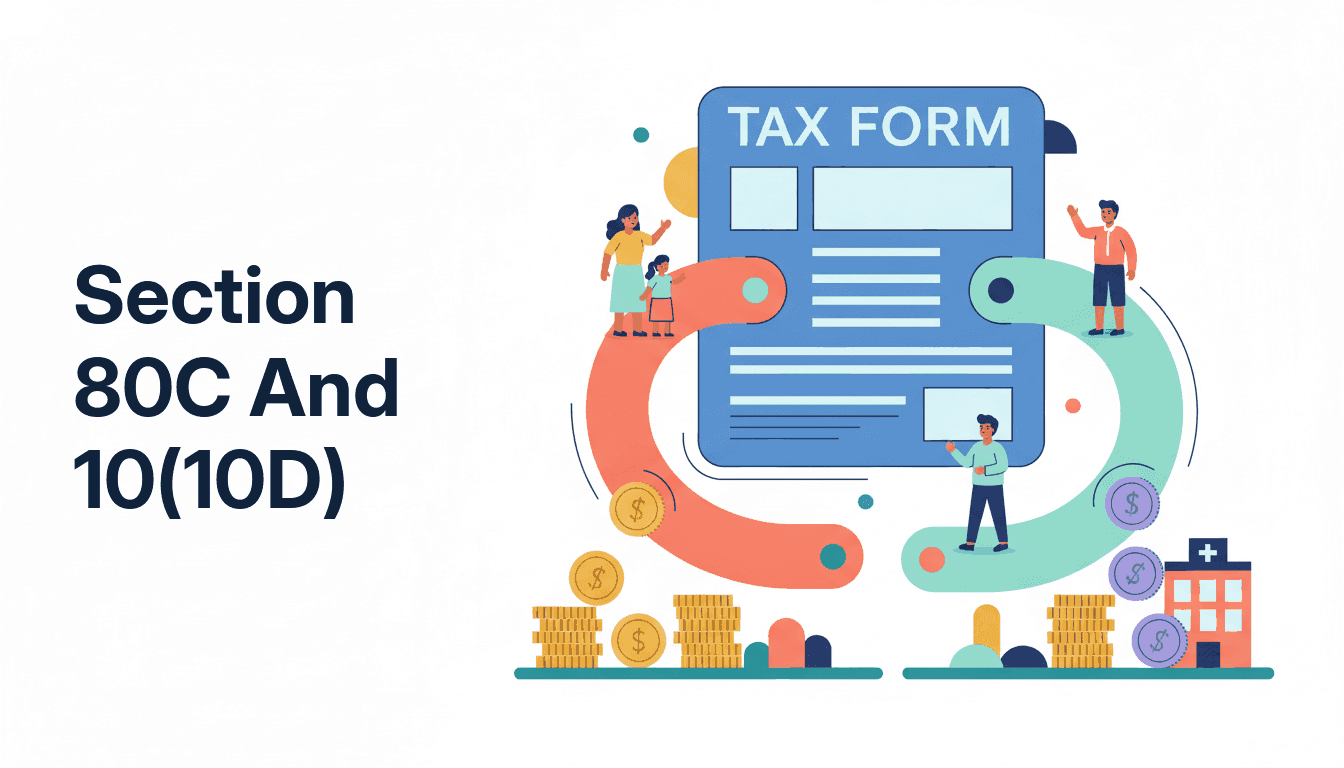
Term insurance tax benefits in India operate under two key sections of the Income-tax Act, 1961. Section 80C (section 123 of the Income-tax Act, 2025, from tax year 2026-27) allows you to claim a deduction of up to ₹1.5 lakhs per year on the premium paid for term insurance (under the old tax regime), reducing your taxable income. Section 10(10D) (Schedule II, item 2 of the Income-tax Act, 2025, from tax year 2026-27) makes the entire death benefit received by your nominee 100% tax-free – with no upper limit on the amount, under either tax regime. The limits are the same under both Acts.
Every premium on this page is the full amount you pay. Individual life insurance has attracted nil GST since 22 September 2025, so there is nothing to add on top.
For a salaried individual in the 30% tax bracket (old regime), a term insurance premium of ₹15,000/year effectively costs only ₹10,500 after the ₹4,680 tax saving (including 4% cess). The death benefit is the most tax-efficient way to transfer wealth to your family – compared to Fixed Deposits (interest taxed as income), stocks (12.5% LTCG above ₹1.25 lakhs), or property (stamp duty and registration charges). Important: Under the new tax regime, Section 80C deductions are not available, so there is no premium tax benefit – but the death benefit remains fully tax-free under 10(10D) regardless of regime.
Back to: Term Insurance guide
Quick checklist
- Goal: understand ₹1.5 lakh annual deduction under Section 80C; term premiums are tax-deductible.
- Avoid: missing tax deduction opportunity; allocate 80C limit to term insurance appropriately.
- Prefer: filing claim with life insurance premium receipts during ITR filing.
- Claims-first: deduction is on premium, not death benefit; death benefit is tax-free to beneficiary.
Tax Benefits at a Glance (2026)
| Tax Section | What It Covers | Limit | Benefit Type |
|---|---|---|---|
| Section 80C | Premium paid | Up to ₹1.5 lakh/year (combined) | Deduction from income |
| Section 10(10D) | Death benefit | No limit | 100% tax-free to nominee |
| Section 80D | Health riders (if applicable) | Up to ₹25,000-₹50,000 | Separate deduction |
From tax year 2026-27 these become section 123 (with Schedule XV), Schedule II item 2, and section 126 of the Income-tax Act, 2025, with the same limits. 80C and 80D apply only under the old tax regime; the 10(10D) exemption applies under both.
Section 80C: Premium Deduction Explained
What qualifies?
- Premium paid for term insurance on your own life
- Premium paid for spouse's life
- Premium paid for children's life
- Both online and offline policies qualify
The ₹1.5 lakh limit
Section 80C (section 123 from tax year 2026-27) has a combined limit of ₹1.5 lakh which includes:
- Term insurance premium
- Life insurance premium (traditional/ULIP)
- EPF contribution
- PPF investment
- ELSS mutual funds
- Home loan principal
- Children's tuition fees
Example calculation:
| Your 80C investments | Amount |
|---|---|
| EPF contribution | ₹80,000 |
| PPF investment | ₹50,000 |
| Term insurance premium | ₹15,000 |
| Total claimed | ₹1,45,000 |
| Remaining 80C limit | ₹5,000 |
Condition for 80C benefit
Only the premium up to 10% of the sum assured counts, for policies issued on or after 1 April 2012 (20% for policies issued before then; 15% for a policy issued from 1 April 2013 on the life of a person with a disability or a specified illness).
| Sum Assured | Maximum Premium for 80C |
|---|---|
| ₹50 Lakhs | ₹50,000 |
| ₹1 Crore | ₹1,00,000 |
| ₹2 Crore | ₹2,00,000 |
Most term plans easily meet this condition (premiums are typically 0.5-1.5% of sum assured).
Real Tax Savings by Income Tax Bracket (2026)
Old Tax Regime
| Taxable Income | Tax Bracket | Premium ₹15,000 | Actual Tax Saved |
|---|---|---|---|
| ₹5-10 Lakh | 20% | ₹15,000 | ₹3,120 (incl. cess) |
| ₹10-15 Lakh | 30% | ₹15,000 | ₹4,680 (incl. cess) |
| ₹15 Lakh+ | 30% | ₹15,000 | ₹4,680 (incl. cess) |
New Tax Regime (the default since FY 2023-24)
Section 80C is NOT available under the new tax regime. If you've opted for new regime, you won't get deduction for term insurance premium.
| Regime | 80C Available? | Better for term insurance? |
|---|---|---|
| Old Regime | Yes | Yes, if you use deductions |
| New Regime | No | No tax benefit on premium |
Section 10(10D): Tax-Free Death Benefit
The most important tax benefit: under Section 10(10D) (Schedule II, item 2 from tax year 2026-27), the death benefit is 100% tax-free for your nominee, under both tax regimes.
What's covered?
- Lump sum death benefit: Tax-free
- Monthly income option: Tax-free
- Rider payouts (most): Tax-free
Example
| Scenario | Amount | Tax |
|---|---|---|
| Death benefit | ₹1 Crore | ₹0 |
| Accidental death rider | ₹50 Lakhs | ₹0 |
| Total to nominee | ₹1.5 Crore | ₹0 tax |
Compare this to other assets:
| Asset Type | Tax on ₹1 Cr inheritance |
|---|---|
| Term insurance | ₹0 |
| FD (interest accrued) | Taxable as income |
| Stocks (gains) | 12.5% LTCG above ₹1.25L |
| Property | Registration + stamp duty |
Section 80D: If Your Policy Has Health Riders
If you add critical illness or health-related riders, that portion may qualify under Section 80D (section 126 from tax year 2026-27), separate from 80C, under the old tax regime.
| Category | 80D Limit |
|---|---|
| Self + family (under 60) | ₹25,000 |
| Self + family (senior citizen) | ₹50,000 |
| Parents (under 60) | Additional ₹25,000 |
| Parents (60+) | Additional ₹50,000 |
Note: Not all riders qualify. Check with insurer if rider premium is 80D eligible.
How to Claim Tax Benefits
Step 1: Collect premium receipt
- Download from insurer portal
- Or request via email/customer care
- Keep policy number, premium amount, dates handy
Step 2: Declare to employer (if salaried)
- Submit proof during investment declaration window
- Usually in January-February
- Employer adjusts TDS accordingly
Step 3: Include in ITR
- Show it in the deductions schedule under Section 80C (section 123 from tax year 2026-27), and only if you file under the old tax regime
- Mention policy details if asked
- Keep receipts for 6 years (in case of scrutiny)
Common Mistakes in Claiming Tax Benefits
| Mistake | Impact |
|---|---|
| Claiming under new tax regime | Claim rejected-80C not available |
| Premium > 10% of sum assured | Only premium up to 10% of sum assured counts |
| Not keeping premium receipts | Can't prove claim during assessment |
| Claiming employer-paid premium | Only self-paid premiums qualify |
| Claiming over ₹1.5L across term, PPF, ELSS and the rest | Excess disallowed: ₹1.5L is one combined limit |
Tax Planning Strategy: Optimize 80C Allocation
If you file under the old tax regime, are in the 30% bracket and haven't exhausted 80C (section 123 from tax year 2026-27):
| Priority | Investment | Why |
|---|---|---|
| 1 | EPF (compulsory) | Already deducted |
| 2 | Term Insurance | Protection + tax benefit |
| 3 | PPF | Safe, long-term |
| 4 | ELSS | Market-linked, 3-year lock-in |
Don't buy term insurance just for tax benefit-buy for protection. Tax benefit is a bonus.
FAQs
Is term insurance death benefit taxable?
No. Death benefit is 100% tax-free for the nominee under Section 10(10D) (Schedule II, item 2 from tax year 2026-27), under both tax regimes.
Can I claim 80C under new tax regime?
No. Section 80C deductions (section 123 from tax year 2026-27) are not available under the new tax regime.
How much tax can I save with ₹15,000 premium?
In 30% bracket (old regime): ~₹4,680 saved. In 20% bracket: ~₹3,120 saved.
Can I claim tax benefit for spouse's term insurance?
Yes, if you pay the premium and the policy is on spouse's life.
Is GST on premium eligible for 80C?
The question is largely moot now: individual life insurance premiums have attracted nil GST since 22 September 2025, so the premium you pay is the whole of it. Under the old tax regime it counts towards 80C (section 123 from tax year 2026-27), subject to the premium-to-sum-assured ceiling and the overall ₹1.5 lakh limit. For premiums paid before that date, the GST component qualified too.
What if my premium exceeds 10% of sum assured?
Under the old tax regime, only the portion up to 10% of sum assured qualifies for the 80C deduction (section 123 from tax year 2026-27), for a policy issued on or after 1 April 2012 (20% for policies issued before then; 15% for a policy issued from 1 April 2013 on the life of a person with a disability or a specified illness).
Do I need to submit policy documents for tax claim?
Premium receipt is usually sufficient. Keep policy documents for reference.
Can both spouses claim 80C on same policy?
No. Only the person who pays the premium can claim the deduction.
Is accidental death rider payout taxable?
No. Rider payouts are generally tax-free under Section 10(10D) (Schedule II, item 2 from tax year 2026-27).
What's the difference between 80C and 80D for insurance?
80C (section 123 from tax year 2026-27) covers life/term insurance premium. 80D (section 126) covers health insurance premium. Both are old-regime deductions.
Should I buy term insurance just for tax benefit?
No. Buy for protection first. Tax benefit is secondary. Don't over-insure just to save tax.
Related Guides
Disclaimer: Tax rules are subject to change. Consult a tax professional for personalized advice. This content is for educational purposes, based on the Income-tax Act, 1961 for FY 2025-26 and the Income-tax Act, 2025 from tax year 2026-27, which renumbers the sections but keeps the limits.
Our editorial principles
- Salaried advisors, not commission-linked: we focus on clarity and suitability, not product hype.
- No spam: we don't sell your data; we keep advice simple and actionable.
- Claims-first: policy features are evaluated by how they behave during claims.
- Education-first: this content is for informational purposes only.
Book a call for advice on the best policy for you and your family
A salaried, IRDAI-certified nyvo advisor will look at your cover, flag the gaps that matter, and tell you plainly what to fix. No commission, no pressure.
A first in India
Buy policy from nyvo insurance with Claim Support Guarantee, otherwise money back.

Alumni of IIT Delhi and IIM Ahmedabad. Former consultant at BCG and part of the strategy team of slice. Founder of nyvo and IRDAI Certified Insurance Advisor.