Cashless Pre-Auth Denied? A 60-Minute Action Plan
Cashless pre-authorisation rejected at hospital admission? Stay calm. This 60-minute action plan walks you through every step – getting denial in writing, escalating to the insurer hotline, switching to reimbursement track, and when to call nyvo claims support.

What to Do in the First 60 Minutes
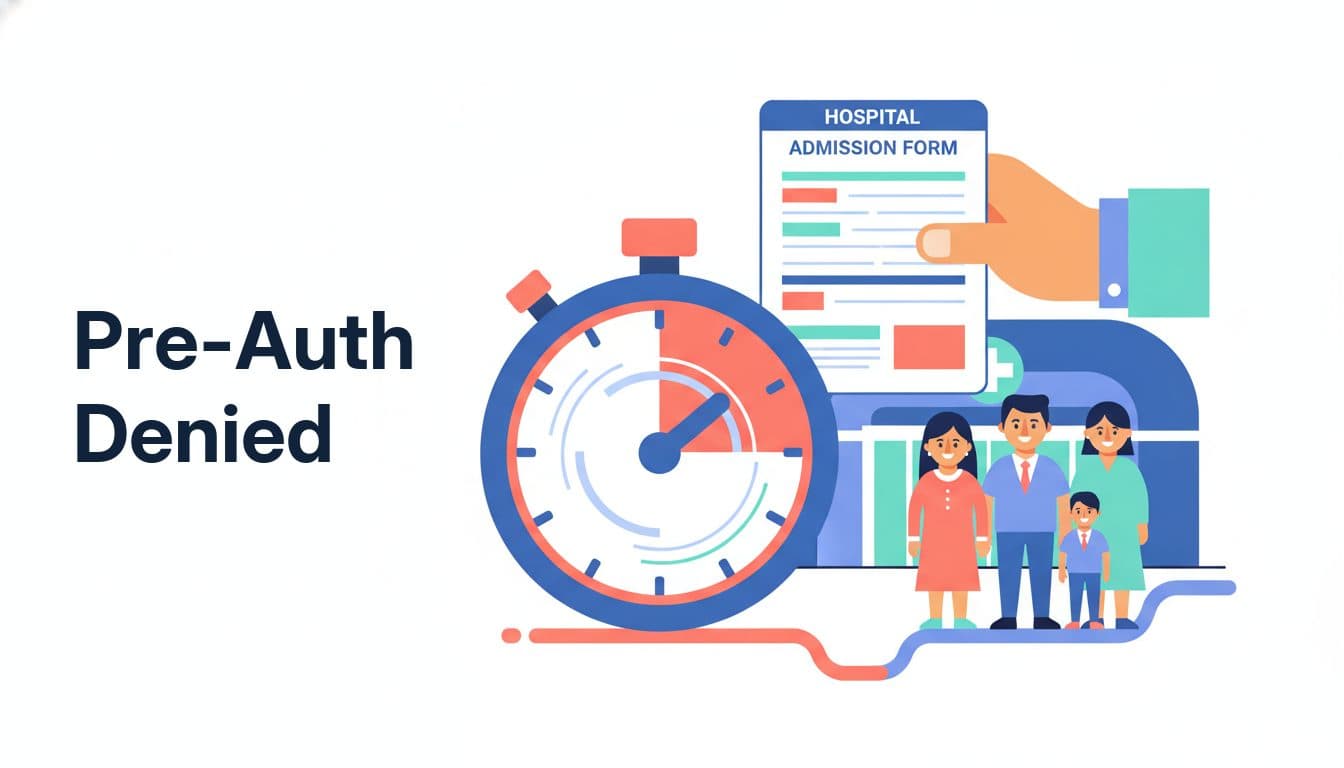
The hospital insurance desk just told you cashless pre-authorisation has been denied. Your family is admitted, the ward boy is asking for advance payment, and the bill is climbing. Stop. Don't pay anything yet, and don't sign any "self-pay" undertaking. Most cashless denials at the counter are reversible – they happen because of incomplete documentation or the wrong claim category, not because the claim itself is invalid. Follow these six steps in the next 60 minutes:
- Get the denial in writing – insist on the official reason printed on letterhead or in email
- Call the insurer's 24/7 helpline directly (not through the hospital desk)
- Ask whether the denial is final or whether the claim can be re-submitted with extra documents
- If denial is final, switch to the reimbursement track and pay the hospital deposit (refundable)
- Document everything – every call, every name, every reference number
- Escalate within 24 hours to the insurer's grievance cell if the denial seems unjust
This guide walks through each step in detail, what documents you need, and how to escalate further if the insurer's response is unsatisfactory. Save the page or screenshot it so it's available offline at the hospital.
Why Cashless Pre-Auth Gets Denied
Most denials at the counter are not because the claim is invalid. They fall into one of four categories:
- Documentation incomplete – the hospital sent the pre-auth request to the insurer with missing or unclear documents (typical: missing pre-admission test reports, ambiguous diagnosis, unclear treatment plan)
- Diagnosis-treatment mismatch – the requested treatment does not match the diagnosis as the insurer reads it (often resolved by the treating doctor adding a clarifying note)
- Policy condition triggered – a waiting period, sub-limit, or exclusion in the policy applies to the specific treatment (this is harder to override)
- Hospital-tariff issue under Cashless Everywhere – the insurer and a non-network hospital have not agreed on the tariff yet (resolvable through hospital coordination)
Categories 1 and 2 are reversible 60-90% of the time once corrected documentation is sent. Category 3 needs review of the policy schedule and possibly switching to reimbursement plus negotiation. Category 4 needs the insurer's helpline to coordinate directly with the hospital.
Step 1: Get the Denial in Writing (5 minutes)
Verbal denials at the hospital insurance desk are the most common – and the least useful. Always insist on a written denial letter or denial email with the official reason.
What to ask for:
- Letter on the insurer's letterhead or an email from the insurer's official domain
- The specific clause of the policy being invoked
- The pre-authorisation reference number
- The name and direct contact of the underwriter / pre-auth officer who decided
Why it matters:
- A written denial is the foundation of any escalation
- Verbal "the company said no" is useless; the hospital often paraphrases
- Many denials disappear once the underwriter is asked to put the reason in writing
If the hospital insurance desk delays, ask them to call the insurer on speakerphone in front of you and request the denial in writing be emailed within the hour.
Step 2: Call the Insurer Directly – Not Through the Hospital (10 minutes)
The hospital insurance desk is a relay. Their job is to handle paperwork, not to negotiate. Once you have the denial in writing, call the insurer's 24/7 helpline yourself. This is the most important step in this entire playbook.
Have these ready before you dial:
- Your policy number and patient name
- Pre-authorisation reference number
- The written denial reason
- Treating doctor's name and contact
What to say:
"I'm a policyholder. My pre-authorisation has been denied at the hospital. The denial reason states X. I want to understand whether the denial is final, and what additional documentation can be submitted to reconsider the decision."
The 24/7 helpline staff have direct visibility into the pre-auth file and can often see what the hospital cannot – for example, whether the underwriter requested a specific document that the hospital did not provide, or whether the diagnosis-treatment mismatch can be resolved by an updated note from the doctor.
Always note down:
- The full name of the agent you speak to
- The new reference number for this conversation
- The exact next-action committed to (e.g., "underwriter will call back within 1 hour")
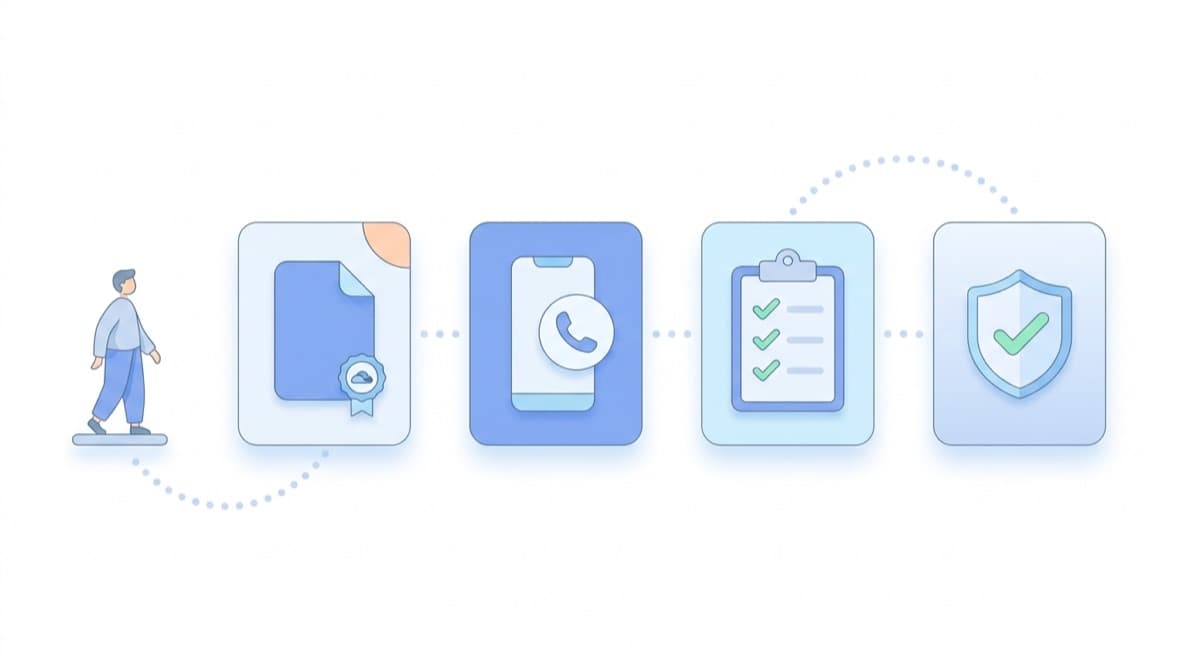 The paper trail that reverses most denials – written reason, direct call, corrected documents, approval.
Step 3: Ask: Final Denial or Re-submission Possible? (5 minutes)
Once the helpline agent has reviewed the file, you need a clear answer to one question: can the claim be re-submitted with additional documents, or is this denial final?
If re-submission is possible:
- Get the list of additional documents requested (e.g., "doctor's letter clarifying that the treatment is for the disclosed PED")
- Confirm the timeline within which the insurer will reconsider
- Coordinate with the treating doctor to provide the missing documents
- Most successful resolutions happen here – the underwriter sees the additional context and approves
If the denial is final:
- Ask for the specific policy clause being invoked
- Ask for a written copy of the final denial reason
- Move to Step 4 (reimbursement track)
Step 4: Switch to Reimbursement Track if Cashless Fails (15 minutes)
If cashless pre-auth is finally denied, the policy is not invalid. You can still claim reimbursement after discharge by paying the hospital first and submitting a reimbursement claim later. The same medical event, the same policy – just a different payment timing.
To switch tracks at the hospital:
- Pay the hospital admission deposit (typically ₹25,000-₹1,00,000 for non-emergency admissions). This is refundable.
- Tell the hospital insurance desk you are switching to reimbursement mode, not self-pay
- Make sure the hospital still issues all standard documents – itemised bill, discharge summary, all investigation reports, treating doctor's notes
Critical: do NOT sign any "self-pay" or "non-claim" undertaking unless explicitly required. That undertaking can later be used as evidence that you waived your insurance claim. Insist that the hospital marks the admission as "insurance pending – reimbursement track".
Step 5: Document Everything (Ongoing)
Every call, every name, every commitment, every reference number – write it down. Keep a single document or notes file with:
| Time | Person | Source | Conversation summary | Reference number |
|---|---|---|---|---|
| 14:32 | Hospital ins. desk | Apollo HSR | Pre-auth denied verbally, asked for written denial | – |
| 14:58 | Insurer helpline | Insurer name | Pre-auth file shows missing pre-admission test reports | INS-9876543 |
| 15:25 | Treating doctor | Dr. Sharma | Will issue clarifying note within 1 hour | – |
Why this matters:
- If you escalate later (Ombudsman, consumer court), this log is your evidence
- It prevents miscommunication between the hospital and insurer
- It catches the insurer if a representative changes the story later
Step 6: Escalate Within 24 Hours if Denial Seems Unjust
If after Steps 1-5 you believe the denial is unjust, the escalation ladder is clear:
Level 1 – Insurer Grievance Cell (within 24 hours)
- Email the insurer's grievance email ID with: policy number, pre-auth ref number, written denial, your case for why it's wrong
- Quote the relevant policy clause and the IRDAI Master Circular where applicable
- Insurer must acknowledge within 3 working days and resolve within 15 working days
Level 2 – IRDAI Grievance Portal (after 15 working days)
- File at bimabharosa.irdai.gov.in with the same documents
- IRDAI tracks the case and pushes the insurer for a response
Level 3 – Insurance Ombudsman (final pre-court resolution)
- File at cioins.co.in within one year of the insurer's final response
- Ombudsman handles disputes up to ₹50 lakhs and decides within 90 days
- The order is binding on the insurer up to ₹30 lakhs
Level 4 – Consumer Court (rare, for amounts above the Ombudsman cap or for principle cases)
Common Reasons That Get Resolved Fast
These are the four most common pre-auth denial reasons that get reversed once the right step is taken:
| Denial reason | Most likely fix |
|---|---|
| Diagnosis-treatment mismatch | Treating doctor adds a clarifying note explaining the medical necessity |
| Pre-existing disease (PED) but waiting period not yet completed | Verify the policy schedule – many policies have specific waiting period exceptions for emergency cases |
| Documentation incomplete | Hospital re-submits with the missing reports (pre-admission tests, prescriptions, doctor's notes) |
| Treatment is for a non-payable condition (e.g., cosmetic) | Often a misread of the diagnosis – ask the doctor to explicitly note the medical necessity vs cosmetic intent |
Most of these resolve within hours of a correct re-submission, and the insurer's 1-hour decision deadline restarts on the fresh request. The biggest mistake families make is assuming a denial is final and paying out of pocket without trying re-submission.
When to Call for Help
If you're stuck at the hospital insurance desk and the denial is not moving, nyvo offers free claims support to anyone – even if you didn't buy the policy through us. Call our claims helpline and an IRDAI-certified advisor will:
- Read the denial letter and identify the right escalation path
- Coordinate with the insurer's helpline directly if needed
- Help draft the grievance letter if escalation is required
- Walk you through reimbursement filing
Frequently Asked Questions
What is cashless pre-authorisation in health insurance?
Cashless pre-authorisation is the approval the hospital must obtain from the insurer before starting treatment so that the insurer can settle the bill directly with the hospital. The hospital sends the patient's diagnosis, proposed treatment plan, and policy details to the insurer, and the insurer responds with an approved cashless limit and any conditions. Without pre-authorisation, the patient must pay upfront and claim reimbursement later.
How long does cashless pre-authorisation take?
Per the IRDAI Master Circular 2024, insurers must decide cashless authorisation within 1–3 hours. Final cashless authorisation at discharge must be issued within 3 hours of the discharge summary being sent. Network hospitals typically meet these timelines reliably; non-network hospitals using Cashless Everywhere may take longer for the first claim.
Why was my cashless pre-authorisation denied at the hospital?
The four most common reasons are: incomplete documentation sent to the insurer, diagnosis-treatment mismatch on paper, a policy waiting period or sub-limit being triggered, or hospital-tariff coordination issues for non-network hospitals under Cashless Everywhere. Categories 1 and 2 are usually reversible within hours once the correct documents are sent. Always get the denial in writing first and call the insurer helpline directly before paying out of pocket.
Should I pay the hospital and claim reimbursement if cashless is denied?
Yes, if you have exhausted the re-submission path and the denial is final. The same policy that was rejected for cashless can still be valid for reimbursement – the policy itself isn't invalid, only the cashless mode of settlement was denied. Pay the hospital deposit, ensure the hospital issues all standard documents (itemised bill, discharge summary, investigation reports), and file reimbursement within the policy's stipulated timeline (typically 30 days from discharge).
What documents do I need for a reimbursement claim after cashless denial?
At minimum: filled and signed claim form, original itemised hospital bills, discharge summary, all investigation reports, prescription receipts, doctor's consultation notes, photo ID of the patient, policy copy or e-card, cancelled cheque for refund transfer, and the original written denial letter from the cashless rejection. Keep photocopies of everything before submitting.
Can I dispute a cashless denial at the Insurance Ombudsman?
Yes, but only after exhausting the insurer's internal grievance process first (15 working days for the insurer to respond). If the insurer's final response is unsatisfactory, file at cioins.co.in within one year of receiving the final response. The Ombudsman handles disputes up to ₹50 lakhs and decides within 90 days; the order is binding on the insurer up to ₹30 lakhs.
Will cashless denial at the hospital count against my no-claim bonus?
No. A denied pre-authorisation that does not result in a paid claim does not affect your no-claim bonus. NCB is calculated on actual claims paid out by the insurer in the policy year. If you switch to reimbursement and the insurer pays, that single paid claim is what affects NCB.
Can nyvo help with claims even if I didn't buy my policy through nyvo?
Yes. nyvo offers free claims guidance to any policyholder, regardless of where the policy was purchased. The team can read the denial letter, identify the right escalation, coordinate with the insurer's helpline, help draft the grievance letter, and walk you through reimbursement filing. The service is genuinely free – no fee, no obligation to switch insurers.
Related guides:
Sources:
- IRDAI Master Circular on Health Insurance Business, Reference No. IRDAI/HLT/CIR/MISC/77/05/2024, 29 May 2024
- IRDAI Cashless Everywhere Circular, 23 January 2024
- Council for Insurance Ombudsmen – cioins.co.in
- IRDAI Grievance Redressal Portal – bimabharosa.irdai.gov.in

Alumni of IIT Delhi and IIM Ahmedabad. Former consultant at BCG and part of the strategy team of slice. Founder of nyvo and IRDAI Certified Insurance Advisor.