First in India
Claim Support Guarantee, otherwise your money back.
Buy through nyvo and we get your claim passed, otherwise refund your premium. We are putting our money on our claim service.
Term Insurance vs Life Insurance: The Real Difference
The difference between life insurance and term insurance: term is one type of life insurance, the kind that pays only on death. What the rest of the category adds, and what that costs you.


Written by Harsh SoniReviewed by Kshitij JainUpdated nyvo insurance Services LLP, IRDAI Corporate Agent (Composite) CA1085Salaried advisors, no commission-based ranking
What is the difference between life insurance and term insurance?
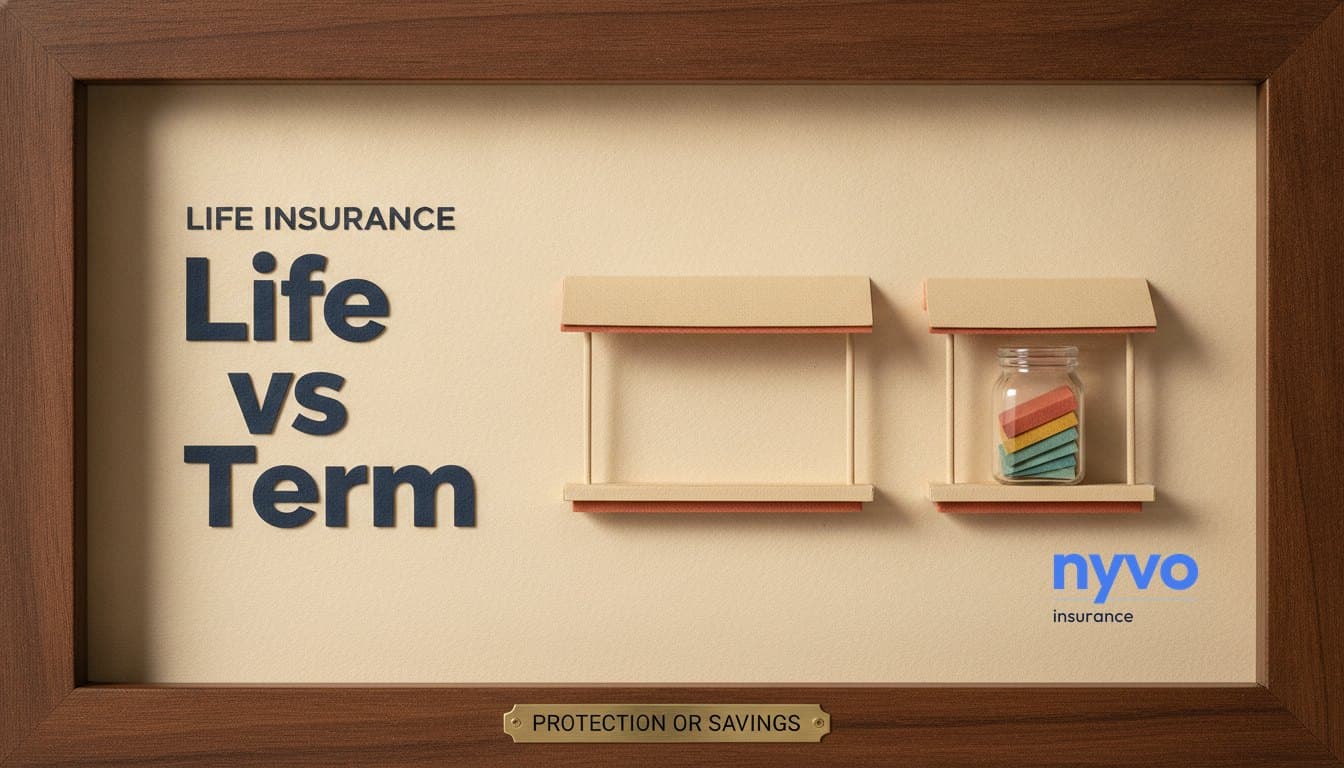
The difference between life insurance and term insurance is that term is one type of life insurance, not an alternative to it. Life insurance is the whole category of policies that pay out on death. Term insurance pays only if you die within the term, so ₹1 crore of cover to 60 cost a healthy 30-year-old man a median ₹9,528 a year (nyvo premium data, May 2026).
So when someone asks "life insurance or term insurance?", the real question is whether to buy pure protection or protection bundled with savings. To answer it, price the same cover as plain term first, then judge the savings part of the bundled policy on the yearly return it earns. The comparison most people have in mind is term insurance against a savings-linked life policy: an endowment, money-back, whole life, ULIP or guaranteed savings plan.
| Term insurance | Savings-linked life insurance | |
|---|---|---|
| Pays on death | Yes | Yes |
| Pays if you survive | Nothing, on plain term | A maturity amount, periodic payouts or a fund value, depending on the product |
| Where your premium goes | The cost of cover only; nothing is set aside for you | Cover and charges first, then the savings side |
| Cost for the same sum assured | A fraction of the savings-linked policies | Multiples of plain term |
| If you stop paying | The cover lapses. On regular pay nothing comes back; some single-pay and limited-pay plans pay an exit value | A surrender value, poor in the early years |
| Who it suits | Anyone whose income other people depend on | Buyers who have judged the return and prefer it to the alternatives |
Two published figures show how wide that cost gap is. LIC's own benefit illustration for Jeevan Labh (Plan 736, UIN 512N304V03) has a 30-year-old paying ₹10,025 a year, for 16 years, for a basic sum assured of ₹2 lakh on a 25-year policy; if he dies during it, his family gets that ₹2 lakh plus any bonuses LIC has added. A 30-year-old non-smoking man pays a median ₹9,528 a year for ₹1 crore of term cover to 60 across the five term plans we rate (nyvo premium data, May 2026). Roughly the same yearly premium buys fifty times the guaranteed death cover on term. What the Jeevan Labh premium buys instead is a payout at maturity, and our LIC Jeevan Labh review works out what that payout earns as a yearly return. For term cover on its own terms, see what term insurance is and how it pays out.
What does term life insurance mean?
Term life insurance, also called term life assurance, is a contract that pays a fixed sum to your nominee if you die within an agreed number of years, and pays nothing if you outlive them. You choose three things: the cover, how long it runs, and how your family is paid. Everything else in a term plan, from riders to premium breaks, is detail on top of those three.
The word "term" is the whole point. Cover that runs to 60 or 65, while people depend on your income, is cheap because most policies end without a claim. Cover that runs for life is a different product, whole life insurance, and it costs far more because it will almost certainly pay out. For every other kind of policy in the category, see our life insurance guides.
What the category actually contains
| Product | Pays on death | Pays if you survive | Typical use |
|---|---|---|---|
| Term insurance | Yes | No | Replacing your income for dependants |
| Return-of-premium term | Yes | Premiums back | Term, at a higher price, for people who dislike getting nothing |
| Endowment | Yes | Lump sum at maturity | Bundled saving over a fixed period |
| Money-back | Yes | Periodic payouts plus maturity | Bundled saving with interim liquidity |
| Whole life | Yes, whenever it occurs | Cover to age 99 or 100 | Estate and legacy planning |
| Guaranteed savings (non-par) | Yes | Contractually fixed maturity amount | Bundled saving with a known outcome |
| ULIP | Yes | Fund value, subject to markets | Bundled market-linked investing |
Everything below the first two rows does the same structural thing: it takes a premium, spends part of it on life cover and charges, and puts the rest towards a payout you receive if you live. The savings component is funded by you. That is simply how these products work, and it explains the price difference.
Why term costs so much less
Because it usually pays nothing. Most term policies expire without a claim, so the insurer prices only the probability of death within the term, spread across everyone in the pool. Nothing is being set aside for you.
The rest of the category promises a payout in both outcomes. Money to fund the surviving-policyholder payout has to come from somewhere, and it comes from your premium, after the cover cost and the charges are taken out.
That gives you a test you can run on any quote:
- Get a quote for the same sum assured as plain term insurance.
- Subtract it from the bundled plan's premium. The difference is what you are paying for the savings component.
- Ask what annual return that difference earns, using the benefit illustration.
If the return is one you would accept from any other twenty-year commitment, the bundle is defensible. If it is materially lower, you are paying a premium for the convenience of one product instead of two.
Why the words get used loosely
Two reasons, and both are worth knowing before a sales conversation.
The category name sounds safer than the product name. "Life insurance" implies permanence and saving. "Term" implies something that runs out. The first is easier to sell, so it is the phrase that gets used for products that are, specifically, savings plans.
Commission follows the premium. Pure term is the cheapest thing in the category and therefore pays the least on a given sale. Nobody has to plan it; the incentive does the work, and it is why someone asking for term insurance is often shown something else.
We should state our own position here. nyvo is an IRDAI-registered corporate agent and is paid commission by insurers, so this incentive describes us as much as anyone; our advisors are salaried rather than paid per sale, which is how we manage it. Ask whoever is selling you a policy how they are paid on it. Knowing the vocabulary means the substitution cannot happen without you noticing.
Which one is the right question
Not "term or life". Better questions:
- "Does anyone depend on my income?" If yes, you need enough death cover, and term is the cheapest way to buy it. Our guide to how much cover you need sizes it.
- "Am I buying protection, or saving?" Both are legitimate. Bundling them into one contract is what makes each harder to evaluate.
- "What return does the savings half earn?" If nobody will state it as a percentage, that is the answer.
- "What happens if I stop paying?" Regular-pay term simply lapses. Savings policies carry a surrender value that is poor in early years, which is why surrendering a policy so often returns less than people expect.
A comparison of the three bundled forms against term is in our guide to term vs ULIP vs endowment.
How do you get a term life insurance quote you can compare?
Size the cover first, then ask every insurer for the same thing. A term life insurance quote is only comparable with another if the cover, the end age, the payment term and the payout shape are identical, and if both assume the same health and tobacco answers. Our term insurance calculator works out the cover from your spending, loans and children.
For a sense of the market before you ask: ₹1 crore of cover to 60 cost a healthy 30-year-old man ₹738 to ₹870 a month across the five plans in our ₹1 crore term plan comparison (nyvo premium data, May 2026). A quote far below that range usually means the cover, the term or the health answers are different. If you would like someone to line the quotes up for you, book a free call and one of our advisors will do it with you.
FAQs
Is term insurance the same as life insurance?
Term insurance is one type of life insurance. Life insurance is the whole category of policies that pay out on death, and term is the variety that pays only on death, with no maturity value if you survive the policy term. So the two are not alternatives, and a question phrased as "term or life" is usually really asking whether to buy pure cover or a savings-linked policy.
What does term life insurance cover?
Death from almost any cause during the policy term, paid to your nominee. The standard exception is suicide in the first 12 months, when plans return part or all of the premiums instead. Many term plans also pay early on a terminal illness diagnosis. Nothing is paid if you outlive the term, unless you bought a return-of-premium version at a higher price.
What is the 3-year rule in term insurance?
It is Section 45 of the Insurance Act, 1938. For the first three years of a policy, or of a revival, the insurer can contest a claim for fraud or for a material fact you did not disclose, and must give its reasons in writing. Once the policy has run for three years it cannot be questioned on any ground, so declare every illness and habit when you apply.
Which is better, term insurance or life insurance?
They are not comparable in that form, because term is part of life insurance. The real comparison is between pure term and a bundled savings product such as an endowment, ULIP or guaranteed plan. Term buys the most death cover per rupee; the bundled products pay something back if you survive, funded from your own premiums after charges.
How do I compare term insurance vs life insurance on price?
Price the same sum assured as plain term, and treat the gap between that and the savings plan's premium as the cost of the savings component. Then work out the annual return that gap earns from the benefit illustration: if it is materially lower than you would accept from any other twenty-year commitment, you are paying for the convenience of one product instead of two.
Why is term insurance so much cheaper?
Because most term policies pay nothing. The insurer prices only the chance of death within the term, and sets nothing aside for a survival payout. A bundled policy has to fund a payout in both outcomes, so a large part of the premium goes into the savings side rather than into cover.
Does term insurance give money back at maturity?
Plain term does not: the cover ends with the term and nothing is paid. Return-of-premium term variants hand back the premiums you paid if you survive the term, at a noticeably higher premium for the same cover, and the refund is in rupees that have lost value to inflation. Our guide to return of premium term insurance works through the trade.
Term insurance vs life insurance: what happens if I stop paying?
A regular-pay term plan lapses and pays nothing back. A few return money on exit: Axis Max Life Smart Term Plan Plus pays 70% of the premiums, in proportion to the term left, on single or limited pay (prospectus, UIN 104N132V01), and Bajaj Life eTouch II's Life Shield variants return your premiums if you exit after 25 policy years and from age 60 (UIN 116N198V10). A savings policy's surrender value is poor in the early years.
Should I buy life insurance if I have no dependants?
Death cover exists to replace income other people rely on, so with nobody depending on your income the case for a large sum assured is weak. That is a general point about what the product does, not advice on your circumstances, which would also take account of liabilities such as a loan carrying a co-borrower.
Is a savings life insurance policy a bad product?
Not inherently. It becomes a bad purchase when it is bought without knowing the return, which is the common case, because the pitch quotes a maturity multiple rather than an annual rate. Compute the rate from the benefit illustration first, and the product then either justifies itself or does not.
Sources
- LIC Jeevan Labh benefit illustration (Plan 736, UIN 512N304V03), as worked through in our Jeevan Labh review
- Axis Max Life Smart Term Plan Plus prospectus, UIN 104N132V01, Early Exit Value · read 24 Oct 2026
- Bajaj Life eTouch II sales literature, UIN 116N198V10, exit option on Life Shield and Life Shield Plus · read 24 Oct 2026
- Term premiums: nyvo's own premium data, May 2026, for ₹1 crore of cover to 60, as published in our ₹1 crore term plan comparison
- Section 45 of the Insurance Act, 1938, as reproduced in insurers' policy documents
Category and product, at a glance
| The relationship | Life insurance is the category. Term insurance is one product inside it. Endowment, money-back, whole life, ULIP and guaranteed savings plans are the others. |
|---|---|
| What term does | Pays a lump sum if you die within the policy term. Pays nothing if you survive it. No maturity value, and no surrender value on regular pay; some single-pay and limited-pay plans pay an exit value (Axis Max Life Smart Term Plan Plus prospectus, UIN 104N132V01). |
| What the rest do | Pay on death AND return money if you live, funding the second promise out of your own premiums. |
| Where the cost sits | The savings products cost multiples of term for the same sum assured, because part of every premium is going into the savings side after charges. |
| The test to run | Price the same cover as plain term, subtract, and ask what annual return the remainder earns. See our guide to reading a benefit illustration. |
| Who each suits | Pure protection for anyone with dependants. Bundled products only where you have consciously judged the return and prefer it to the alternatives. |
This page explains the categories. It is not advice on which product suits your circumstances, which depends on your dependants, existing cover, liabilities and tax position.
Book a call for advice on the best policy for you and your family
A salaried, IRDAI-certified nyvo advisor will look at your cover, flag the gaps that matter, and tell you plainly what to fix. No commission, no pressure.
A first in India
Buy policy from nyvo insurance with Claim Support Guarantee, otherwise money back.

16+ years in financial services. Former investment banker at Bank of America, Kotak Investment Banking, and SBICaps, and ex-CFO of slice. Founder of nyvo and Principal Officer – IRDAI Certified.