First in India
Claim Support Guarantee, otherwise your money back.
Buy through nyvo and we get your claim passed, otherwise refund your premium. We are putting our money on our claim service.
How to Surrender a Life Insurance Policy in India
Surrendering an endowment, money-back or ULIP: the documents, the process, the alternatives most people are never offered, a worked LIC Jeevan Labh example of surrender against paid-up against keep paying, and the cover gap it leaves.

Written by Harsh SoniUpdated nyvo insurance Services LLP, IRDAI Corporate Agent (Composite) CA1085Salaried advisors, no commission-based ranking
How do I surrender a life insurance policy?
You surrender a life insurance policy by filing a signed surrender or discharge form at the branch that services it, with the original policy document, photo ID, PAN and a bank mandate in the policyholder's name. The insurer then pays the surrender value and the cover ends.
That is the mechanic. The more useful question is whether you should, because surrender is one of four ways out and it is usually the worst of them – and nobody at the counter is required to tell you the other three. If your policy is an LIC Jeevan Labh, Jeevan Umang or New Jeevan Anand, the worked example below takes one policy through all three on LIC's own numbers.
The four exits, before you pick one
| Option | What happens | When it makes sense |
|---|---|---|
| Surrender | Insurer pays the surrender value. Cover ends immediately. | You need the money now, or the policy is genuinely unsalvageable. |
| Make it paid-up | You stop paying premiums. The policy stays alive at a reduced sum assured and pays out at maturity or death. | You cannot afford the premium but do not need cash today. Usually returns more than surrendering, though later. |
| Policy loan | Borrow against the policy's value, keep the cover, repay later. | You need money temporarily and want the policy intact. |
| Continue | Keep paying. | The heavy front-loaded costs are behind you and the remaining years carry the return. |
Paid-up is the option most people are never offered, and on a policy several years in it frequently beats surrender by a wide margin – you give up future premiums without giving up the policy. Ask about it by name.
The number that actually decides it
Not what you have paid in. That money is gone either way, and treating it as a reason to continue is the sunk-cost trap that keeps people in bad policies for a decade.
Ask the insurer for three figures in writing:
- What you would receive if you surrender today.
- What the policy pays if you make it paid-up and hold to maturity.
- What it pays if you continue paying to maturity.
Then compare 1 against 2, and 2 against 3. A policy that returns little on surrender but a reasonable amount paid-up is not a policy to surrender – it is one to stop feeding.
The reason the early-year figure is so poor is structural: a traditional savings policy loads most of its costs into the first years, so the value builds slowly at the start and faster later. Exiting early means paying the costs and collecting none of the benefit.
Surrender values for plans filed under the IRDAI (Insurance Products) Regulations, 2024 follow its rules. For a non-linked savings policy, the Guaranteed Surrender Value must be at least 30% of the premiums paid if you surrender in the second year, 35% in the third, 50% in the fourth to seventh, rising to 90% in the last two years, less any survival benefits already paid (Schedule I, clause 4(A)(a)(1)). The Special Surrender Value can be higher and becomes payable once the first policy year is complete and a full year's premium has been paid (IRDAI Master Circular on Life Insurance Products, 12 June 2024, para 26.4). You are paid the higher of the two. If your policy predates those rules, its own document sets the terms, which is why you ask for your own figure rather than working from any general rule, including one on this page.
How do surrender, paid-up and continuing work on an LIC policy?
LIC re-filed these plans under the 2024 rules and has sold them since 1 October 2024 as Jeevan Labh (Plan 736), Jeevan Umang (Plan 745) and New Jeevan Anand (Plan 715); the older Jeevan Labh, Plan 936, was sold from 1 February 2020 until its withdrawal on 1 October 2024. LIC's own policy documents for these plans set the rules:
| Jeevan Labh 736, Jeevan Umang 745, New Jeevan Anand 715 | Jeevan Labh 936 (UIN 512N304V02) | |
|---|---|---|
| Becomes paid-up if you stop paying | After at least one full year's premium | After at least two full years' premiums |
| Can be surrendered | After the first policy year, with one full year's premium paid | After two full years' premiums |
| Guaranteed Surrender Value | From two full years' premiums: premiums paid × LIC's GSV factor, plus a factor on vested bonuses | Premiums paid × LIC's GSV factor, plus a factor on vested bonuses |
| Special Surrender Value | From the end of the first policy year, reviewed annually under IRDAI's Master Circular | Set by LIC from time to time, with IRDAI approval |
| You are paid | The higher of the two | The higher of the two |
| Paid-up sum assured | Sum assured × premiums paid ÷ premiums payable, plus bonuses already vested | Same formula |
| Bonuses after going paid-up | Jeevan Labh and New Jeevan Anand: none, and no Final Additional Bonus. Jeevan Umang: none during the premium-paying term (see below) | None, and no Final Additional Bonus |
Two details that are easy to miss. Premiums paid excludes taxes, rider premiums and any extra premium when LIC works out the Guaranteed Surrender Value. And on Jeevan Labh 736 and 936 with a 25-year term, LIC's GSV factor on premiums is 35% in policy year 3 and 50% in years 4 to 7, the same as the minimums in the 2024 regulations, rising to 90% in the last two years.
A worked example: one Jeevan Labh policy, three ways out
Take LIC's own benefit illustration for Jeevan Labh (Plan 736, UIN 512N304V03): a 30-year-old, a ₹2,00,000 basic sum assured, a 25-year policy and premiums of ₹10,025 a year for 16 years. Suppose three premiums have been paid, ₹30,075 in all, and the fourth is due. The amounts below are LIC's 4% scenario, with its 8% scenario in brackets; both are assumed returns that IRDAI requires insurers to illustrate, not promises.
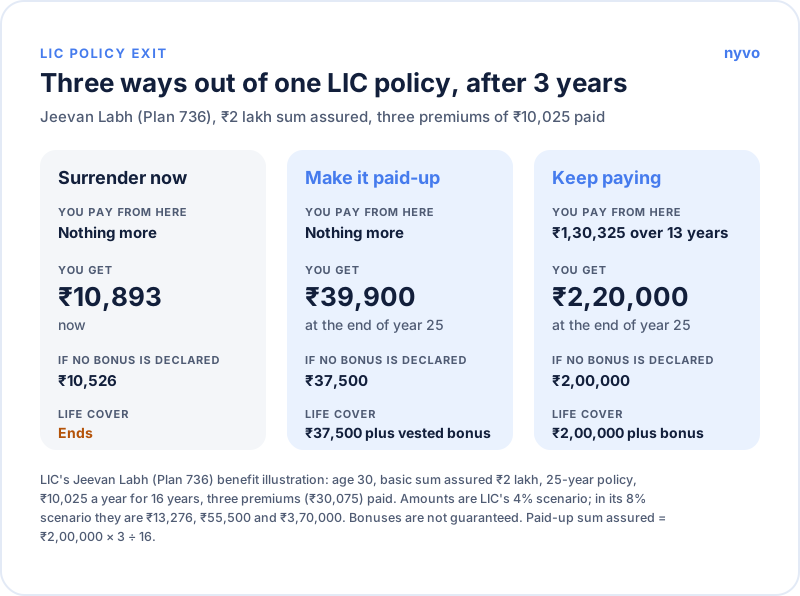
| Surrender now | Make it paid-up | Keep paying | |
|---|---|---|---|
| You pay from here | Nothing | Nothing | 13 more premiums, ₹1,30,325 |
| You get | ₹10,893 now (₹13,276) | ₹39,900 at the end of year 25 (₹55,500) | ₹2,20,000 at the end of year 25 (₹3,70,000) |
| If LIC declared no bonus at all | ₹10,526 now | ₹37,500 at year 25 | ₹2,00,000 at year 25 |
| Life cover from here | None | ₹37,500 plus vested bonuses | ₹2,00,000 plus bonuses |
How each figure is worked out:
- Surrender. The Guaranteed Surrender Value is 35% of the ₹30,075 paid, or ₹10,526, plus 15.28% of the bonus already vested (₹2,400 in LIC's 4% scenario, about ₹367), giving the ₹10,893 LIC's illustration prints. In the 8% scenario the vested bonus is ₹18,000 and the figure is ₹13,276. LIC's illustrated Special Surrender Value at year 3 is lower (₹8,519, or ₹11,849), so the guaranteed value is what you would be paid.
- Paid-up. ₹2,00,000 × 3 ÷ 16 = ₹37,500, payable at maturity, plus the bonuses already vested: ₹39,900 (or ₹55,500). A paid-up policy earns no further bonuses and no Final Additional Bonus.
- Keep paying. LIC's illustration at year 25: the ₹2,00,000 sum assured plus bonuses, ₹2,20,000 (or ₹3,70,000).
What the numbers say. Making the policy paid-up instead of surrendering it means leaving ₹10,893 in the policy to collect ₹39,900 twenty-two years later: about 6.1% a year (6.7% in the 8% scenario, and 5.9% on the no-bonus figures, ₹10,526 against ₹37,500). That is arithmetic on LIC's illustration, not a recommendation: set it against your need for cash now and what else the money could do over those 22 years.
Keeping paying instead of going paid-up means putting in ₹1,30,325 more over 13 years to raise the year-25 payout from ₹39,900 to ₹2,20,000. On those extra premiums that works out to about 2.0% a year in LIC's 4% scenario, 5.5% in its 8% scenario, and 1.4% if no further bonus were declared. So the real question about continuing is whether those rates beat what else ₹10,025 a year could do, and whether you need the policy's cover; LIC declares bonuses each year, and they can land anywhere relative to its scenarios.
All of these are arithmetic on LIC's illustration for a 30-year-old. Your own figures depend on your age, sum assured, term and the bonuses LIC has actually declared on your policy, so ask your branch for the surrender value and the paid-up value in writing and run the same comparison. Our guide to the real return on guaranteed income plans explains the rate arithmetic, and our Jeevan Labh review covers the plan as a whole.
What changes on Jeevan Umang and New Jeevan Anand?
The paid-up and surrender rules are the same as Jeevan Labh's, with one trap on each plan.
Jeevan Umang (Plan 745): the 8% income can stop entirely. On a paid-up Jeevan Umang, LIC's policy document pays the yearly survival benefit only if the paid-up sum assured is at least ₹2 lakh, the plan's minimum basic sum assured; if it is, the income is 8% of the paid-up sum assured. Below ₹2 lakh, no survival benefit is paid at all. A paid-up Umang also earns no bonus during the premium-paying term; LIC's document says one with a paid-up sum assured of ₹2 lakh or more may share in profits after it, in a different form. On a ₹2,00,000 policy with a 15-year premium term, stopping after three years leaves a paid-up sum assured of ₹2,00,000 × 3 ÷ 15 = ₹40,000, so the income stops. To keep any income after three years of a 15-year term, the original sum assured would need to be at least ₹10,00,000. Our Jeevan Umang review sets out what the plan pays when kept in force.
New Jeevan Anand (Plan 715): the lifelong cover shrinks too. New Jeevan Anand keeps paying the basic sum assured on death even after maturity. On a paid-up policy, LIC's policy document reduces that after-maturity death benefit to the basic sum assured × premiums paid ÷ premiums payable. If the lifelong cover is the reason you bought it, a paid-up policy keeps only that fraction of it. Our New Jeevan Anand review covers the plan's guaranteed and bonus parts.
If your Umang or Anand policy is an older plan number, its own policy document sets the terms; the UIN is printed on your policy schedule.
What you actually need to file
The exact form number and route differ by insurer and by product, so confirm with the servicing branch. The document set is broadly standard:
- The original policy document. If you have lost it, expect an indemnity bond and a delay.
- A signed surrender or discharge form, from the insurer.
- Photo ID and PAN.
- A cancelled cheque or bank mandate in the policyholder's own name. A mismatch here is the single most common reason a payout stalls.
- The premium payment record, if the insurer asks for it.
Some insurers accept a surrender request through their customer portal for eligible policies; others still require the servicing branch. Ask which applies to yours before travelling.
ULIPs work differently
A unit-linked policy carries a five-year lock-in. Surrender inside it and you are not paid out: the proceeds move to a discontinuance fund, which earns at least 4% a year under IRDAI's Master Circular on Life Insurance Products (12 June 2024), and are released when the lock-in period ends.
If the policy was mis-sold to you as an investment in the first place, our comparison of term vs ULIP vs endowment explains why the bundled products under-perform on both jobs, and our guide to a ULIP sold at your bank covers the free-look exit, the capped discontinuance charges and how to complain.
So for a ULIP the question is rarely "should I surrender" but "should I stop paying and wait". If you are inside the lock-in, exiting achieves nothing except capping further contributions – and you can usually do that by stopping premiums rather than by surrendering.
The part nobody mentions: the cover disappears
Surrendering a life insurance policy ends the life cover. If anyone depends on your income, you have just removed their protection to release cash.
This matters more than it sounds, because of what has changed since you bought:
- You are older. Term premiums rise with age, so replacing the cover costs more than it would have.
- Your health may have changed. A condition diagnosed since you bought can mean a loading, an exclusion, or a decline.
So the order matters. Price and, if possible, buy the replacement term cover before you surrender, not after. Discovering that you cannot get cover at an acceptable price is a fact you want while you still hold the old policy, not once you have signed it away.
Our guide to term insurance with pre-existing conditions covers what happens when health has moved, and how much cover you need sizes the replacement.
Want someone to run your own LIC figures through the three paths and price the term cover that would replace it? A nyvo advisor can do both with you. nyvo is an IRDAI-registered corporate agent (composite), licence CA1085.
When surrendering is the right call
It is not always wrong. Surrender genuinely makes sense when:
- The policy is a small, early-stage one you were mis-sold, the sum assured is trivial against your actual need, and continuing means years of premiums for cover that would never have been enough.
- You have a real, immediate need for the money and a policy loan does not cover it or costs more.
- You already hold adequate term cover elsewhere, so exiting removes no protection you are relying on.
- You have compared surrender against paid-up in writing and surrender is genuinely the better number.
What it should not be is a decision made at a counter, on the day, without the paid-up figure in front of you.
FAQs
How do I surrender an LIC policy?
File a signed surrender or discharge form at the LIC branch servicing the policy, with the original policy document, photo ID, PAN and a cancelled cheque in the policyholder's name. Some policies can be surrendered through the customer portal – check which applies to yours. Before you do, ask for the paid-up value alongside the surrender value, because on a policy several years in it is often the better outcome.
How is the paid-up value of an LIC policy calculated?
LIC's policy documents for Jeevan Labh, Jeevan Umang and New Jeevan Anand set the paid-up sum assured as the sum assured multiplied by the premiums paid and divided by the premiums originally payable, plus bonuses already vested. On a ₹2,00,000 Jeevan Labh with 16 yearly premiums, three paid gives ₹2,00,000 × 3 ÷ 16 = ₹37,500, payable at maturity.
Should I surrender LIC Jeevan Labh or make it paid-up?
On LIC's own Plan 736 illustration for a 30-year-old with a ₹2,00,000 sum assured, 16 premiums of ₹10,025 and a 25-year term, holding the policy paid-up after three years instead of taking the ₹10,893 surrender value implies about 6.1% a year over the remaining 22 years. That is arithmetic, not a recommendation; weigh it against your need for cash and your alternatives, on your own written figures.
How much will I get if I surrender my policy?
Ask your insurer for your own figure in writing – it depends on the product, how many years you have paid, and whether the policy was filed before or after the IRDAI (Insurance Products) Regulations, 2024, which changed how surrender values are calculated. Any general percentage you read, including on this page, is not your number.
Can I make Jeevan Umang paid-up and keep the 8% income?
Only if the paid-up sum assured is at least ₹2 lakh. LIC's policy document stops the survival benefit on a paid-up Jeevan Umang whose paid-up sum assured is below the ₹2 lakh minimum; above it, the income is 8% of the paid-up sum assured. Three years into a 15-year term, that needs an original sum assured of at least ₹10 lakh.
Is LIC Plan 936 treated differently from Plan 736?
Yes, on timing. LIC's policy document for Jeevan Labh Plan 936 (UIN 512N304V02) allows paid-up status and surrender only after two full years' premiums, against one full year for Plan 736. The paid-up formula and, on the 25-year term, the Guaranteed Surrender Value factors on premiums are the same in both documents.
Is it better to surrender or make a policy paid-up?
Paid-up is frequently better and rarely offered. Surrendering ends the policy for a cash figure that is usually poor in the early years. Making it paid-up stops the premiums but keeps a reduced policy alive to maturity or death. Ask for both figures side by side before deciding.
Can I surrender a term insurance policy?
There is nothing to surrender. Plain term insurance builds no surrender value because you are buying protection, not saving – if you want to exit, you stop paying and the cover lapses. Return-of-premium term variants are different and do carry a surrender value; check that plan's own terms.
Can I surrender a ULIP before five years?
You can request it, but you will not be paid out during the lock-in. The proceeds move to a discontinuance fund, earning at least 4% a year, and are released when the five-year period ends. If your aim is to stop putting money in, stopping premiums usually achieves that without surrendering.
Will I lose my life cover if I surrender?
Yes, immediately. That is the part most easily overlooked. If anyone depends on your income, price a replacement term plan before you surrender – you are older than when you bought, and any health condition diagnosed since will affect what you can get.
Related guides:
Sources:
- LIC's Jeevan Labh (Plan 736, UIN 512N304V03) policy document (Part D, conditions 2 and 4; Annexures 4 and 5) and sales brochure benefit illustration (licindia.in, read 19 October 2026)
- LIC's Jeevan Labh (Plan 936, UIN 512N304V02) policy document and product page (date of launch 1 February 2020, withdrawn 1 October 2024)
- LIC's Jeevan Umang (Plan 745, UIN 512N312V03) policy document (non-forfeiture regulations, survival benefits under a paid-up policy)
- LIC's New Jeevan Anand (Plan 715, UIN 512N279V03) policy document (non-forfeiture regulations, surrender)
- IRDAI (Insurance Products) Regulations, 2024, Schedule I, clause 4 (surrender value, paid-up sum assured)
- IRDAI Master Circular on Life Insurance Products, Ref. IRDAI/ACTL/MSTCIR/MISC/89/6/2024, 12 June 2024, para 26.4 (Special Surrender Value) and para 40.1.5 (discontinued policy fund)
Surrender at a glance
| The four exits | Surrender · make it paid-up · take a policy loan · continue as-is. Compare all four before choosing. |
|---|---|
| Typical document set | Original policy document, signed surrender or discharge form, photo ID, PAN, cancelled cheque or bank mandate in the policyholder's name. |
| LIC paid-up sum assured | Sum assured × premiums paid ÷ premiums payable, plus bonuses already vested. On Jeevan Labh and New Jeevan Anand, no further bonuses and no Final Additional Bonus (LIC policy documents, Plans 736, 745 and 715). |
| When an LIC policy can go paid-up or be surrendered | After one full year's premium on Plans 736, 745 and 715; after two full years' premiums on the older Plan 936. |
| LIC surrender value | The higher of the Guaranteed Surrender Value and the Special Surrender Value. |
| IRDAI minimum Guaranteed Surrender Value | 30% of premiums paid in year 2, 35% in year 3, 50% in years 4 to 7, 90% in the last two years (IRDAI (Insurance Products) Regulations, 2024). |
| ULIP lock-in | Five years. Exit before it ends and the proceeds move to a discontinuance fund, earning at least 4% a year, rather than being paid out. |
| Term insurance | Plain term has no surrender value – there is nothing to surrender, you simply stop paying. |
| The gap it leaves | Life cover ends on surrender. Replace it before you exit, not after. |
Surrender values, form numbers and submission routes differ by insurer and by product, and the rules changed for plans filed under the IRDAI (Insurance Products) Regulations, 2024. The LIC rules here are from LIC's policy documents for Plans 736, 745, 715 and 936; check the UIN on your own policy and ask for your own figures in writing.
Book a call for advice on the best policy for you and your family
A salaried, IRDAI-certified nyvo advisor will look at your cover, flag the gaps that matter, and tell you plainly what to fix. No commission, no pressure.
A first in India
Buy policy from nyvo insurance with Claim Support Guarantee, otherwise money back.

16+ years in financial services. Former investment banker at Bank of America, Kotak Investment Banking, and SBICaps, and ex-CFO of slice. Founder of nyvo and Principal Officer – IRDAI Certified.