First in India
Claim Support Guarantee, otherwise your money back.
Buy through nyvo and we get your claim passed, otherwise refund your premium. We are putting our money on our claim service.
Term Insurance Tenure: Cover Till 60, 65, 75 or 85?
How to choose the age your term cover ends: match it to your dependants and your loans, pick the cover amount at the same time, and see what a cover to 75 or 85 really buys.

Written by Kshitij JainUpdated nyvo insurance Services LLP, IRDAI Corporate Agent (Composite) CA1085Salaried advisors, no commission-based ranking
Till what age should term insurance cover you?
Term insurance tenure is how long your cover lasts, and the cover-till age is your age when it ends: a 30-year term bought at 30 ends at 60. Set the cover-till age at the later of two dates, the year your youngest dependant can live without your income and the year your last loan is paid, plus a small buffer. For many salaried buyers that lands between 60 and 65. Most plans let cover run to 85 and some to 99 or 100, so the plan's limit is rarely the problem; the price of each extra year is. If you outlive the term, a plain term plan pays nothing, unless you chose a return-of-premium variant.
Pick the cover amount at the same time. A cover that ends sooner leaves your family less time to build savings of their own, so it may need to be larger; one that runs longer protects for more years and costs more every year.
Back to: Term Insurance guide
Quick checklist
- Goal: cover the years in which someone depends on your income, or a loan would fall on your family.
- Avoid: choosing the cover-till age by the lowest premium, or ending cover before your home loan does.
- Prefer: deciding the cover amount and the cover-till age together, in one sitting.
- Claims-first: the longest cover is worth nothing if the application is wrong; disclose your health and habits in full.
Quick decision table
| Your situation | Cover-till age that usually makes sense |
|---|---|
| No dependants, no major loans | You may not need term cover yet; revisit when that changes |
| Home loan ending at 55 to 60 | At least the loan's end date, plus a buffer |
| Children under 10 | Often 60 to 65, or until the youngest is independent |
| Late marriage or late children | Consider 65 to 70 |
| Strong retirement savings and few liabilities early | Possibly 55 to 60 |
How do I pick the cover-till age and the cover amount together?
Pick the cover-till age first, then size the cover for the years it protects. The cover-till age is the later of your dependants' and your loans' end dates. The amount is your loans, plus 10 to 15 years of household expenses, plus goals such as your children's education, minus liquid assets and existing life cover: the worksheet on our page on how much term cover you need.
- Dependants. Write down your age when your youngest dependant will no longer need your income.
- Loans. Write down your age when your last loan EMI will be paid.
- Cover-till age. Take the later of the two and add a few years of buffer, because real life runs late: job changes, a late child, a loan that is refinanced. Check that the plan's maximum cover-till age reaches it.
- Cover amount. Run the worksheet: loans + 10 to 15 years of expenses + goals – liquid assets – existing cover. Our term cover calculator runs a similar sum.
- Two quotes. Ask for quotes at two cover-till ages on the same plan, for example 60 and 70, and look at the gap before you choose.
The two numbers interact. A cover that ends at 60 has to have done its job by then: if you die at 58 with a child still in college, the amount must carry the family through the years that remain. A cover that runs to 70 reaches into years when your loans should be paid and your savings larger, so the family needs less from it late on, but a level plan keeps the same amount throughout. If you want the cover to shrink as a loan is repaid, our guide to level and decreasing term cover explains the trade.
Cover till 65 or 85: what does the longer cover buy?
A cover to 85 is far more likely to pay out than a cover to 60 or 65, and it is priced that way. On the Registrar General of India's life tables for 2020-24, about 19 in 100 men alive at 30 die before 60, but about 81 in 100 die before 85. Cover to 85 is therefore less like insurance against an early death and more like a payout your family is likely to receive, and the premium reflects that every year.
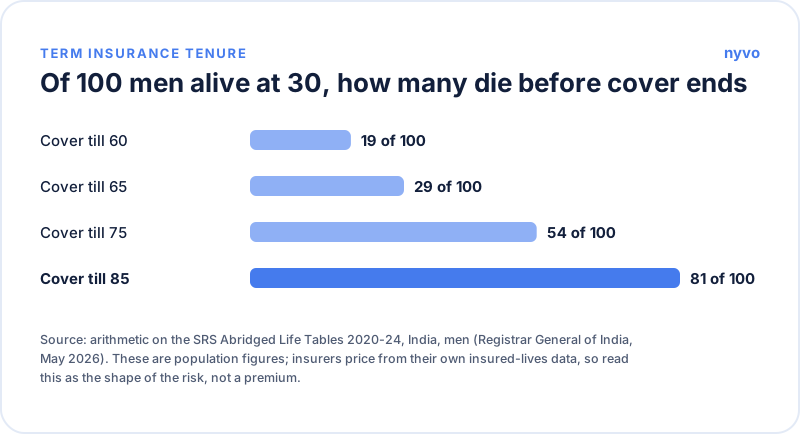
| Cover ends at | Men alive at 30 who die before then | Women alive at 30 who die before then |
|---|---|---|
| 60 | About 19 in 100 | About 12 in 100 |
| 65 | About 29 in 100 | About 19 in 100 |
| 75 | About 54 in 100 | About 42 in 100 |
| 85 | About 81 in 100 | About 72 in 100 |
Arithmetic on the SRS Abridged Life Tables 2020-24 (Office of the Registrar General & Census Commissioner, India, published May 2026): for each sex, the share dying before each age is 100 × (1 − number alive at that age ÷ number alive at 30). These are figures for India's whole population. Insurers price from their own experience of the people they insure, who are screened for health, so read the table as the shape of the risk rather than an insurer's number.
The same tables put the expectation of life at 60 at 18.6 more years: 17.5 for men and 19.8 for women. Someone who reaches 60 lives, on average, to 78.6, so a cover to 85 runs past that average age.
What the longer cover is good for:
- A dependant who will never be independent, such as a child with a disability or a spouse with no income of their own.
- A loan or a liability that runs late, such as a home loan taken in your forties.
- Leaving a fixed sum to your family if you die before the cover ends, if you value that above investing the difference yourself. A cover to 85 pays nothing for a death after 85.
If none of those applies, the extra years mostly replace income you will no longer be earning. That is the case for ending cover at 60 to 65 and putting the premium you save towards your retirement savings.
On price. A longer cover costs more every year, and on regular pay you also pay for more years. nyvo's premium data is for cover till 60 only, so we do not publish a figure for cover to 65, 75 or 85. Insurers' own brochures show the direction: Kotak e-Term's sample premiums for the same ₹1 crore rise at every entry age as the policy term lengthens from 25 to 40 years. Ask for both quotes on the plan you want and compare them yourself.
How far can term cover run on each plan?
Of the 31 term plans in nyvo's policy database that we checked against each insurer's brochure in October 2026, 24 let cover run to at least 85 on their standard option, and 12 offer 99, 100 or whole-of-life cover on some option. Our term plan comparison shows each plan's longest cover side by side. The five plans nyvo rates all go to at least 85; the longer options usually come with limited pay or narrower entry ages. Check the limit on the exact variant and payment option you are quoted, because the ceiling changes with both.
| Plan | Standard cover runs to | Longer option |
|---|---|---|
| HDFC Life Click 2 Protect Supreme Plus | 85 | None in the brochure; a renewability option at maturity can extend the term |
| Axis Max Life Smart Term Plan Plus | 85 | 100 on Whole Life Cover, entry up to 50 |
| ICICI Pru iProtect Smart Plus | 85 | 99, whole life on the Life variant |
| Bajaj Life eTouch II | 85 | 99 on Life Shield and Life Shield Plus, limited pay only |
| Tata AIA Sampoorna Raksha Promise | 100 | – |
Source: each plan's current brochure or prospectus, read October 2026. Some plans stop earlier: LIC's Digi-Term and Yuva Term end cover at 75 and LIC's New Tech-Term and New Jeevan Amar at 80 (LIC's sales brochures), and ABSLI Salaried Term and Shriram Life Online Term Plan at 75. Our page on term insurance for parents aged 50 to 60 lists all 31 plans with their entry and cover-till ages.
Should I pay premiums after I retire?
You do not have to. If your cover must run past the age your salary stops, a "pay till 60" or limited-pay option lets you finish paying while you still earn, at a higher premium each year. The option closes at lower entry ages on some plans: pay till 60 closes at entry age 44 on Axis Max Life Smart Term Plan Plus and at 55 on Bajaj Life eTouch II (each plan's prospectus or brochure). Our page on limited pay vs regular pay works through when it pays off.
Can I extend my term cover later?
Sometimes, but plan for not being able to. A few plans carry a renewability option at maturity that extends the term at your age then: HDFC Life Click 2 Protect Supreme Plus offers one on regular pay under its Life and Life Plus options, and Tata AIA Maha Raksha Supreme Select allows it up to five times on regular pay, both subject to the insurer's underwriting policy (each plan's brochure). Otherwise, extending means buying a new policy, with fresh medicals and income proof at an older age, and most plans stop taking new buyers at 65. Our page on term insurance for parents aged 50 to 60 shows how the choice narrows with age.
Common mistakes
- Choosing the cover-till age by the lowest premium.
- Ending cover before the home loan ends.
- Ignoring late responsibilities: a late child, or parents who depend on you.
- Buying cover to 85 because the extra premium looks small, without asking what the money is for.
FAQs
Till what age should I take term insurance?
Until the later of two dates: when your youngest dependant no longer needs your income, and when your last loan is paid, plus a small buffer. For many salaried buyers that is 60 to 65. Go longer only if a dependant will always need support or a loan runs late.
Is term insurance till 85 worth it?
Only if you have a reason for cover that late, such as a dependant who will never be independent or a liability that runs into your seventies. On the SRS Abridged Life Tables 2020-24, about 81 in 100 men alive at 30 die before 85, so the cover is far more likely to pay out and is priced higher every year.
What happens if I outlive my term insurance?
The policy ends and nothing is paid, unless you chose a return-of-premium variant, which costs more throughout and hands back the premiums you paid. A few plans let you extend the term at maturity through a renewability option.
Does a longer term mean a higher premium?
Yes. A longer cover costs more every year, and on regular pay you pay for more years. nyvo's premium data covers cover till 60 only, so ask for quotes at two cover-till ages on the same plan and compare them.
Can I extend term insurance tenure later?
Sometimes. HDFC Life Click 2 Protect Supreme Plus and Tata AIA Maha Raksha Supreme Select offer a renewability option at maturity, subject to underwriting. Otherwise you buy a new policy at your age then, with fresh medicals, and most plans stop taking new buyers at 65.
Should my term cover end when my home loan ends?
At the least, yes, plus a small buffer. If your children will still depend on you after the loan is paid, let the later of the two dates decide.
Is term insurance needed after retirement?
Usually less, if you have retirement savings and no one depends on your income. The exceptions are a dependant who will always need support and a loan that runs past retirement.
Related Guides
Sources:
- Office of the Registrar General & Census Commissioner, India: SRS Based Abridged Life Tables 2020-24, published May 2026 (India, total, male and female)
- Each plan's current brochure, prospectus or sales literature, read October 2026, including HDFC Life Click 2 Protect Supreme Plus (UIN 101N189V03), Axis Max Life Smart Term Plan Plus (104N132V01), ICICI Pru iProtect Smart Plus (105N205V07), Bajaj Life eTouch II (116N198V10), Tata AIA Sampoorna Raksha Promise (110N176V13), Tata AIA Maha Raksha Supreme Select (110N171V15), Kotak e-Term (107N129V04) and LIC's Digi-Term, Yuva Term, New Tech-Term and New Jeevan Amar
Disclaimer: Educational content only. Choose tenure based on your family's dependency timeline.
Our editorial principles
- Salaried advisors, not commission-linked: we focus on clarity and suitability, not product hype.
- No spam: we don't sell your data; we keep advice simple and actionable.
- Claims-first: policy features are evaluated by how they behave during claims.
- Education-first: this content is for informational purposes only.
Cover-till age at a glance
| The rule | The later of: your youngest dependant becomes independent, or your last loan is paid, plus a small buffer |
|---|---|
| How far plans go | 24 of the 31 term plans we checked run cover to at least 85; 12 offer 99, 100 or whole of life on some option (each plan's brochure, October 2026) |
| Men alive at 30 who die before 60 | About 19 in 100 (arithmetic on SRS Abridged Life Tables 2020-24, Registrar General of India, May 2026) |
| Men alive at 30 who die before 85 | About 81 in 100 (arithmetic on SRS Abridged Life Tables 2020-24, Registrar General of India, May 2026) |
| Life expectancy at 60 | 18.6 more years: 17.5 for men, 19.8 for women (SRS Abridged Life Tables 2020-24, May 2026) |
| Premium for a longer cover | Higher every year; nyvo's premium data covers cover till 60 only (May 2026), so this page quotes no figure beyond it |
| Extending later | A renewability option at maturity on HDFC Life Click 2 Protect Supreme Plus and Tata AIA Maha Raksha Supreme Select (brochures, read October 2026); otherwise a new policy at your age then |
Life-table figures are for India's population, not insured lives; insurers price from their own data, so read them as the shape of the risk.
Book a call for advice on the best policy for you and your family
A salaried, IRDAI-certified nyvo advisor will look at your cover, flag the gaps that matter, and tell you plainly what to fix. No commission, no pressure.
A first in India
Buy policy from nyvo insurance with Claim Support Guarantee, otherwise money back.

Alumni of IIT Delhi and IIM Ahmedabad. Former consultant at BCG and part of the strategy team of slice. Founder of nyvo and IRDAI Certified Insurance Advisor.