First in India
Claim Support Guarantee, otherwise your money back.
Buy through nyvo and we get your claim passed, otherwise refund your premium. We are putting our money on our claim service.
How to Talk to Your Parents About Health Insurance
Most Indian adult children avoid the parents-and-insurance conversation because it feels morbid, presumptuous, or financially intrusive. Here's how to actually have it – three opening lines that work, the four pieces of information you genuinely need, and what to do when your parents say no.

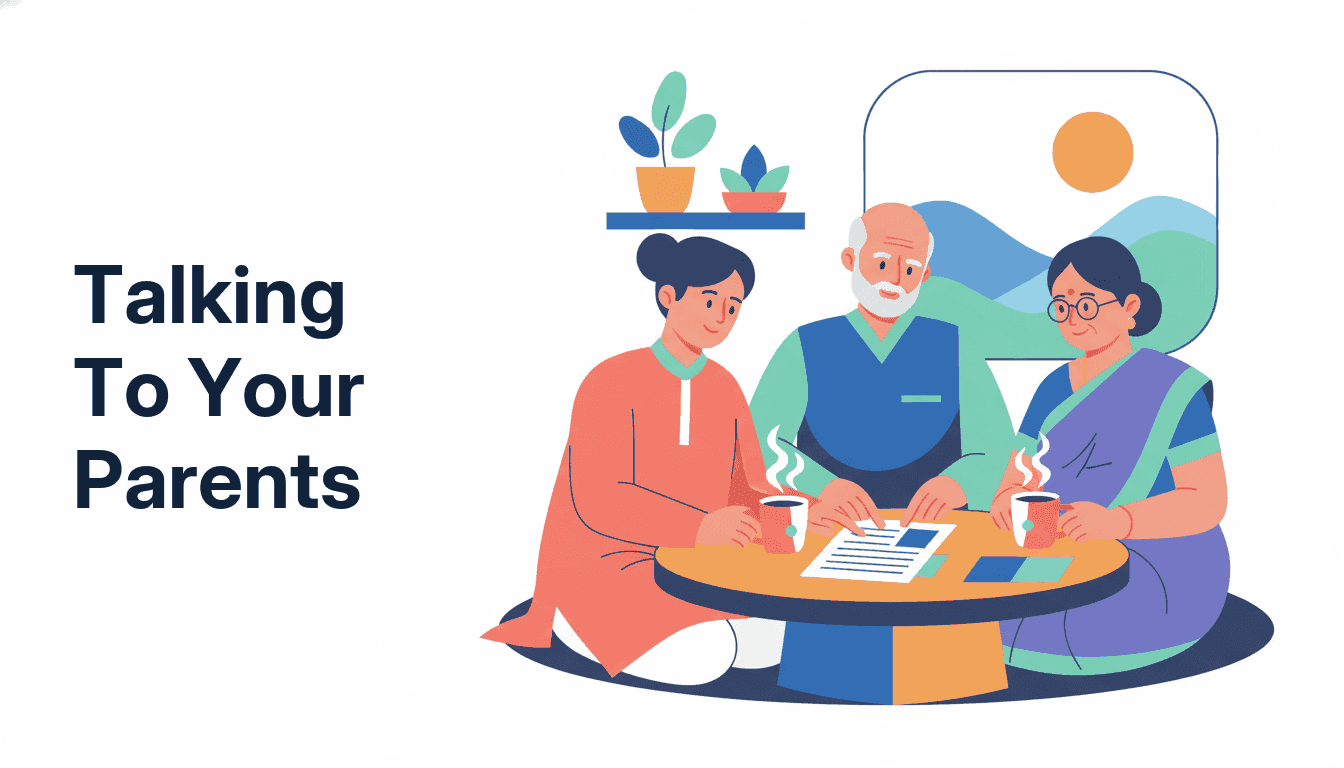
In 2022 my elder brother moved abroad. Within a month, my parents lost their corporate health insurance. Both were in their early 60s, in reasonably good health, and now suddenly uninsured for the first time in 30 years. I called my mother the same evening to talk about getting them a fresh policy.
She changed the subject within forty seconds.
I tried again a week later. Within a minute she'd routed the call to my father and disappeared. My father was only marginally better. "We're fine, beta, don't worry. We have savings." This is a man who watched his own mother's hospital bills wipe out a decade of his savings in 1998. He knew exactly why insurance mattered. And yet here we were, dancing around it.
If you've tried to have this conversation with your parents and gotten anywhere similar, this article is for you. After two years of helping Indian families through some version of this exact moment, I can tell you the conversation isn't impossible. It just needs to start somewhere other than where you think.
Why the conversation feels so hard
The parents-and-insurance conversation is uniquely awkward in Indian families because it sits at the intersection of three taboos at once:
Money. In most Indian households, parents don't openly discuss their financial situation with their children, even adult children with their own incomes and families. Asking "how much do you have saved?" feels like prying.
Mortality. Insurance is, in the abstract, a planning tool for what happens when bad things happen. Parents in their 60s and 70s often hear "let's plan for what happens when you fall sick or die" even when you say something gentler. Hindu and most Indian cultural framings around longevity make this conversation feel actively inauspicious.
Authority. For the first three or four decades of your life, your parents made the financial decisions. Now you're walking in offering to advise on theirs. That role inversion is uncomfortable for everyone – them and you.
The mistake most adult children make is leading with the third taboo (taking authority) on top of the first two (money + mortality). The conversation starts with "Mom, Dad, we need to talk about your health insurance" and ends with everyone retreating.
The path through is to lead with the one taboo that actually opens up – and back into the rest gently.
How to convince Indian parents to buy health insurance: three opening lines that actually work
You don't need a Powerpoint deck. You need a single sentence that doesn't trigger the defenses. Three that consistently work in my experience:
1. "I just bought our family's health insurance. Want me to tell you what I learned?"
This works because it inverts the authority problem. You're not lecturing them. You're sharing what you learned doing your own homework. Most parents are curious about what their children are figuring out, especially when it's competent adult life decisions.
You then naturally drift into "by the way, your corporate cover is going to end at retirement, right? What's the plan after?" without it feeling like an ambush.
2. "My friend's father got hospitalised last week and his cashless got denied. I want to make sure that doesn't happen to us."
Anchor in someone else's story. Indian families talk about other people's misfortunes far more easily than they talk about hypothetical futures of their own. When you say "this happened to a friend's family," you've sidestepped the inauspicious framing – the bad thing already happened, just to someone else, and you're learning from it.
The follow-up: "Can I ask whose name your existing policy is in? I just want to make sure all the basics are sorted." Most parents will answer this factually because it's a logistics question, not a planning question.
3. "I want to give myself peace of mind. Will you help me with one thing?"
Frame the request as your need, not theirs. Parents who would refuse to talk about themselves will move mountains for their children. "I sleep better at night when I know your insurance is sorted. Can we just check what you currently have so I can stop worrying?"
This is the line I eventually used with my parents. It worked because it was true.
The four things you actually need to know
Once the conversation is open, you don't need to interrogate them. You need exactly four pieces of information. Get these and you can build a plan. Don't get these and you're flying blind.
1. Do they currently have any health insurance, and what type?
Possibilities to ask about:
- A personal individual policy bought decades ago
- A family floater that included them as members
- A corporate group health insurance from their job (active or retired)
- A government scheme (PSU pensioner cover, ESI, state senior scheme)
- A Mediclaim policy from a specific bank where they have an account
Sometimes parents have one they've forgotten about. Sometimes they have three overlapping ones. Sometimes they have none and assume they have one.
2. What chronic conditions has each parent been diagnosed with?
This is the most sensitive question. The right framing: "For when we eventually need to make a claim, the policy needs to know about everything. So while we're here, can you list out any condition the doctor has ever told you about?"
Common ones to specifically prompt for: hypertension, diabetes, thyroid, cholesterol, mild cardiac issues. Indian parents often dismiss "borderline diabetes" or "controlled BP" as not real conditions. They are, for insurance purposes.
3. How much do they have set aside for medical emergencies?
Don't ask "how much do you have saved." Ask the targeted version: "If something needed ₹5 lakh tomorrow, where would it come from?"
The answer determines whether they can self-insure (very few can, fully), whether they'd liquidate investments (problematic if locked in), or whether they'd need to borrow (worst case). It also tells you how big a sum insured to plan for.
4. Who would they call first in a medical emergency?
Sounds soft. It's not. The answer tells you:
- Whether they know your phone number is the first one to dial
- Whether they have a family doctor on speed-dial
- Whether they'd default to a specific hospital
- Whether they'd panic-call a relative who isn't equipped to help
A 4-line "in case of emergency" cheat sheet stuck on the fridge solves problems you don't realise exist until 2am at the hospital.
What to do when your parents refuse
The honest reality: roughly a third of Indian parents in their 60s and 70s will refuse the conversation entirely, at least the first two times. The reasons sound rational from inside their heads:
- "Premiums are too expensive at our age."
- "We won't fall sick – we eat well, we exercise."
- "If something happens, you children will manage."
- "It's bad luck to talk about this."
- "We don't trust insurance companies."
You don't argue these point by point. Arguing converts a soft no into a hard no. Three pragmatic moves:
1. Solve a smaller problem first
If the big "buy you a fresh ₹15 lakh policy" conversation is dead, propose a smaller scope. "Can I at least make sure we have your existing policy details, your hospital preferences, and your doctor's contact in one place?" That's not a buying decision. That's a logistics question. They'll usually agree.
Once you're holding the file, the next conversation is much easier. "By the way, I was looking at this with the team – your existing cover ends at age 70. Want me to look at options for after that?" The conversation has moved from abstract to concrete, and they're already in it.
2. Make it about your own peace of mind, not theirs
Parents will refuse on their own behalf. Few will refuse to do something for their child's peace of mind. "I'm not asking for you. I'm asking for me. I will be the one running around the hospital if something happens. Will you help me have what I need?"
This is manipulative-sounding when written down. In conversation, with the right tone, it's just true.
3. Wait for the right trigger event
Sometimes the conversation can't happen until a trigger event makes it real. A friend's parent gets hospitalised. An uncle has a cardiac scare. A neighbour's claim gets denied. These moments crack open the conversation without you having to push. When they happen, don't waste them. "Sad about Dadi's hospitalisation. Got me thinking – what's our family's plan?" Sad-but-grounded, not opportunistic.
The hardest version of this: when the trigger event happens to your own parent. By then, half your options are off the table – the new diagnosis becomes a pre-existing condition, the waiting period clock just started, and the insurance you wished you'd bought 5 years ago would now have already been mature. The point of having the conversation early is to keep the options open while you have them.
What we ended up doing in my family
In my case, the breakthrough came from line #3 above. My peace of mind, not theirs.
My mother eventually pulled out a 2002 LIC mediclaim policy. ₹2 lakh sum insured. She'd been paying ₹4,800 a year for 22 years. She thought it was sufficient.
It wasn't. ₹2 lakh in 1998 medical inflation was substantial. ₹2 lakh in 2022 covered 30% of a single hospital admission for cardiac evaluation. And the policy had no co-payment in 2002 – when it was reissued in 2018, a 30% co-payment clause had been silently introduced. They had not noticed.
We added a fresh ₹10 lakh base health insurance plan + a ₹15 lakh super top-up. Annual premium went up by about ₹85,000. My father's first reaction was "that's a lot" and within a week his second reaction was "but I can sleep better." That second reaction was the one that mattered.
Three years later, my mother had a knee replacement. Cashless went through smoothly. The total bill was ₹4.7 lakh. The new plan covered ₹4.5 lakh. The 2002 policy would have covered ₹1.4 lakh (after the room rent cap and co-pay deductions on what was technically a ₹2 lakh sum insured). The difference is real money. Enough to fund three years of premiums on the new plan with cash to spare.
But more than that, the conversation we had three years earlier – awkward, deflecting, two hung-up phone calls in – was the thing that made the surgery itself feel managed instead of catastrophic. My mother went into surgery knowing she was covered. My father slept the night before. I didn't have to make a single phone call begging a hospital for an extension on payment.
That's what good insurance buys. It buys the calm of the conversation, not just the math of the cover.
How nyvo can help
If you've read this far and you're wondering whether to have the conversation this weekend, the answer is yes. If you're stuck on how to evaluate the actual policy options once your parents are open to it – which insurer, which sum insured, which structure – nyvo offers a free 30-minute consultation specifically for Indian families thinking about parents' health insurance.
The advisor will:
- Help you map your parents' current cover (or lack of) against what they actually need at their age and medical history
- Walk you through a base + super top-up structure if it fits, or a single comprehensive policy if it fits better
- Identify which insurers underwrite their medical profile favourably
- Coordinate the medical tests + paperwork once you're ready to apply
- Offer free claims support after the policy is issued, regardless of which insurer you go with
It's a 30-minute call. There's no fee, no obligation, and no spam afterward. We've helped 1,500+ Indian families through some version of exactly this moment. Book a slot at any time.
Frequently Asked Questions
How do I convince my parents to buy health insurance in India?
Don't lead with the buying decision. Start with logistics – "I just want to know what coverage we currently have" – and let the gaps reveal themselves. Frame the request as your own peace of mind rather than their need. Solve smaller problems first (organising existing policy details, listing chronic conditions, agreeing on a primary hospital) before tackling the bigger purchase. Roughly a third of Indian parents in their 60s and 70s refuse the first two attempts at this conversation; persistence, not argument, is what works.
What information should I get from my parents about their existing health insurance?
Four things: (1) Do they currently have any health insurance, and what type – personal policy, family floater, corporate retiree group cover, government scheme, bank Mediclaim. (2) What chronic conditions has each parent been diagnosed with – including dismissed-as-minor things like borderline diabetes, controlled BP, or thyroid. (3) How much they've set aside specifically for medical emergencies and where it would come from in a ₹5 lakh emergency tomorrow. (4) Who they would call first in a medical emergency – the answer reveals whether their emergency-readiness has gaps you can fix without buying a new policy.
My parents already have a health insurance policy from 20 years ago. Is that sufficient?
Probably not. Older policies (1990s-early 2000s vintage) typically have low sum insured (₹1-2 lakh) that hasn't kept up with medical inflation, sub-limits on specific procedures (cataract, knee replacement), room rent caps that trigger proportional deductions, and sometimes silent introductions of co-payment clauses at later renewals. ₹2 lakh in 1998 was substantial coverage; ₹2 lakh in 2026 covers a fraction of one major admission. Pull out the original policy schedule, check the current sum insured against typical hospitalisation costs in your city, and assess whether it's still adequate.
What if my parents are too old to buy fresh health insurance?
Per the IRDAI Master Circular 2024, insurers cannot refuse fresh enrollment based on age – even at 70, 75, or 80, your parents are eligible. Premiums are higher, the underwriting includes mandatory medical tests, and waiting periods apply for pre-existing conditions, but coverage is available. See our dedicated guide on Health Insurance After 70 for the realistic plan options, premium ranges, and the structure (base + super top-up) that typically works best at this age.
How do I bring up health insurance without sounding like I'm planning my parent's death?
Don't open with the insurance topic at all. Open with what you've recently figured out about your own family's coverage, or with someone else's hospitalisation story (not your parent's), or with your own peace-of-mind framing. The conversation needs to start somewhere that doesn't trigger the mortality defense; you can drift into specifics once it's already in motion. Three opening lines that work: "I just bought our family's policy, want me to tell you what I learned?", "My friend's father got hospitalised last week and his cashless got denied – I want to make sure that doesn't happen to us", and "I sleep better when I know your insurance is sorted, will you help me?"
What chronic conditions are most important to disclose when buying parents' health insurance?
All of them, even the ones your parents dismiss. Specifically prompt for hypertension, diabetes, thyroid, cholesterol issues, mild cardiac history, kidney function, joint issues, vision problems requiring surgery, and any past hospitalisations – Indian parents commonly say "no chronic conditions" while taking daily BP and diabetes medication. Non-disclosure is the number-one reason claims get rejected. The insurer will almost certainly find out during the claim review (medical records, prescription history, hospital records). Honest disclosure either gets you accepted with a premium loading or specific exclusions; non-disclosure gets your claim rejected at the worst possible moment.
Should I buy a separate plan for my parents or add them to my family floater?
Generally, a separate dedicated senior plan for parents plus the existing family floater for the rest of the family works better than combining everyone on one floater. The senior parents' claims would otherwise deplete the floater for the whole family. The premium math also typically favours separation – the family floater premium increases sharply when a senior is added because the oldest member sets the risk band. nyvo's free consultation runs both calculations side-by-side for your specific family situation; the right answer depends on the parents' age, medical history, and your existing floater structure.
What if my parents refuse to have the insurance conversation entirely?
Wait for the right trigger event – a friend's parent's hospitalisation, an uncle's cardiac scare, a neighbour's denied claim. These moments crack open the conversation organically. In the meantime, do what you can without their participation: gather what you can about their existing cover (look in old emails, ask aunties if you have to), build a "what we know" file that you can reference when the moment opens up. The hardest version of this is when the trigger event happens to your own parent – by then, the new diagnosis becomes a pre-existing condition with a 36-month waiting period, and your buying options narrow significantly. The point of having the conversation early is keeping options open while you still have them.
Related guides:
Sources:
- IRDAI Master Circular on Health Insurance Business, Reference No. IRDAI/HLT/CIR/MISC/77/05/2024, 29 May 2024
- IRDAI published data (a weighted average of the last three financial years, latest available as of March 2026, from IRDAI's published data) – irdai.gov.in
- nyvo advisory experience across 1,500+ Indian families (2024-2026)
Book a call for advice on the best policy for you and your family
A salaried, IRDAI-certified nyvo advisor will look at your cover, flag the gaps that matter, and tell you plainly what to fix. No commission, no pressure.
A first in India
Buy policy from nyvo insurance with Claim Support Guarantee, otherwise money back.

Alumni of IIT Delhi and IIM Ahmedabad. Former consultant at BCG and part of the strategy team of slice. Founder of nyvo and IRDAI Certified Insurance Advisor.