First in India
Claim Support Guarantee, otherwise your money back.
Buy through nyvo and we get your claim passed, otherwise refund your premium. We are putting our money on our claim service.
Corporate vs Personal Health Insurance India
Corporate vs personal health insurance: why corporate cover alone isn't enough and how to build complete family protection.

Written by Kshitij JainUpdated nyvo insurance Services LLP, IRDAI Corporate Agent (Composite) CA1085Salaried advisors, no commission-based ranking
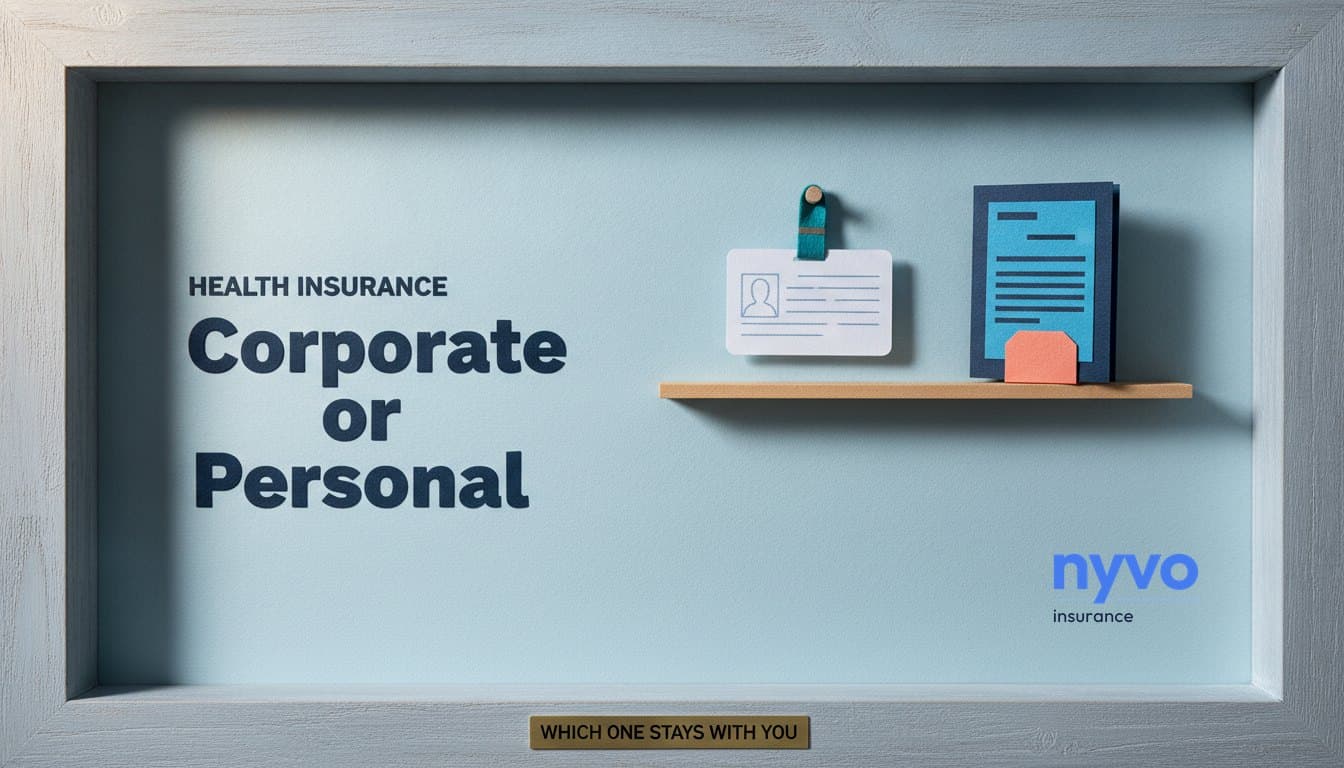
Corporate health insurance is a great perk but not a complete solution. It typically has sub-limits, ends when you leave your job, doesn't cover parents, and can't be ported to your next employer. Personal health insurance gives you lifelong coverage, portability, and control. Smart approach: use corporate insurance as a bonus layer on top of your own personal policy.
Quick checklist
- Reality: Corporate cover ends when employment ends – often when you need it most.
- Gap: Most corporate policies have sub-limits, room rent caps, and exclude parents.
- Smart move: Own a personal policy as your base; treat corporate as supplementary.
- Timing: Buy personal insurance young – premiums only increase with age.
Side-by-side comparison
| Aspect | Corporate Insurance | Personal Insurance |
|---|---|---|
| Who pays premium | Employer | You |
| Portability | Ends with job | Lifetime, fully portable |
| Customize coverage | No | Yes |
| Pre-existing diseases | Usually covered from Day 1 | Waiting period (up to 3 years) |
| Sum insured choice | Employer decides | You choose |
| Parents coverage | Often not included | You can include |
| Waiting periods | Minimal or none | Standard 30 days + PED waiting |
| Room rent limits | Common | Can choose no-limit plans |
| Sub-limits | Common | Varies by plan |
| No Claim Bonus | Usually no | Yes, increases coverage |
| Maternity | Sometimes included | Separate or rider |
| Control over renewal | None | Full control |
The hidden risks of relying only on corporate insurance
1. Employment risk
| Scenario | What happens |
|---|---|
| Job change | Coverage ends; new job may have different/no cover |
| Layoff/resignation | Immediate loss of coverage |
| Retirement | No coverage when health risks are highest |
| Career break | Uninsured during break |
| Company closure | Insurance stops |
Reality: Average corporate tenure is 2-3 years. Insurance gaps create major risk.
2. Coverage limitations
| Corporate Policy Limitation | Impact |
|---|---|
| ₹3-5 lakh sum insured | One hospitalization exhausts it |
| Room rent cap (₹3,000/day) | Proportionate cut across the bill, except medicines, implants and tests |
| Co-pay 10-20% | You pay portion of every claim |
| Maternity sub-limits | Actual costs often higher |
| Disease-wise caps | Major illness coverage insufficient |
| No restoration | One large claim ends coverage for year |
The optimal strategy: Personal + Corporate
Layer your protection
- Layer 1: Personal Base Policy (₹10-15 lakh)
- Your permanent, portable foundation.
- Layer 2: Corporate Insurance (₹5-10 lakh)
- Use for routine claims, PED coverage.
- Layer 3: Super Top-up (₹50 lakh, ₹10L deductible)
- Triggers after base exhausted. Catastrophic coverage.
Sample cost structure
| Component | Coverage | Annual Premium |
|---|---|---|
| Personal base (family) | ₹15 lakh | ₹20,000-30,000 |
| Corporate (employer-paid) | ₹5 lakh | ₹0 (employer pays) |
| Super top-up | ₹50 lakh | ₹5,000-10,000 |
| Total coverage | ₹70 lakh | ₹25,000-40,000 |
FAQs
Can I port my corporate health insurance to personal when I leave?
No. Corporate group insurance cannot be ported to individual policy. You need to buy a separate personal policy. This is why having your own policy is essential.
Should I claim on corporate or personal insurance?
Generally, claim on corporate first to preserve your personal policy's No Claim Bonus. However, if corporate has high co-pay or sub-limits, personal may be better for specific claims.
Does corporate insurance cover pre-existing diseases?
Usually yes, from Day 1. This is a major advantage. Use corporate for PED claims while your personal policy completes its waiting period.
My corporate insurance covers ₹10 lakh. Is that enough?
For routine hospitalizations, possibly. For critical illness, surgeries, or ICU stay – probably not. Consider adding a super top-up for catastrophic coverage.
What happens to my corporate insurance if I'm on notice period?
Coverage typically continues till your last working day. Some companies extend till month-end. Confirm with HR and ensure personal coverage is active.
Can I buy top-up insurance on my corporate policy?
Some insurers offer top-up/super top-up plans that trigger after your corporate base exhausts. This is a cost-effective way to increase coverage.
Is corporate insurance premium taxable?
Premium paid by employer for group health insurance is generally not taxable as perquisite up to certain limits. However, you don't get the Section 80D deduction (section 126 from tax year 2026-27) since you didn't pay.
My spouse also has corporate insurance. Should we still buy personal?
Yes. Both corporate policies will end when either of you changes jobs. Personal policy ensures continuous, lifelong coverage for the family.
How do I file a claim if I have both corporate and personal insurance?
Choose which policy to claim from based on coverage terms. You cannot claim the same expense from both (no double recovery). If corporate doesn't cover full amount, you can claim balance from personal.
At what age should I buy personal health insurance?
As early as possible. Ideally in your 20s. Premiums are lowest, underwriting is easier, and waiting periods complete while you're still young and healthy.
Disclaimer: Corporate insurance terms vary significantly by employer and insurer. Always verify your specific policy details with HR and read the policy document.
Related Guides
Our editorial principles
- Salaried advisors, not commission-linked: we focus on clarity and suitability, not product hype.
- No spam: we don't sell your data; we keep advice simple and actionable.
- Claims-first: policy features are evaluated by how they behave during claims.
- Education-first: this content is for informational purposes only.
Book a call for advice on the best policy for you and your family
A salaried, IRDAI-certified nyvo advisor will look at your cover, flag the gaps that matter, and tell you plainly what to fix. No commission, no pressure.
A first in India
Buy policy from nyvo insurance with Claim Support Guarantee, otherwise money back.

Alumni of IIT Delhi and IIM Ahmedabad. Former consultant at BCG and part of the strategy team of slice. Founder of nyvo and IRDAI Certified Insurance Advisor.