First in India
Claim Support Guarantee, otherwise your money back.
Buy through nyvo and we get your claim passed, otherwise refund your premium. We are putting our money on our claim service.
Bima Sugam: India's UPI Moment for Insurance, and the Three Things That Will Decide If It Works
Bima Sugam is IRDAI's unified insurance marketplace – what NPCI did for UPI and digital payments, Bima Sugam aims to do for Indian insurance. This guide explains the macro opportunity, the three real challenges (commoditisation, claims, advisory gap), and what it means for Indian families.

Bima Sugam in One Paragraph
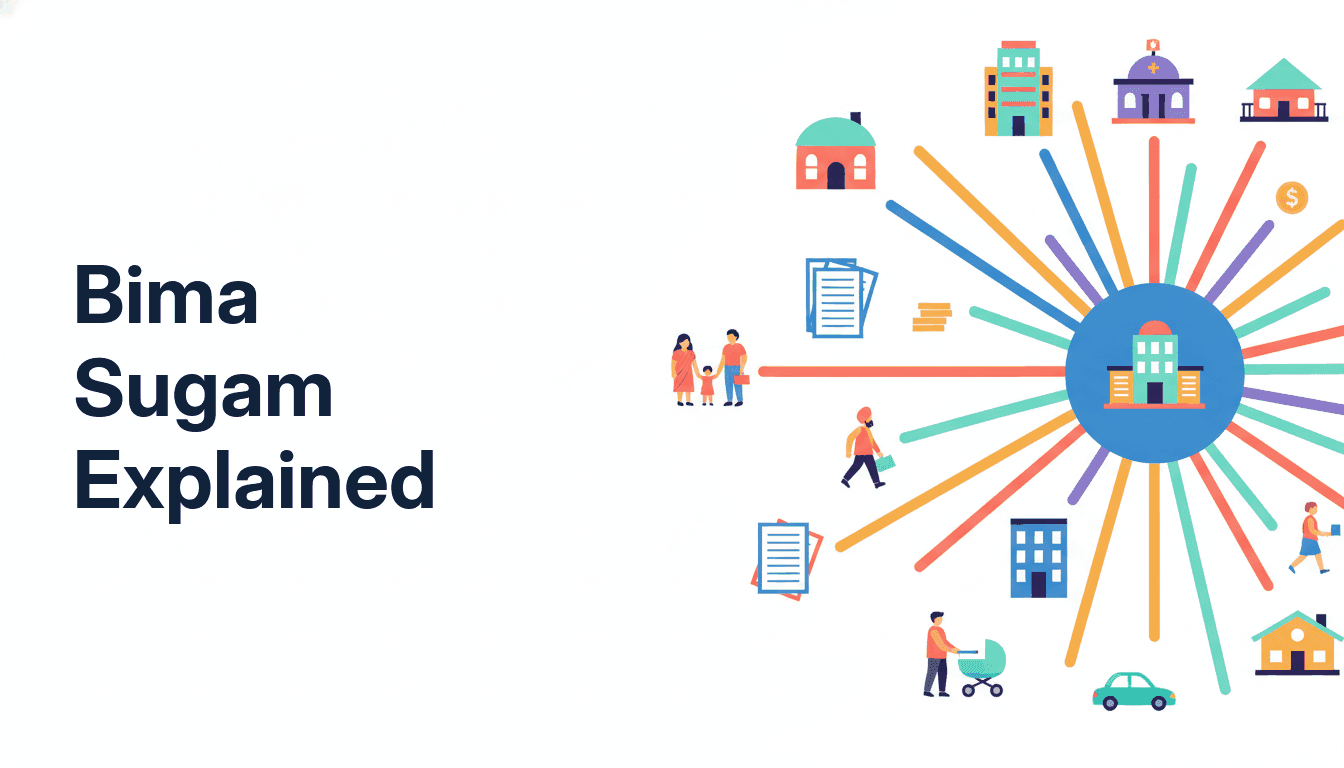
Bima Sugam is IRDAI's attempt to do for Indian insurance what NPCI did for digital payments. A single regulator-backed platform where every IRDAI-licensed insurer plugs in, products are standardised across the industry, and buying or claiming insurance becomes a few-tap experience instead of a fragmented one. Done well, it could compress 30 years of insurance penetration progress into a much shorter window – the same way UPI took India from cash-and-cheque to real-time digital payments in less than a decade. Whether Bima Sugam delivers that outcome depends on three specific things: how the platform handles the commoditisation paradox when products start looking identical, whether it puts claims and operations at the centre rather than just discovery, and who explains insurance to families when the agent layer thins out. This article walks through each.
The UPI Parallel: Why Bima Sugam Could Be a Decade-Compressing Moment
Before UPI, sending money in India meant choosing between cheques (slow, branch-dependent), NEFT/RTGS (working hours, ₹5-20 fee, batched), card payments (high merchant fees), or cash (everything else). Each bank had its own app. Each transaction was its own friction.
NPCI built a regulator-backed common rail. Banks plugged in. Suddenly any UPI app could send money to any UPI app, instantly, free, 24×7. The user experience collapsed across banks. Volume scaled from millions to billions of monthly transactions. India leap-frogged a decade of card-payment infrastructure that the West had built over 30 years.
Bima Sugam is the same architectural bet, applied to insurance. Today, buying or servicing insurance in India means dealing with each insurer's own portal, its own app, its own helpline, its own document formats, its own claim-form templates. Even comparing two health insurance plans means visiting two websites, downloading two policy wordings, and reading both end-to-end. The friction is the bottleneck.
If Bima Sugam works, every IRDAI-licensed insurer plugs into a regulator-curated common platform. Products use standardised formats. Claims, portability, grievances all flow through one rail. The user experience collapses across insurers the way payments collapsed across banks. Insurance penetration in India – currently around 4% of GDP, materially below global benchmarks – could see a structural lift.
That's the macro story, and it's the right one. The execution risk lies in three specific places.
The Three Things That Will Decide If Bima Sugam Works
Challenge 1: The Commoditisation Paradox – When Every Product Looks the Same
A common platform with standardised products solves one problem and creates another. The problem it solves is the impossibility of comparing today – every insurer uses different definitions, different sub-limit structures, different exclusion language. Standardisation fixes this. The problem it creates is what happens when every health insurance plan looks roughly the same to a customer.
Imagine a Bima Sugam interface in 2027 showing eight health insurance plans for a 35-year-old in Mumbai. Each plan is from a different IRDAI-licensed insurer. Each has standardised definitions, similar sum insured tiers, similar room rent terms, similar pre-existing-disease waiting periods (now uniformly capped at 36 months under the IRDAI Master Circular 2024), similar Cashless Everywhere processes. Premiums are within ±15% of each other.
Which one does the customer pick? When products commoditise, the differentiator that remains is claim experience and brand trust. But those don't show up in a standardised comparison grid the way features do. The customer is left with eight near-identical options and no obvious way to choose between them. Choice paralysis replaces choice scarcity. Many will pick on premium alone – which is exactly the wrong factor to optimise for, because the lowest premium often correlates with the strictest claim posture.
This is genuinely solvable. Bima Sugam could surface claim-experience metrics – Claim Settlement Ratio, complaints ratio, average pre-authorisation time, dispute resolution outcomes – alongside the product comparison. If it does, the platform actively educates the buyer. If it doesn't, it accidentally makes the choice harder by removing the surface-level differentiation insurers used to compete on.
Challenge 2: Claims and Operations – The Actual Pain in Indian Insurance
Distribution isn't the bottleneck in Indian insurance. Claims and operations are.
Ask any Indian family what frustrates them about their insurance. The answers aren't "I couldn't find a place to buy it" or "I couldn't compare options." With aggregators, agents, employer plans, bank branches, mobile apps, and direct-to-consumer websites, Indian buyers have more distribution surface than they know what to do with. The frustrations are downstream:
- Pre-authorisation denied at the hospital counter at 2am
- Claim repudiated 30 days after admission citing a clause nobody explained at the time of buying
- Reimbursement claim stuck in "under review" for 60 days
- Network hospital list mysteriously shrinks at renewal
- TPA (Third Party Administrator) gives different answers than the insurer
- Sub-limits and proportional deductions silently strip 30-40% of what the family expected to be paid
- Discharge held up because cashless approval is delayed into the next day
These are claims and operational failures, not discovery or distribution failures. A standardised front-end doesn't fix a fragmented back-end. For Bima Sugam to genuinely move the industry forward, it needs to absorb claims into its scope – not just provide a unified claim filing form, but build infrastructure that meaningfully changes claim outcomes.
That looks like:
- Uniform claim-decision SLAs with regulatory teeth – the IRDAI Master Circular 2024 sets timelines (1 hour for planned pre-auth, 30 days for reimbursement decisions); Bima Sugam can mandate breach reporting on the platform itself
- A public claim-decision audit trail – anonymised dashboards showing why claims were paid, partially settled, or rejected, by category. Forces consistency.
- Centralised TPA governance – so the same TPA does not behave differently for different insurers
- Standardised policy-wording interpretation – the same exclusion clause means the same thing across the industry, not subject to per-insurer reading
- Real-time grievance integration with the Insurance Ombudsman – escalations don't require leaving the platform
If Bima Sugam evolves to include claims and operations as first-class features, it becomes genuinely transformative. If it stays as a discovery and purchase platform with claim filing tacked on, it improves the buying experience but leaves the claims pain – which is the experience that determines whether Indian families trust insurance enough to buy more of it – largely untouched.
Challenge 3: The Advisory Gap – Who Explains Insurance to Customers Now?
Today, when an Indian family buys health insurance, an agent usually sits with them – often imperfect, sometimes commission-driven, but at least someone who explains room rent capping, sub-limits, what a co-payment clause does, what the difference is between cashless and reimbursement. The advice is uneven, but advice exists.
In a Bima Sugam world, where the customer buys directly through a unified portal, who plays the explanation role?
Three possibilities, none yet fully answered:
Bima Vahak – IRDAI's village-level distribution network of trained insurance agents – addresses this for rural households at the grass-roots level. But Bima Vahak is targeted at first-time buyers in low-penetration markets, not at urban families navigating a ₹25 lakh super top-up decision.
Insurer-side advisory – the marketplace could surface AI-driven plan recommendations or chat-based advisors. The honest assessment: rule-based recommenders are good at filters; they're not good at explaining "why a base + super top-up structure typically beats a single ₹25 lakh policy" or "what to actually look for in your policy schedule." That's still a human conversation today.
Independent advisors and corporate agents – IRDAI-licensed advisory firms remain in the picture. The platform doesn't replace advice; it just changes the consumer surface. Advice continues to matter, but its delivery channel changes.
The real risk is the middle: a customer who feels confident enough to buy directly because the platform looks easy, but who doesn't know enough to ask whether the plan they picked actually fits their family. They buy a plan, hit a sub-limit at claim time, and discover the gap they didn't know existed.
Bima Sugam moves the industry forward most cleanly when it acknowledges that buying insurance is not the same as solving insurance – and integrates a path to advice for buyers who want it, rather than treating advice as something to disintermediate.
The Bima Trinity: How Bima Sugam Fits With Bima Vistaar and Bima Vahak
Bima Sugam isn't a standalone initiative. IRDAI announced three connected pieces – collectively the Bima Trinity – designed to work together to expand insurance penetration in India.
| Initiative | What it is | Role in the trinity |
|---|---|---|
| Bima Sugam | Unified digital insurance marketplace | The platform – every insurer plugs in here |
| Bima Vistaar | Composite insurance product (life + health + property + personal-accident bundle, targeted at ₹1,500-₹3,000 annual premium for low-income families) | The mass-market product – designed to be affordable enough to onboard the bottom 60% of Indian households who currently have zero formal cover |
| Bima Vahak | Community-based women-led distribution network at the Gram Panchayat level | The distribution muscle – gets Bima Sugam and Bima Vistaar to rural households without internet access |
The three pieces compose into a single mission. Sugam is the rail. Vistaar is the affordable mass-market product. Vahak is the distribution at the last mile. What NPCI was to UPI – the rail without the products – Bima Sugam is to insurance, with IRDAI also designing the entry-level product (Vistaar) and the rural distribution layer (Vahak) on top.
This integrated approach is more ambitious than NPCI's UPI effort, which focused only on the rail. The trade-off is execution complexity – three coordinated initiatives have more failure surface than one.
What's Already Live: Bima Bharosa
The first practical piece of the Bima Trinity that Indian families can use today is Bima Bharosa, the integrated grievance redressal portal at bimabharosa.irdai.gov.in. Any policyholder can file an insurance grievance from a single portal that routes the complaint to the right insurer plus IRDAI for tracking. It replaces the older IGMS portal and accepts complaints destined for the Insurance Ombudsman.
This is the foundational layer. Standardised policy formats, claim form templates, Aadhaar-based KYC integration, and the regulatory framework for insurer onboarding into Bima Sugam are also live or in late-stage finalisation. Practically, this means the back-end for the unified marketplace is being built; the consumer-facing front-end will land progressively.
What This Means For Indian Families Today
Don't wait for Bima Sugam to buy insurance. Insurance pricing is age-based – every year you wait increases the premium for the same cover. Health insurance waiting periods only start counting once a policy is in force. The structural reforms that already shipped – the IRDAI Master Circular 2024 (PED cap at 36 months, age cap removed, free-look extended to 30 days) and Cashless Everywhere (cashless treatment at any registered hospital) – are immediately useful. Bima Sugam will improve the buying experience over time; the cost of waiting outweighs the platform-experience gain.
Use Bima Bharosa for grievances today. If you're stuck on a claim dispute or service issue, bimabharosa.irdai.gov.in is already the right escalation portal.
Keep advice in the picture. Even if Bima Sugam makes buying simpler, the choice of plan, the structure (base + super top-up, family floater vs individual, term cover sizing for single-income households), and the navigation of claims when they happen all still benefit from genuinely independent advisory. The marketplace simplifies discovery; it doesn't replace strategy.
Bima Sugam As a Macro Bet On Indian Insurance
If Bima Sugam ships on its full ambition – claims integrated, advisory layer addressed, commoditisation paradox solved through visible claim-experience metrics – Indian insurance penetration could see a step-change the way UPI delivered for digital payments. That outcome would be significant: India's insurance penetration of around 4% of GDP could converge towards developed-market benchmarks of 8-12%. Tens of millions more Indian families covered. Trillions of rupees of additional annual premium volume. Better claim experience because regulator-mandated transparency makes underperformance visible.
The bet is the right one. Whether the execution lands the full vision is a question for the next 24-36 months. The pieces to watch: does claims governance get folded into Bima Sugam's scope; how is advisory addressed for non-trivial buying decisions; does the standardisation of products surface claim-experience metrics that prevent commoditisation from collapsing into premium-only competition.
For Indian families today, the practical answer is the same: build the right insurance now using the rules that just got better, work with an advisor who will be in the picture before, during, and after a claim, and watch Bima Sugam's evolution because the long arc is genuinely favourable.
Frequently Asked Questions
What is Bima Sugam in simple terms?
Bima Sugam is IRDAI's unified digital insurance marketplace – a single regulator-backed platform where every IRDAI-licensed insurer plugs in. Indian consumers will be able to buy insurance, manage existing policies, file claims, port between insurers, and raise grievances from one portal. The architectural ambition is comparable to what NPCI did with UPI for digital payments: a common rail that collapses the user experience across providers and unlocks a step-change in adoption.
How is Bima Sugam similar to NPCI and UPI?
Both are regulator-backed common platforms designed to standardise a fragmented industry. Before UPI, sending money in India meant choosing between cheques, NEFT/RTGS, card payments, or cash, with each bank running its own apps and processes. NPCI built a unified rail; banks plugged in; UPI scaled from millions to billions of monthly transactions. Bima Sugam is the same architectural bet for insurance – every insurer plugs into a regulator-curated platform, products use standardised formats, and the user experience collapses across providers. The execution challenge for Bima Sugam is greater because IRDAI is also designing the entry-level product (Bima Vistaar) and the rural distribution layer (Bima Vahak) alongside the marketplace itself.
What are the biggest challenges Bima Sugam needs to solve?
Three specific challenges will decide whether Bima Sugam delivers on its potential. First, the commoditisation paradox: when every standardised product looks identical, customers face choice paralysis and may default to choosing on premium alone, which often correlates with the strictest claim posture. Second, claims and operations: the actual pain in Indian insurance is downstream of distribution – pre-authorisation denials, claim repudiations, TPA fragmentation, sub-limit deductions – and a standardised front-end doesn't fix a fragmented back-end. Third, the advisory gap: when the agent layer thins out, the question of who explains insurance to customers buying directly through a portal needs a clear answer, since rule-based recommenders are good at filters but poor at explaining structural decisions.
Will Bima Sugam replace insurance agents and advisors?
Probably not, but it will change the role. Bima Vahak – the rural distribution network within the Bima Trinity – addresses the explanation role for first-time buyers in low-penetration markets. For urban families navigating non-trivial decisions like ₹25 lakh super top-up structures or single-earner term insurance sizing, independent advisory is likely to remain valuable. The marketplace simplifies discovery; the choice of plan, family-specific structure, and navigation of claims when they happen still benefit from genuinely independent advice. nyvo's view is that advice continues to matter; only its delivery channel changes.
What is the Bima Trinity?
The Bima Trinity is IRDAI's three connected initiatives announced in 2023, designed to work together to expand insurance penetration in India: Bima Sugam (the unified digital marketplace), Bima Vistaar (an affordable composite insurance product bundling life, health, property, and personal-accident cover for low-income households at ₹1,500-₹3,000 per family per year), and Bima Vahak (a community-based women-led distribution network at the Gram Panchayat level). The three pieces compose into a single "Insurance for All by 2047" mission.
Is Bima Bharosa the same as Bima Sugam?
No. Bima Bharosa, available at bimabharosa.irdai.gov.in, is the integrated grievance redressal portal where Indian consumers can file insurance complaints from a single portal that routes them to the relevant insurer plus IRDAI for tracking. It is one foundational component of the larger Bima Sugam vision – but is not itself the full marketplace. Bima Sugam, when fully built, will encompass policy purchase, management, claims, portability, and grievance through a single consumer journey, not just complaint filing.
Should I wait for Bima Sugam to buy health insurance or term insurance?
No. Insurance pricing is age-based – every year you wait increases the premium for the same coverage, especially for term insurance and senior health insurance. Health insurance waiting periods only start counting once a policy is in force, so delaying delays the maturation of waiting period credits. The structural reforms that already shipped, the IRDAI Master Circular 2024 and Cashless Everywhere mandate, are immediately useful. Bima Sugam may offer a simpler experience when fully launched, but the cost of waiting outweighs the platform-experience gain. Buy what you need now; switch via portability if Bima Sugam later offers a better deal.
Will Bima Sugam reduce insurance premiums in India?
Modestly, not dramatically. The marketplace removes some distribution costs (agent commissions for direct online buyers) but the underlying actuarial pricing – premium based on age, medical risk, sum insured – does not change because of the platform. Realistic expectation: 5-15% better pricing on direct buys at most. The bigger structural win is not lower premium but better claim experience if Bima Sugam includes claims governance in its scope. For families currently uninsured because individual policies cost ₹15,000-₹30,000 annually, Bima Vistaar's targeted ₹1,500-₹3,000 composite cover for the bottom 60% of Indian households is the bigger affordability story.
Related guides:
Sources:
- IRDAI Roadmap "Insurance for All by 2047" – irdai.gov.in
- Bima Bharosa Integrated Grievance Portal – bimabharosa.irdai.gov.in
- IRDAI published data (a weighted average of the last three financial years, latest available as of March 2026, from IRDAI's published data) – irdai.gov.in
- IRDAI Master Circular on Health Insurance Business, Reference No. IRDAI/HLT/CIR/PRO/84/5/2024, 29 May 2024
- National Payments Corporation of India (NPCI) – UPI parallel reference, npci.org.in
Book a call for advice on the best policy for you and your family
A salaried, IRDAI-certified nyvo advisor will look at your cover, flag the gaps that matter, and tell you plainly what to fix. No commission, no pressure.
A first in India
Buy policy from nyvo insurance with Claim Support Guarantee, otherwise money back.

16+ years in financial services. Former investment banker at Bank of America, Kotak Investment Banking, and SBICaps, and ex-CFO of slice. Founder of nyvo and Principal Officer – IRDAI Certified.