First in India
Claim Support Guarantee, otherwise your money back.
Buy through nyvo and we get your claim passed, otherwise refund your premium. We are putting our money on our claim service.
Cashless Everywhere: Complete 2026 Guide (Insurer-by-Insurer)
IRDAI's Cashless Everywhere mandate (Jan 2024) lets you claim cashless treatment at any hospital, not just network. This guide explains how to use it, the timelines insurers must honour, what to do if non-network cashless is delayed, and a per-insurer reference for the top 12 health insurers in India.

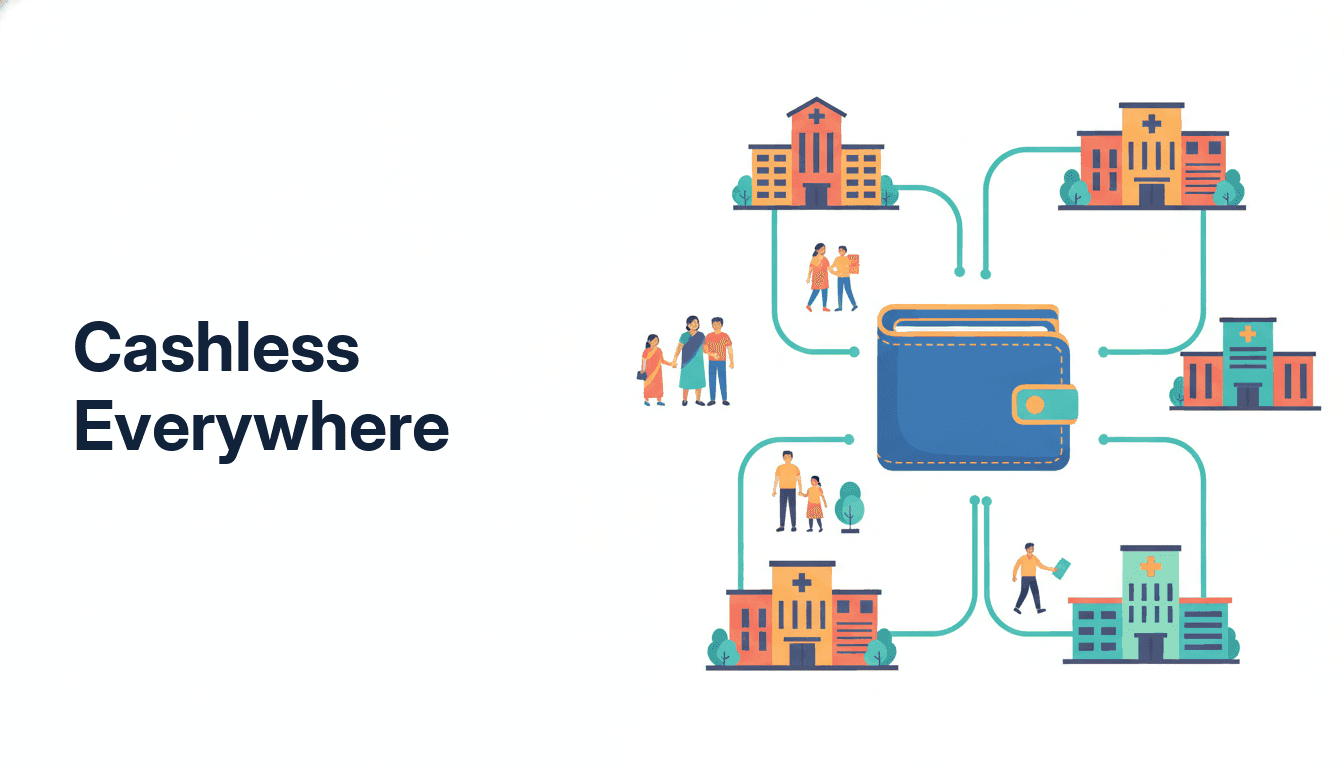
What Cashless Everywhere Means For You
Until 2024, "cashless treatment" was a privilege of network hospitals – those on your insurer's empanelled list. If you walked into a non-network hospital, you paid the bill upfront and claimed reimbursement later. On 23 January 2024, IRDAI changed this with the Cashless Everywhere mandate: every health insurer must now process cashless claims at any registered hospital in India, not just the ones on its network.
The practical consequences: you can choose the hospital based on medical fit, not network availability. The timelines insurers must honour are tight – 1 hour for planned pre-authorisation, 3 hours for emergencies, and final cashless approval at discharge within 3 hours of receiving the discharge summary. In practice, network hospitals still process cashless faster because their systems are pre-integrated. Non-network hospitals work too, but the first claim takes longer because the insurer and hospital are coordinating tariff and documentation in real-time.
This guide covers the mandate's mechanics, the step-by-step at a non-network hospital, what to do if it's delayed, and a per-insurer reference for using Cashless Everywhere with the 12 most-used health insurers in India.
What Changed in January 2024
IRDAI Circular Ref. No. IRDAI/HLT/CIR/MISC/12/01/2024, dated 23 January 2024, made cashless treatment the default expected service at any hospital, regardless of whether it is on the insurer's empanelled network. Before this, cashless was only contractually available at empanelled hospitals; non-network admissions defaulted to reimbursement.
Three things the mandate establishes:
- Universal cashless availability: insurers must arrange cashless treatment at any hospital with valid registration under the Clinical Establishments (Registration and Regulation) Act, 2010
- Mandatory pre-auth response timelines that are now identical across network and non-network hospitals
- Public disclosure of the cashless workflow – every insurer must publish a Cashless Everywhere helpline and process on its website
The IRDAI Master Circular on Health Insurance (29 May 2024) reinforced this and tightened the timelines further. Read our Master Circular explainer for the full regulatory context.
How to Use Cashless Everywhere – Step by Step
The workflow at any hospital, network or non-network, is broadly the same. The differences are in speed and coordination:
Planned Hospitalisation (Surgery, Investigation Admissions)
Inform your insurer 48 hours before admission. Call the Cashless Everywhere helpline (each insurer's number is in the per-insurer table below). Share: policy number, expected admission date, hospital name and address, treating doctor, planned procedure with provisional ICD code.
Insurer issues a guarantee of payment to the hospital. The hospital insurance desk receives confirmation that cashless will be processed. The insurer simultaneously coordinates with the hospital to agree on the tariff if the hospital isn't on the regular network.
Pre-authorisation form on admission day. The hospital insurance desk submits the pre-auth request with: admission diagnosis, treatment plan, expected duration, expected total cost. Insurer responds within 1 hour with the approved cashless limit.
Treatment proceeds. The hospital draws against the approved cashless limit as the bill accumulates.
Final cashless authorisation at discharge. Hospital sends the discharge summary and final bill to the insurer. The insurer must approve within 3 hours. The hospital is paid directly; you only sign for non-covered items (e.g., extra food, registration fees).
Emergency Hospitalisation
Admission first, paperwork second. In an emergency, the hospital admits the patient based on clinical need; pre-authorisation paperwork starts immediately after.
Hospital insurance desk submits pre-auth. Within the first 24 hours, the hospital sends the request with: admission diagnosis, ER notes, treating doctor's plan.
Insurer responds within 3 hours. Either with the approved limit or with a request for additional documentation.
Treatment continues. Same as planned: insurer settles bill at discharge after final cashless authorisation.
Documents to Carry to the Hospital
For both planned and emergency admissions:
- Photo ID (Aadhaar / PAN)
- Health insurance e-card (downloadable from insurer's app or website)
- Policy number written down on a slip in case the e-card app fails
- Any previous medical records relevant to the admission
- A copy of the policy schedule (1-2 pages, prints from the insurer's email when policy was issued)
If the hospital insurance desk asks for a "cashless deposit", politely refuse and ask them to call the insurer directly. Cashless does not require a deposit. (The hospital may ask for an admission deposit which is refundable post-discharge – that's separate and standard.)
When Cashless Everywhere Doesn't Work Smoothly
Three real-world situations where the workflow stalls:
1. First Cashless Claim with a Non-Network Hospital
The insurer and hospital may not have processed claims together before. Tariff negotiation can add 1-2 hours. The hospital insurance desk often pushes you toward "self-pay first, reimburse later" because it's easier for them.
What to do: Insist on cashless. Call the insurer's Cashless Everywhere helpline yourself (don't rely only on the hospital). Most non-network claims do go through within the IRDAI timelines if you push.
2. Hospital Says Cashless Is "Not Available"
This is a hospital-side issue, not a regulatory one. A hospital can choose to operate as cash-only – but it cannot refuse to coordinate with your insurer for a Cashless Everywhere request.
What to do: Ask the hospital to put the refusal in writing. Quote the IRDAI 23 January 2024 circular. If they still refuse, switch to reimbursement track – pay the deposit and submit the claim post-discharge. The policy is still valid for reimbursement.
3. Pre-auth Denied at the Counter
Often a documentation gap, not a policy issue. See our detailed Cashless Pre-Auth Denied Playbook – the 60-minute action plan covers exactly what to do.
Per-Insurer Reference (Top 12 Health Insurers)
This is a factual reference of how each major Indian health insurer publishes its Cashless Everywhere process. Helpline numbers and process notes are taken from each insurer's official website as of May 2026. Verify the latest numbers on the insurer's site before relying on them.
HDFC ERGO General Insurance
HDFC ERGO has integrated Cashless Everywhere through its existing Cashless Claim Settlement portal and dedicated 24/7 helpline. The insurer maintains one of the largest cashless networks in India (16,000+ hospitals) and the Cashless Everywhere extension applies to non-network hospitals across all states.
How to initiate:
- Helpline: 022-6234-6234
- Email: healthclaims@hdfcergo.com
- Mobile app: HDFC ERGO Health app → "Cashless Request"
- Online portal: hdfcergo.com → Health → Claims → Cashless Pre-authorization
Notable strengths: Large network depth in Tier-1 and Tier-2 cities means most admissions are at network hospitals where cashless is fastest. Cashless Everywhere process is documented clearly on the website.
Aditya Birla Health Insurance
Aditya Birla Health Insurance ("Activ" suite of plans) uses the Activ Health app and Cashless Everywhere helpline for non-network admissions. The process is integrated with the rest of the Aditya Birla customer service stack.
How to initiate:
- Helpline: 1800-270-7000
- Mobile app: Activ Health by ABHI
- Online portal: adityabirlacapital.com → Health Insurance → Cashless
Notable strengths: Strong digital-first claim workflow. The Activ Health app supports cashless requests with document uploads.
Niva Bupa Health Insurance
Niva Bupa publishes a dedicated Cashless Everywhere FAQ on its website and offers parallel helpline + app workflows. The "Niva Bupa Health" app supports the full pre-auth and discharge process.
How to initiate:
- Helpline: 1860-500-8888
- Email: customercare@nivabupa.com
- Mobile app: Niva Bupa Health
- WhatsApp: +91 80470-99099
Notable strengths: Dedicated WhatsApp channel for claim queries. Useful when you can't call from a hospital.
Care Health Insurance
Care Health Insurance runs Cashless Everywhere through its centralised claims helpline and "Care Health Insurance" app. The insurer publishes its 24/7 cashless desk numbers on the policy schedule directly.
How to initiate:
- Helpline: 1800-102-4488
- Mobile app: Care Health Insurance
- Online portal: careinsurance.com → Claims → Cashless Hospitalisation
Notable strengths: 24/7 dedicated cashless desk that responds reliably during night admissions.
Star Health and Allied Insurance
Star Health is one of the oldest standalone health insurers in India and has a dedicated cashless infrastructure. Cashless Everywhere is processed via the Star Health helpline and "Star Health and Allied Insurance" mobile app.
How to initiate:
- Helpline: 1800-425-2255
- Email: support@starhealth.in
- Mobile app: Star Health
- WhatsApp: +91 95-9-1-6-9-9-2-2-2
ICICI Lombard
ICICI Lombard's "IL Take Care" app supports Cashless Everywhere requests including document uploads. The insurer has a strong cashless workflow integrated with most major hospital chains.
How to initiate:
- Helpline: 1800-2666
- Mobile app: IL Take Care
Tata AIG General Insurance
Tata AIG's Cashless Everywhere desk is integrated with the Tata Neu superapp and dedicated helpline. The insurer publishes its hospital-side Cashless Everywhere instructions on its website.
How to initiate:
- Helpline: 1800-266-7780
- Email: customersupport@tataaig.com
- Mobile app: Tata Neu / Tata AIG Health
Bajaj General Insurance
Bajaj General uses a dedicated Health Claim Assistance number for Cashless Everywhere admissions. The "Bajaj General" mobile app supports the workflow.
How to initiate:
- Helpline: 1800-209-5858
- Email: bagichelp@bajajallianz.co.in
- Mobile app: Bajaj General Insurance
IndusInd General Insurance
IndusInd General routes Cashless Everywhere through its 24/7 health claim helpline. The "IndusInd General Insurance" app supports document upload for pre-auth requests.
How to initiate:
- Helpline: 022-4890-3009 / 1800-3009
- Mobile app: IndusInd General Insurance
Manipal Cigna Health Insurance
Manipal–Cigna runs a 24/7 cashless helpline integrated with its claim management partner. The "Manipal Cigna Health Insurance" app supports the full workflow.
How to initiate:
- Helpline: 1800-102-4462
- Mobile app: Manipal Cigna Health
SBI General Insurance
SBI General Insurance handles Cashless Everywhere through its centralised health claims desk and partner hospitals. The "SBI General" app supports cashless requests.
How to initiate:
- Helpline: 1800-102-1111
- Email: customer.care@sbigeneral.in
- Mobile app: SBI General
Digit Insurance
Digit Insurance ("Go Digit") supports Cashless Everywhere through its app-first workflow. The "Digit Insurance" app handles policy management, pre-auth, and post-claim follow-up.
How to initiate:
- Helpline: 1800-258-5956
- Email: hello@godigit.com
- Mobile app: Digit Insurance
What If My Insurer Refuses Cashless Everywhere?
The mandate is regulatory; refusal is a violation. The escalation path:
- Demand the refusal in writing – email or letterhead from the insurer stating the specific reason for refusing cashless at the chosen hospital
- File a grievance with the insurer's grievance cell – they must acknowledge within 3 working days and resolve within 15
- Escalate to IRDAI's grievance portal – bimabharosa.irdai.gov.in
- File with the Insurance Ombudsman if the insurer's response is unsatisfactory – see our Ombudsman walkthrough for the full process
In practice, most "refusals" turn into resolutions once the IRDAI mandate is quoted formally.
Frequently Asked Questions
Is Cashless Everywhere available at all hospitals in India?
The mandate covers any hospital that is registered under the Clinical Establishments (Registration and Regulation) Act, 2010 or the equivalent state-level registration. In practice, this is virtually every hospital with 15+ beds. Standalone clinics, day-care centres without 24-hour observation, and unregistered facilities may not qualify. If unsure, ask the hospital for its registration status before admission.
How fast must my insurer respond to a Cashless Everywhere pre-authorisation request?
Per the IRDAI Master Circular 2024, insurers must decide on planned pre-authorisation within 1 hour and emergency pre-authorisation within 3 hours. Final cashless authorisation at discharge must be issued within 3 hours of receiving the discharge summary and final bill. Breach of these timelines without a valid reason can be escalated to the insurer's grievance cell and then to the Insurance Ombudsman.
Do I need to inform the insurer before going to a non-network hospital?
For planned hospitalisations, yes – give 48 hours notice via the Cashless Everywhere helpline so the insurer can coordinate with the hospital and confirm the tariff. For emergencies, no – admission can happen first and the hospital initiates pre-authorisation within 24 hours.
Will my Cashless Everywhere claim be slower at a non-network hospital?
Often, yes – the first claim at a hospital where the insurer has not previously processed claims can take 1-3 hours longer because the insurer and hospital are coordinating tariff and documentation in real-time. Subsequent claims at the same hospital typically run faster as the relationship is established. Network hospitals remain the fastest because their systems are pre-integrated with insurers.
Can the hospital ask me to pay a cash deposit if I'm using Cashless Everywhere?
The hospital can ask for an admission deposit (typically ₹25,000-₹1,00,000) which is refundable when the cashless claim is fully approved. This is standard hospital practice and not a violation of the mandate. What the hospital cannot do is refuse to process the cashless request or insist on full payment upfront despite a valid cashless approval from the insurer.
What documents do I need for Cashless Everywhere at a non-network hospital?
The same as for network hospitals: photo ID, health insurance e-card, policy schedule (printed copy), previous medical records relevant to the admission, and any pre-admission test reports the hospital requires. The treating doctor's notes and ICD-10 admission diagnosis are added by the hospital insurance desk during the pre-auth submission.
What happens if the insurer agreed to Cashless Everywhere but later denies the claim?
Cashless approval at admission is a "guarantee of payment" subject to final claim review at discharge. In rare cases, the insurer may reduce the final settlement (for non-covered items) or, very rarely, deny the claim post-discharge if non-disclosure or fraud is established. If you receive an unjust post-discharge denial, follow the pre-auth denied playbook escalation steps.
Is Cashless Everywhere available for senior citizen plans and senior-specific policies?
Yes. The IRDAI mandate applies to all health insurance policies sold in India, including senior citizen plans, irrespective of the policyholder's age. Cashless treatment timelines and process are the same.
Related guides:
Sources:
- IRDAI Cashless Everywhere Circular Ref. No. IRDAI/HLT/CIR/MISC/12/01/2024, 23 January 2024
- IRDAI Master Circular on Health Insurance Business, Reference No. IRDAI/HLT/CIR/MISC/77/05/2024, 29 May 2024
- Clinical Establishments (Registration and Regulation) Act, 2010 – clinicalestablishments.gov.in
- Council for Insurance Ombudsmen – cioins.co.in
- Insurer official websites (helpline numbers and process notes verified May 2026)
Book a call for advice on the best policy for you and your family
A salaried, IRDAI-certified nyvo advisor will look at your cover, flag the gaps that matter, and tell you plainly what to fix. No commission, no pressure.
A first in India
Buy policy from nyvo insurance with Claim Support Guarantee, otherwise money back.

16+ years in financial services. Former investment banker at Bank of America, Kotak Investment Banking, and SBICaps, and ex-CFO of slice. Founder of nyvo and Principal Officer - IRDAI Certified.