Parent Admitted to Hospital: First 24 Hours Playbook
Your parent has just been admitted to hospital. The next 24 hours decide whether the cashless claim goes through smoothly or your family ends up paying lakhs out of pocket. Here's a hour-by-hour action plan – what to do, who to call, what to bring, and the mistakes that cost families money.

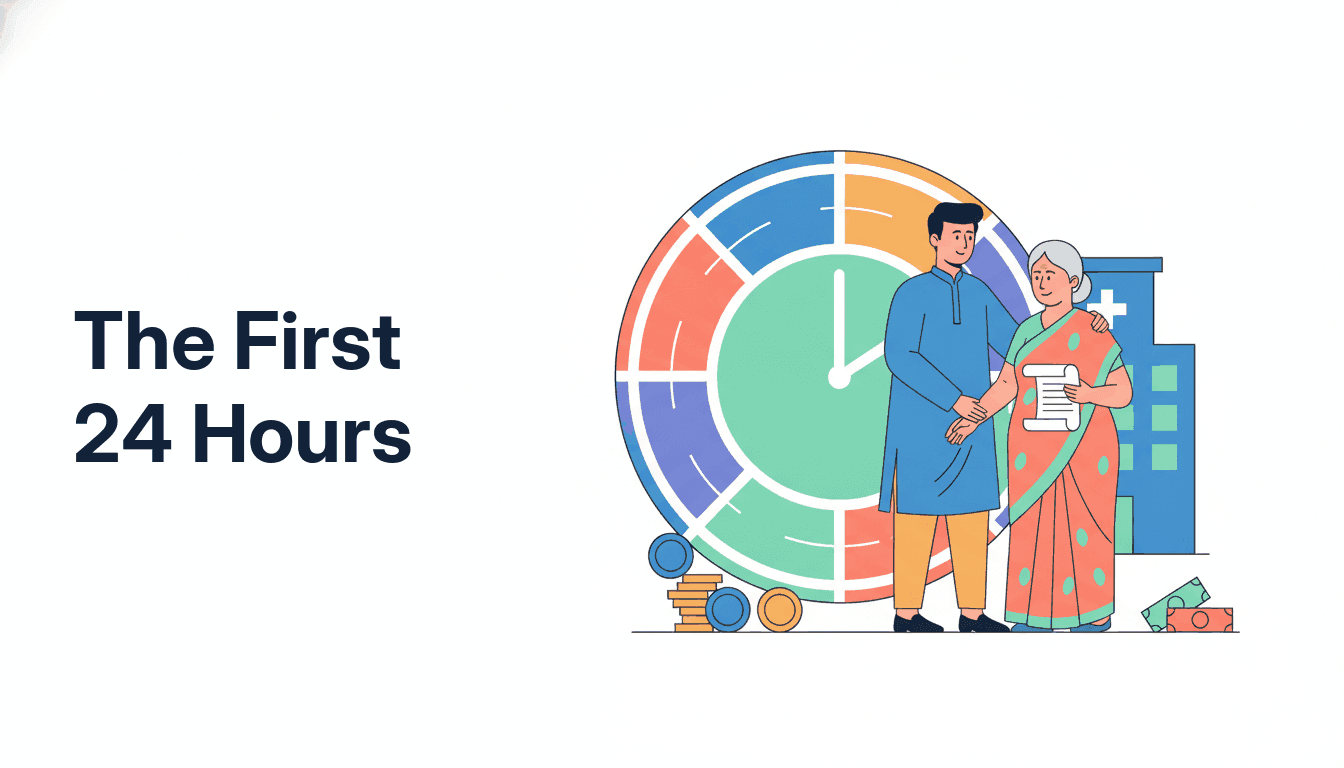
The phone call comes at 11:14 pm. Dad's been admitted to the emergency room. The cardiologist suspects a mild MI. Your mother is at the hospital, her voice composed in the way Indian mothers compose themselves at exactly this kind of moment. You're 800 km away on a work trip. Your sister is on a flight that lands at 6 am.
What you do in the next 24 hours decides whether his cashless claim goes through smoothly, whether the family pays lakhs out of pocket, whether the right specialists see him on day one, and whether you spend the next month chasing paperwork or focused on his recovery.
This is the playbook. Hour by hour. The order matters.
I've worked through some version of this with dozens of Indian families over the last three years. The patterns are consistent. The mistakes that cost families money are consistent too. If you're reading this in advance of the call, save it. If you're reading this because the call has already happened, scroll to whichever hour you're in.
What to do when a parent is admitted to hospital – the first 24 hours, in order
This is the searchable summary if you've landed here in a hurry: in the first 24 hours of a parent's hospital admission in India, your priority order should be (1) get them medically stable with the right specialist, (2) confirm cashless pre-authorisation with their insurer, (3) gather all documents the hospital will need, (4) brief whoever in the family is taking medical lead, (5) start a documentation trail of every conversation, and (6) decide on the discharge-time bill audit approach. Detailed step-by-step below, in roughly chronological order from the moment you get the call.
Hour 0–1: When the call happens
If you're not at the hospital, the first decision is whether to travel. The instinct is to drop everything. Sometimes that's right. Sometimes it isn't.
Stay where you are if:
- Another competent adult family member is already at the hospital
- The condition has been stabilised based on initial assessment
- You can be more useful coordinating from outside than adding one more anxious person to a small ER waiting area
Travel immediately if:
- The condition is unstable or under active investigation
- Critical decisions about treatment are imminent (surgery, ICU admission, transfer to another hospital)
- The family member at the hospital is overwhelmed and needs handover
For most cardiac admissions, mild strokes, accident admissions, and major medical events, the first 4-8 hours are about stabilisation. The competent family member already there is dealing with that. You add more value by managing the things they can't manage from inside the ER – the insurance, the documentation, the broader family communication.
While the parent is being stabilised, do these in parallel:
Get the policy number of every health insurance policy your parent holds. There may be more than one. Common locations: their insurance company's mobile app, an old email from the policy issuance, the policy schedule print out, the family folder. If you don't know, call the insurance company's helpline with your parent's PAN or Aadhaar – they can locate the policy.
Locate the e-card for the policy. Either downloadable from the insurer's app or a PDF in their email. Take a screenshot.
Make a single-page summary for the family member at the hospital: insurer name, policy number, sum insured, helpline number, e-card image, your phone number, your sister's phone number, a list of every chronic condition your parent has (write this from memory if you're far away – better imperfect than absent).
Send this to the family member at the hospital. WhatsApp, email, both. You've just removed 80% of the chaos at the insurance desk. Most adult children skip this step and the family member at the hospital ends up calling you for each piece of information one by one while the cashless approval sits stalled.
Hour 1–3: Pre-authorisation and the insurance desk
Once the parent is admitted (formally, with bed allocated), the hospital insurance desk submits a pre-authorisation request to the insurer. This is where the cashless approval is decided.
What you can do remotely:
Call the insurer's 24/7 cashless helpline directly with the policy number and the parent's name. Confirm that the pre-authorisation request has been received. Most denials at this stage are because the request never reached the insurer or reached with missing documents. A direct policyholder call gets faster attention than a hospital insurance desk relay.
The questions to ask:
- "Has the pre-authorisation request from the hospital been received?"
- "What's the current status?"
- "Is any document or information missing that we should provide?"
- "What's the expected response time?"
Per IRDAI rules, the insurer must respond within 1 hour for planned and 3 hours for emergency pre-authorisations. If it's been longer, escalate.
What the family member at the hospital should do:
- Verify with the insurance desk that they have the e-card and policy number
- Disclose every chronic condition truthfully – non-disclosure now risks claim rejection later
- Confirm whether the hospital is on the network or they're using Cashless Everywhere (different documentation paths)
- Get a written or email copy of the pre-authorisation request that was submitted
If pre-auth is denied:
This is more common than families expect, especially for complex admissions. Most are reversible. Read our Cashless Pre-Auth Denied Playbook for the 60-minute action plan. Most denials at the counter dissolve once the underwriter sees additional documentation from the treating doctor.
Hour 3–6: Medical decision-making
By now the parent is stabilised, the diagnosis is becoming clearer, and decisions about treatment plan are being made. Two checkpoints:
Verify the treating consultant. Not all consultants on hospital panels are equally specialised for the condition. For cardiac, you want an interventional cardiologist if PCI/angioplasty is on the table. For neuro, a stroke-trained neurologist. For oncology, a sub-specialist matched to the cancer type. The hospital assigns based on availability. You can request a specific consultant if needed; this is most relevant for non-emergency admissions where the choice matters more.
Understand the proposed treatment plan. Have the family member at the hospital ask the treating doctor:
- What is the diagnosis (in plain English)?
- What treatment is being recommended?
- What are the alternatives, and why this one?
- What is the expected duration of admission?
- What's the expected total cost (rough estimate)?
- What's the risk of complications?
Many Indian families miss this step in the first 6 hours and find out 36 hours later that a more expensive procedure was performed than necessary. The doctor isn't being adversarial; they're moving fast based on the standard of care. Asking the questions early changes the conversation.
Hour 6–12: Information cascade
By the 6-hour mark, you have:
- Diagnosis and treatment plan
- Pre-authorisation status (approved, pending, or denied with re-submission path)
- Likely length of stay and cost range
- Treating consultant identified
Now you brief everyone who needs to know.
The family WhatsApp / call tree:
You don't want 17 phone calls coming in from various aunts and uncles asking for updates. Set up a single WhatsApp group or scheduled update window. Suggested:
- 8 am: morning update (post-rounds)
- 6 pm: evening update (post-rounds)
- Flash updates for major decisions only
The work front:
Email or message the family member at the hospital's employer (and your own) with a clear timeline. "My father is hospitalised. I'll be on reduced availability until [date]. Major decisions can reach me at [number]. Routine items will queue." Most workplaces are extraordinarily understanding when given clear information; they get unhelpful only when uncertain.
The day-to-day logistics:
Who's bringing food to the hospital tomorrow? Who's looking after younger children at home? Who's picking up your mother from the hospital tonight? Who's handling the medication refills for your other parent? These small things add up in week one.
Hour 12–24: Documentation discipline
This is the part most families get wrong. From hour 12 onward, start a single source of truth for every interaction with the hospital and the insurer. A Google Doc, a spreadsheet, a notebook – whatever, but in one place.
What goes in the documentation:
| Time | Event / Conversation | Who | What was decided | Reference number |
|---|---|---|---|---|
| Hour 0:00 | Admission | ER team | Mild MI suspected, cardiology evaluation | – |
| Hour 0:42 | Pre-auth submitted | Hosp insurance desk | ₹3 lakh requested for initial work-up | 87639121 |
| Hour 2:15 | Insurer response | Insurer helpline | ₹2.5 lakh approved, awaiting troponin results | 8742391-1 |
| Hour 4:30 | PCI recommended | Dr. Mehta | Single stent, est. ₹2 lakh additional | – |
This document is your insurance against confusion later. When the discharge bill is ₹4.7 lakh and the hospital says "the doctor authorised an extra investigation," you can check the log and say "no, that wasn't authorised – the conversation on Hour 18:42 was about an alternative non-invasive test."
It's also what you'll attach to any post-discharge dispute, ombudsman filing, or insurance claim escalation.
What to bring to the hospital (the family hospital bag)
For a planned admission, you have time to pack. For an emergency, the family member with you usually doesn't. Coordinate by phone:
Documents:
- Patient's photo ID (Aadhaar, PAN)
- Health insurance e-card or policy schedule
- Previous medical records relevant to the admission (last hospital discharge summary if any, cardiology / oncology / chronic-condition specialist notes)
- List of current medications with doses and times
Personal items (for a 3-7 day stay):
- 3-4 sets of comfortable clothes (front-button shirts make tests easier)
- Toiletries
- Phone charger + power bank
- Reading material or basic entertainment for between treatments
- Slippers, comfortable footwear
- A water bottle
- A pen (more important than it sounds – you'll be filling forms)
Cash and cards:
- ₹15,000-₹30,000 in liquid cash for hospital deposit (refundable post-discharge, or adjusted against the cashless co-payment)
- Both spouses' cards, in case ATM access is needed at odd hours
What to do at discharge
The discharge bill audit matters as much as the admission paperwork did. Indian hospital bills are routinely inflated 15-40% on phantom charges, double-billed consumables, marked-up drug prices, and excess room rent.
Before signing the final discharge bill:
- Demand the itemised bill (not the summary). It is your right under the Patient's Rights Charter. Hospitals will default to giving the summary; insist on itemised.
- Audit the line items – room rent days, doctor consultations, diagnostic tests, medications, consumables, procedure charges, hidden charges. See our detailed Hospital Bill Audit Guide.
- Negotiate before signing. Most billing managers have authority to adjust 5-15% of the bill at discretion.
- Don't pay anything you've identified as inflated until the hospital reduces it or justifies it in writing.
For most ₹3-10 lakh hospitalisations, a careful pre-discharge bill audit reduces the final amount by 10-20%.
What I learned from my own mother's surgery
In late 2023 my mother had a knee replacement. Planned admission, scheduled surgery. We had insurance in place, we had time to prepare. None of which prevented mistakes.
The mistakes I made, recorded so future-me does better:
I didn't write down the pre-authorisation reference number when I called the insurer. Three days later, when the hospital insurance desk was confused about a discharge approval delay, I had to call back, identify myself, re-trace the conversation. Wasted 90 minutes. The lesson: every call gets a reference number written down, immediately.
I assumed the standard implant brand was being used. It wasn't. The surgeon used a premium imported implant that cost ₹1.4 lakh more than the standard option. The hospital insurance desk billed accordingly. The insurer initially objected. The argument was resolved (the surgeon had documented the medical justification), but it took 11 days. Lesson: ask before, not after, for non-emergency admissions.
I didn't audit the discharge bill before signing. I assumed the cashless approval meant the bill was fine. It wasn't – the bill had ₹47,000 of inflated consumables and ₹22,000 of double-billed pharmacy charges. The insurer caught these in audit and deducted them from the cashless settlement. The deductions became my mother's out-of-pocket expense at discharge. Lesson: pre-emptive audit by you matters as much as the insurer's audit.
The surgery itself went well. Recovery was on schedule. None of the above changed the outcome of her treatment. But each represented money that should have stayed with my family rather than the hospital, and a few hours of my time at hour 12 instead of week 3 of the recovery.
The article you're reading is what I'd hand my younger self standing outside that hospital at midnight. It's not exhaustive. The medical decisions in any individual case are between your family and the treating doctor. But the operations layer – insurance, documentation, billing, family communication – has a recipe, and the recipe is worth the 30 minutes it takes to read it before the call comes.
How nyvo can help
If you're reading this because the call just came in, our claims team is available 24/7 for free advisory support – even if your parent's policy isn't with nyvo. The advisor will:
- Walk you through the cashless pre-authorisation flow with the specific insurer
- Coordinate directly with the insurer's helpline if pre-auth is delayed or denied
- Review the discharge bill and identify inflated line items before you sign
- Help draft any grievance letter if the cashless settlement is unfairly reduced
- Stay on standby through the post-discharge claim filing if reimbursement is needed
WhatsApp or call the nyvo claims line – the number is on the contact page. The service is genuinely free, no obligation, no spam afterward. We've helped 1,500+ Indian families through some version of exactly the call you just got.
Frequently Asked Questions
What should I do first when my parent is admitted to hospital in India?
Two parallel things in the first hour: (1) make sure a competent adult family member is physically at the hospital handling medical stabilisation, and (2) gather every health insurance policy your parent holds, the policy numbers, the e-cards, and the helpline numbers, and send a single-page summary to whoever is at the hospital. Most cashless approval delays in the first 3 hours happen because the insurance desk is missing basic information; pre-empting this saves time and stress when it matters most.
How long does cashless pre-authorisation take when a parent is admitted?
Per IRDAI Master Circular 2024 rules, the insurer must respond to a pre-authorisation request within 1 hour for planned admissions and 3 hours for emergency admissions. Network hospitals typically meet these timelines reliably; non-network hospitals using Cashless Everywhere may take 1-3 hours longer for the first claim. If it's been longer than the SLA without explanation, call the insurer's 24/7 cashless helpline directly to escalate.
What documents do I need at the hospital for my parent's cashless claim?
Patient's photo ID (Aadhaar or PAN), health insurance e-card (downloadable from the insurer's app or email), policy schedule print or PDF, previous hospital discharge summaries if any, list of current medications with doses, and any specialist notes for chronic conditions. The hospital insurance desk can typically retrieve missing documents from the insurer if the policy number is provided, but having physical or digital copies on you reduces approval time.
Should I travel to be at the hospital when my parent is admitted?
Travel immediately if the condition is unstable, critical treatment decisions are imminent, or the family member already at the hospital is overwhelmed. If a competent adult is already there and the condition has been stabilised, you may be more useful coordinating remotely – managing the insurance, documentation, family communication, and logistics – than adding to the people in the ER waiting area. The right call depends on the condition's severity and family capacity, not on what feels right emotionally.
What if the cashless pre-authorisation is denied at the hospital?
Most pre-authorisation denials at the counter are reversible. They happen because of incomplete documentation, diagnosis-treatment mismatch on paper, or a policy waiting period being misinterpreted. Get the denial in writing, call the insurer's 24/7 helpline directly (don't rely only on the hospital insurance desk), ask whether the claim can be re-submitted with additional documentation, and coordinate with the treating doctor to provide any missing notes. Detailed step-by-step in our Cashless Pre-Auth Denied Playbook.
How do I check if the hospital bill is inflated before paying?
Demand the itemised bill (not the summary) before signing the final discharge document – this is your right under the Patient's Rights Charter issued by the Ministry of Health and Family Welfare. Audit each line item against the seven categories: room rent days and category, doctor consultation count, diagnostic tests and repeats, medication prices against NPPA ceiling, implant/consumable charges, procedure coding, and hidden charges (registration, miscellaneous, infrastructure). Most ₹3-10 lakh hospitalisations have ₹40,000-₹2 lakh of inflation that can be reduced through pre-discharge negotiation. See our Hospital Bill Audit Guide.
Can I claim on multiple health insurance policies if my parent is hospitalised?
Yes, in some specific cases. If your parent has corporate group health insurance plus a personal policy plus a senior citizen scheme like Ayushman Bharat (PM-JAY), you can claim cashless first on the primary policy and reimbursement-claim the remaining (deductibles, sub-limit excess, room rent excess) on the secondary policy. Each insurer must be informed at the time of claim filing, and you'll need original bills + claim form for the primary insurer plus certified copies for the secondary. The order of claim filing matters; the first claim sets the documentation trail for the second.
What's the most common mistake families make in the first 24 hours of a parent's hospitalisation?
Three repeating patterns: (1) not documenting conversations with the hospital and insurer with reference numbers, leading to confusion 2-3 days later when a question arises; (2) assuming the cashless approval means the discharge bill is correct, leading to surprise out-of-pocket charges when the insurer audits and deducts inflated line items at discharge; (3) not asking the treating doctor explicit questions about treatment alternatives in the first 6 hours, leading to more expensive treatment than necessary being performed. Each takes about 15 minutes to prevent and an order of magnitude longer to fix after the fact.
Related guides:
Sources:
- IRDAI Master Circular on Health Insurance Business, Reference No. IRDAI/HLT/CIR/MISC/77/05/2024, 29 May 2024
- Patient's Rights Charter, Ministry of Health and Family Welfare, 2021 – main.icmr.nic.in
- IRDAI Cashless Everywhere Circular, 23 January 2024
- nyvo claims-support experience across 1,500+ Indian families

Alumni of IIT Delhi and IIM Ahmedabad. Former consultant at BCG and part of the strategy team of slice. Founder of nyvo and IRDAI Certified Insurance Advisor.