First in India
Claim Support Guarantee, otherwise your money back.
Buy through nyvo and we get your claim passed, otherwise refund your premium. We are putting our money on our claim service.
Moratorium Period in Health Insurance: The 5-Year Rule
After your health policy has run continuously for five years, the insurer largely loses the right to reject a claim on the grounds of non-disclosure or misrepresentation, except for proven fraud. This is the moratorium period, and IRDAI shortened it from eight years to five in 2024. Here is what the moratorium protects, what it does not, and why it is the strongest argument for buying early and never letting a policy lapse.


Written by Kshitij JainReviewed by Harsh SoniUpdated nyvo insurance Services LLP, IRDAI Corporate Agent (Composite) CA1085Salaried advisors, no commission-based ranking

Most people buy health insurance worried about the premium. The thing they should be just as interested in is a clause that does nothing for years and then, one day, becomes the most powerful protection in the entire policy. It is called the moratorium, and almost nobody talks about it because it only matters in hindsight.
Here is the scenario it was built for. You bought a policy years ago, disclosed what you knew, and forgot a detail that felt minor at the time. Years later you make a large claim, and the insurer's investigator finds that old, undisclosed detail and uses it to reject the claim. The moratorium is the rule that says: after enough time has passed, that door is closed to the insurer. They can no longer reach back and unravel the policy over a disclosure question.
In 2024, IRDAI made this protection significantly stronger, and far too few policyholders know it changed.
The short answer
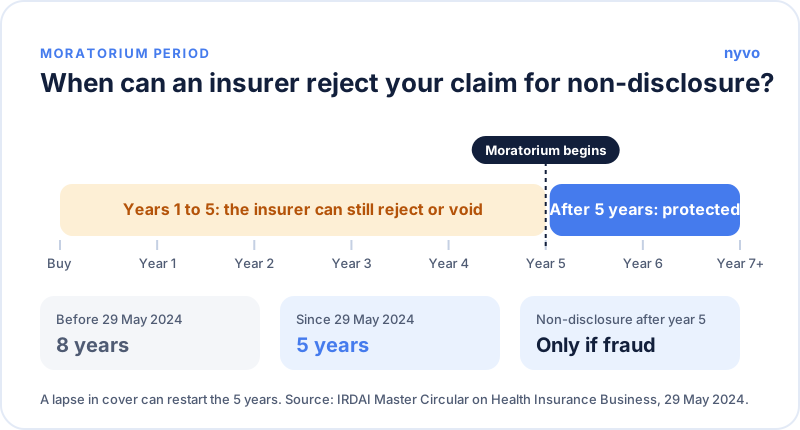
The moratorium period is the window after which an insurer can no longer reject a health claim, or void the policy, on the grounds of non-disclosure or misrepresentation, with the sole exception of established fraud. Under IRDAI's Master Circular on Health Insurance Business (29 May 2024), that window was reduced from eight years to five years of continuous coverage. Once you have held the policy (including its renewals and any ported continuity) for five years, the insurer's right to contest your claims on disclosure grounds falls away. It does not cover everything, permanent exclusions and standard policy terms still apply, but it removes the single most common reason large, long-tenure claims get challenged.
What the moratorium actually protects
When you apply for health insurance, you make disclosures about your health history. If an insurer later believes you withheld or misstated something material, it can use that to reject a claim or cancel the policy. That power is real, and it is the reason honest disclosure matters so much.
The moratorium puts a time limit on that power. After five continuous years, the insurer is barred from invoking non-disclosure or misrepresentation against you. The logic is fairness: an insurer that has accepted your premiums for five years, and had every opportunity to investigate, should not be able to reopen the disclosure question the moment you finally need to claim.
After the moratorium, a claim can essentially only be questioned on the basis of proven fraud, a deliberately high bar, not an innocent or forgotten omission.
What changed in 2024
This is the part worth circling. IRDAI's Master Circular on Health Insurance Business (29 May 2024) cut the moratorium from eight years to five years. For policyholders, that is three fewer years, or three-eighths less time, spent in the contestable zone. A policy you bought recently crosses into moratorium protection three years sooner than one bought under the old rule.
A separate instrument, the IRDAI (Insurance Products) Regulations, 2024 (effective 1 April 2024), capped the pre-existing-disease waiting period at three years, down from four. The direction of travel is consistent: less time during which the insurer can say no.
What the moratorium does NOT do
It is important to be precise, because the moratorium is powerful but not unlimited:
- It does not override a permanent exclusion. If a specific condition was permanently excluded when you bought the policy, it stays excluded.
- It does not pay claims that fail standard policy terms such as room-rent limits, co-pay, sub-limits or non-payable items.
- It does not protect fraud. Deliberate, proven fraud can still be acted on after the moratorium.
- It does not survive a break in cover. This is the trap. The moratorium counts continuous coverage. Let the policy lapse, and you risk resetting the clock.
| Within moratorium (first 5 years) | After moratorium (5+ years) | |
|---|---|---|
| Reject for non-disclosure | Possible | No (fraud excepted) |
| Reject for misrepresentation | Possible | No (fraud excepted) |
| Enforce permanent exclusions | Yes | Yes |
| Apply co-pay / sub-limits / room rent | Yes | Yes |
| Act on proven fraud | Yes | Yes |
Want to know when your policy crosses into moratorium protection? Tell us your policy's start date and any porting history. We'll work out your moratorium date and whether your continuity is intact, so you know exactly where you stand.
Why this is the real case for buying early and never lapsing
The moratorium turns two pieces of common advice into hard, dated logic.
Buy early. The five-year clock starts the day your continuous coverage starts. Buy at 30 and you are moratorium-protected by 35, long before the age when large claims become likely. Buy at 50, after a scare, and you spend your most claim-prone early years still inside the contestable window. The cheapest moratorium is the one you started years ago.
Never let it lapse. Because the protection rides on continuous coverage, a lapsed renewal is not just a temporary gap in cover, it can throw away years of accumulated moratorium credit and restart the clock. This is why we treat renewal dates as non-negotiable, and why the grace period and revival rules matter more than they appear.
Port without breaking continuity. IRDAI portability lets you change insurers while carrying your accumulated credit, including your moratorium and waiting-period tenure, provided you port correctly at renewal without a break. Done right, switching insurers does not cost you your five years. Done carelessly, it can. IRDAI's Master Circular on Health Insurance Business (29 May 2024) counts years under ported and migrated policies towards the 60 months; what carries over when you port covers the rest.
The moratorium rewards exactly one behaviour: holding continuous cover for the long term. Everything else in this guide is a footnote to that.
Switching insurers and worried about losing your tenure? Porting at the wrong moment can reset hard-won continuity. We'll time and structure the port so your moratorium and waiting-period credit carry across intact.
FAQs
Can a health insurer reject my claim after five years?
After five continuous years (the moratorium period), an insurer can no longer reject a claim or void the policy on grounds of non-disclosure or misrepresentation, except in cases of proven fraud. Standard terms like exclusions, co-pay and sub-limits still apply, but the disclosure question is effectively closed.
How long is the moratorium period in India now?
Five years, reduced from eight by IRDAI's Master Circular on Health Insurance Business (29 May 2024). After five years of continuous coverage, the policy is "incontestable" except for established fraud.
Does the moratorium reset if I change insurers?
Not if you port correctly. IRDAI portability lets you carry your accumulated continuity, including moratorium tenure, when you switch insurers at renewal without a break in cover. A lapse or an improperly handled switch can reset it.
Does the moratorium cover everything after five years?
No. It removes the insurer's ability to contest on non-disclosure or misrepresentation grounds, but permanent exclusions, co-pay, sub-limits, room-rent limits and other standard policy terms continue to apply, and proven fraud is always an exception.
What happens to the moratorium if my policy lapses?
A lapse can break the "continuous coverage" the moratorium depends on and reset the five-year clock. Staying within the grace period on renewals is essential to preserve it.
Related guides:
Sources:
- IRDAI Master Circular on Health Insurance Business, Reference No. IRDAI/HLT/CIR/PRO/84/5/2024, 29 May 2024 (moratorium reduced to 5 years); IRDAI (Insurance Products) Regulations, 2024, effective 1 April 2024 (pre-existing-disease waiting period capped at 36 months)
- IRDAI (Insurance Products) Regulations, 2024
- nyvo advisory experience across 30+ insurer partners
Summary sheet
| Moratorium period | 5 years of continuous cover (IRDAI Master Circular on Health Insurance Business, 29 May 2024) |
|---|---|
| Before 29 May 2024 | 8 years |
| After the moratorium | no rejection or voiding for non-disclosure or misrepresentation |
| Still applies after it | proven fraud, permanent exclusions, co-pay, sub-limits, room-rent limits |
| What can restart it | a lapse in cover |
| What keeps it | renewing on time, or porting at renewal without a break |
Count from the start of continuous cover, including renewals and ported continuity.
Book a call for advice on the best policy for you and your family
A salaried, IRDAI-certified nyvo advisor will look at your cover, flag the gaps that matter, and tell you plainly what to fix. No commission, no pressure.
A first in India
Buy policy from nyvo insurance with Claim Support Guarantee, otherwise money back.

Alumni of IIT Delhi and IIM Ahmedabad. Former consultant at BCG and part of the strategy team of slice. Founder of nyvo and IRDAI Certified Insurance Advisor.