First in India
Claim Support Guarantee, otherwise your money back.
Buy through nyvo and we get your claim passed, otherwise refund your premium. We are putting our money on our claim service.
Super Top-Up for Parents When the Insurer Won't Raise Cover
When your parents' insurer will not raise their sum insured, a super top-up can add cover above the policy they already hold. How the deductible splits a bill, which plans take a parent above 60, and what to check when the two policies are with different insurers.

When an insurer will not raise your parents' sum insured, a super top-up can add cover above the policy they already hold. It pays the admissible part of the year's hospital bills above a deductible, so a ₹5 lakh base policy with a ₹25 lakh super top-up and a ₹5 lakh deductible gives ₹30 lakh of cover in a year. Several plans take a parent above 65, and Bajaj Extra Care Plus takes new members up to 80.
The base policy stays. It keeps the waiting-period and moratorium credit your parents have already built, and it pays first. The super top-up sits above it.
Why won't the insurer raise my parents' sum insured?
An insurer can renew your parents' existing cover without fresh underwriting, but an increase in the sum insured is underwritten again. HDFC ERGO's wording is one example: the insurer "shall not resort to fresh underwriting unless there is an increase in sum insured", and then underwrites the increased amount (my:Optima Secure prospectus, UIN HDFHLIP26058V082526). A parent's health history can lead the insurer to decline or limit the increase.
Two more rules apply to any extra cover, however you get it:
- Waiting periods start again on the new part. On an increase, the pre-existing and specified-disease waits "apply afresh to the extent of Sum Insured increase" (same prospectus). A super top-up is a new policy, so its waits start from day one too.
- Some plans cap increases by age. Aditya Birla's Super Health Plus Top Up allows a sum insured increase at renewal only up to its maximum entry age of 65 (policy wording, UIN ADIHLIP21061V022021), so check the age limit of any plan you expect to grow.
So the choice is rarely between an increase and nothing. It is between asking the current insurer for an increase, adding a super top-up, or both.
How does a super top-up add cover for parents?
A super top-up pays hospital bills above an aggregate deductible: every admissible claim in the policy year counts towards the same deductible, and once the year's total crosses it, the super top-up pays the rest up to its own sum insured. Your parents' existing policy is meant to pay the deductible, so start from a deductible equal to that policy's sum insured. That closes the gap between where the base stops and the super top-up starts on bills both policies admit; it does not make every bill payable, because co-pays, exclusions and room-rent rules in either policy, or policy years that do not line up, can still leave you a share.
Three details decide whether that works in practice:
- The deductible counts admissible expenses, not the hospital's total bill. Care Supreme Enhance applies its deductible to "the aggregate of all Claims that are either paid or payable under this Policy" (prospectus, UIN CHIHLIP25036V012425), so a room-rent cut or a non-payable item under the super top-up's own wording does not count towards it. See how room-rent limits cut a claim.
- It resets every policy year. A bill in a new policy year has to cross the deductible again.
- It is a separate policy. It has its own proposal form, its own waiting periods and its own room-rent rules, which can differ from the base policy's.
Our top-up and super top-up guide covers the mechanics in more detail, including the difference from a per-claim top-up.
How does a bill split between the base policy and the super top-up?
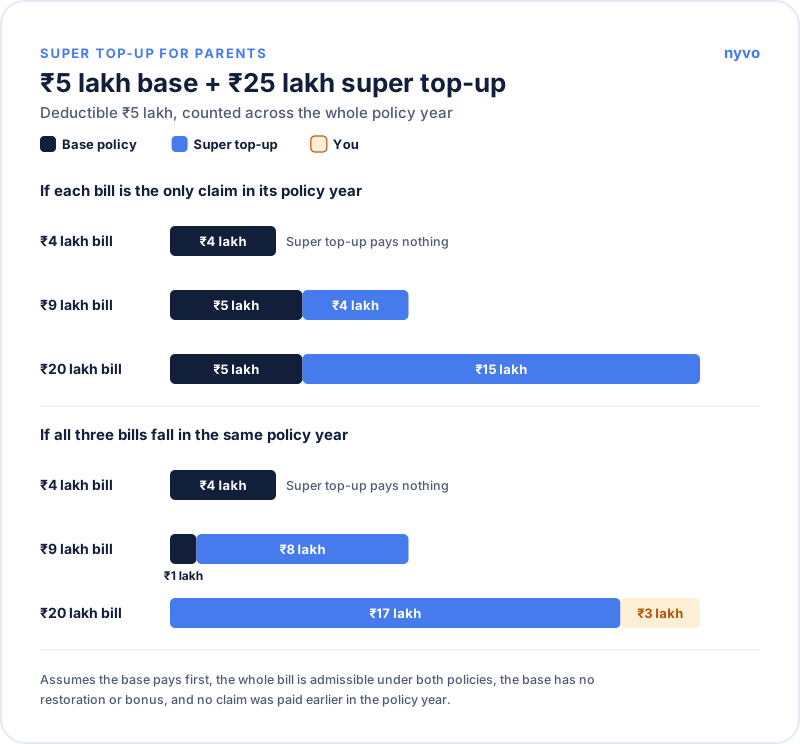
With a ₹5 lakh base policy and a ₹25 lakh super top-up carrying a ₹5 lakh deductible, the base policy pays the first ₹5 lakh of the year's admissible bills and the super top-up pays the rest, up to ₹25 lakh. A ₹4 lakh bill stays with the base policy, a ₹9 lakh bill splits ₹5 lakh and ₹4 lakh, and a ₹20 lakh bill splits ₹5 lakh and ₹15 lakh.
The inputs are an example, not typical figures. The assumptions: the base policy pays first, the whole bill is admissible under both policies, the base policy has no restoration benefit and no bonus, and neither policy has paid a claim earlier in the policy year.
If each bill is the only claim in its policy year:
| Hospital bill | Base policy pays | Super top-up pays | You pay |
|---|---|---|---|
| ₹4 lakh | ₹4 lakh | ₹0 (the year's bills have not crossed ₹5 lakh) | ₹0 |
| ₹9 lakh | ₹5 lakh | ₹4 lakh | ₹0 |
| ₹20 lakh | ₹5 lakh | ₹15 lakh | ₹0 |
If all three bills fall in the same policy year, the aggregate deductible counts them together:
| Bill, in order | Base policy pays | Super top-up pays | You pay | Why |
|---|---|---|---|---|
| ₹4 lakh | ₹4 lakh | ₹0 | ₹0 | The year's total, ₹4 lakh, is below the ₹5 lakh deductible |
| ₹9 lakh | ₹1 lakh | ₹8 lakh | ₹0 | The year's total is now ₹13 lakh; the base pays its last ₹1 lakh and the super top-up pays the ₹8 lakh above ₹5 lakh |
| ₹20 lakh | ₹0 | ₹17 lakh | ₹3 lakh | The base is used up; the super top-up has ₹17 lakh of its ₹25 lakh left |
Across that year, the bills total ₹33 lakh: the base pays ₹5 lakh, the super top-up ₹25 lakh and you ₹3 lakh. The ₹3 lakh is what is left once both policies' sums insured are used up.
The deductible has to match the cover underneath it. Had your parents' base policy been ₹3 lakh under the same ₹5 lakh deductible, the ₹9 lakh bill would split ₹3 lakh from the base, ₹4 lakh from the super top-up and ₹2 lakh from you, because nothing funds the gap between ₹3 lakh and ₹5 lakh.
Which super top-ups accept parents above 60?
Of the eight super top-ups below, four take a new member of any age, Bajaj Extra Care Plus takes new members up to 80, and three stop at 65. Bajaj Extra Care Plus also has the shortest pre-existing disease wait, 12 months against 36 months on the other seven (each plan's prospectus, wording or brochure, by the UIN under the table). Each applies an aggregate deductible across the policy year.
| Plan | Oldest age to buy | Deductible options | Pre-existing disease wait | Check before you buy |
|---|---|---|---|---|
| ICICI Lombard Activate Booster | No practical limit; the prospectus states 125 | ₹3 lakh to ₹20 lakh | 36 months; an optional cover cuts it to 24 or 12 | Medical tests from 45; room rent up to a single private AC room as standard |
| ManipalCigna Super Top Up | No maximum | ₹1 lakh to ₹10 lakh, paired with cover of ₹1 lakh to ₹30 lakh | 36 months; 24 with an optional cover | Tele-underwriting from 56, medical tests above 65 |
| Care Supreme Enhance | No maximum for adults | ₹1, 2, 3, 4 or 5 lakh with cover of ₹5 lakh to ₹25 lakh; or ₹3, 5, 7, 10, 15, 20 or 25 lakh with cover of ₹30 lakh to ₹6 crore | 36 months | Medical tests from 66; the aggregate super top-up is its Plan A |
| Care Enhance | No age bar | ₹50,000 or ₹1 lakh to ₹10 lakh (Enhance 1); ₹5, 10, 15 or 20 lakh (Enhance 2) | 36 months | A 20% co-payment on every claim where the eldest insured enters at 61 or over |
| Bajaj Extra Care Plus | 80 | ₹2, 3, 5 or 10 lakh, depending on cover of ₹3 lakh to ₹50 lakh | 12 months | Medical tests from 56 |
| HDFC ERGO my:health Medisure Super Top Up | 65 | ₹2 lakh to ₹5 lakh, with cover up to ₹20 lakh | 36 months | Medical tests above 55; a 10% co-payment on every claim above 80 |
| Niva Bupa Health Recharge | 65 | ₹10,000, ₹25,000 or ₹50,000 (E-saver), or ₹1 lakh to ₹10 lakh | 36 months | A pre-policy check-up from 55 on the super top-up tier |
| Aditya Birla Super Health Plus Top Up | 65 | ₹1 lakh to ₹15 lakh | 36 months | Not issued to NRIs, OCIs or PIOs |
Sources, by plan: ICICI Lombard Activate Booster prospectus, UIN ICIHLIP27059V022627; ManipalCigna Super Top Up prospectus, UIN MCIHLIP23022V032223; Care Supreme Enhance prospectus and proposal form, UIN CHIHLIP25036V012425; Care Enhance prospectus, UIN RHIHLIP21372V022021; Bajaj Extra Care Plus brochure and policy wording, UIN BAJHLIP23069V032223; HDFC ERGO my:health Medisure Super Top Up prospectus, UIN HDFHLIP22021V042122; Niva Bupa Health Recharge prospectus, UIN NBHHLIP22156V032122; Aditya Birla Super Health Plus Top Up prospectus, UIN ADIHLIP21061V022021.
Three plans in the table need a closer look for a parent:
- Bajaj Extra Care Plus suits a parent with a known condition, because its 12-month pre-existing wait is a third of the usual 36 months. Its deductible choices depend on the cover: ₹25 lakh of cover comes with a ₹3 lakh, ₹5 lakh or ₹10 lakh deductible.
- Care Enhance takes a parent at any age, but its 20% co-payment means you share every claim once the eldest insured enters at 61 or over. On a ₹10 lakh admissible claim above the deductible, that is ₹2 lakh from your pocket.
- Care Supreme Enhance is sold in two forms. Plan A is the aggregate super top-up described here. Plan B is a different cover that pays above your base policy's room-rent and cataract limits on a per-claim basis, and it is cancelled if the base policy is not active at the time of a claim (prospectus, UIN CHIHLIP25036V012425). Ask which one you are quoted.
For base plans that take older parents, see health insurance for parents and the best health insurance for senior citizens. For the wider super top-up market, see the best super top-up plans.
What should you check when the base and the super top-up are from two insurers?
You can hold the base policy with one insurer and the super top-up with another. Under the Master Circular on Health Insurance Business, 29 May 2024, you choose which policy to claim under first; if that policy's cover is less than the admissible claim, that insurer must seek details of your other policies and coordinate with the other insurer to settle the balance, "without causing any hassles to the policyholder".
In practice, six checks keep a two-insurer claim straightforward:
- Claim on the base policy first and keep its settlement letter. Before a planned admission, ask both insurers whether the super top-up's share will be settled cashless or as a reimbursement, and what papers each needs.
- Keep copies of every bill and report. Bajaj Extra Care Plus, for example, accepts attested photocopies with a declaration from the other insurer that it holds the originals, and asks for the other insurer's claim decision letter where that insurer paid part of the claim (policy wording, UIN BAJHLIP23069V032223).
- Expect each policy to apply its own wording. The super top-up assesses the bill under its own room-rent rules, sub-limits and exclusions, and only what is admissible under its wording counts towards its deductible.
- Know both renewal dates. The deductible resets with the super top-up's policy year, not the base policy's. Bajaj Extra Care Plus settles a claim that runs across two of its policy years by taking into account the sum insured and the deductible of each year (same wording).
- Disclose the base policy and every condition on the super top-up's proposal form. The super top-up is a new contract with its own five-year moratorium clock, and its own waiting periods.
- Keep the base policy renewed. If it lapses, the deductible does not shrink: you pay it yourself before the super top-up pays anything.
One more right is worth knowing. Bajaj Extra Care Plus's multiple-policies clause lets you claim under it for an amount another policy disallowed, and the insurer then settles that claim independently under its own terms. The super top-up's deductible still applies to it.
When is a super top-up the wrong fix for parents?
A super top-up is the wrong fix when nothing reliable sits under its deductible. That covers parents with no base policy, a base policy smaller than the deductible, or cover through an employer's group policy that ends when the job does. It also pays nothing in a policy year whose admissible bills stay within the deductible, though several smaller admissions in the same year can cross it together.
In those cases the order works the other way round: a base policy that accepts your parents first, then a super top-up whose deductible matches it. If the existing base policy itself is the problem, with a room-rent cap or a co-pay on every claim, porting it to another insurer carries the waiting-period credit already built to the extent of the sum insured (Master Circular on Health Insurance Business, 29 May 2024), and the new insurer underwrites the proposal.
Not sure which deductible or plan fits your parents' existing policy? An IRDAI-certified nyvo advisor will read both wordings with you. Salaried, not commission-led. Health and term only. IRDAI Corporate Agent (Composite), licence CA1085.
FAQs
Can I buy a super top-up for parents above 65?
Yes. ICICI Lombard Activate Booster, ManipalCigna Super Top Up, Care Supreme Enhance and Care Enhance have no practical upper entry age, and Bajaj Extra Care Plus takes new members up to 80. HDFC ERGO my:health Medisure, Niva Bupa Health Recharge and Aditya Birla Super Health Plus Top Up stop at 65 (each plan's prospectus or brochure).
Does a super top-up cover my parents' pre-existing diseases?
Yes, after its own waiting period, which starts afresh even if the base policy's wait is over. It is 12 months on Bajaj Extra Care Plus and 36 months on the other seven plans compared here, and the condition must be declared on the proposal form.
Can the base policy and the super top-up be from different insurers?
Yes. You choose which policy to claim under first, and if its cover falls short of the admissible claim, that insurer must coordinate with the other insurer to settle the balance (Master Circular on Health Insurance Business, 29 May 2024). Keep the first insurer's settlement letter and copies of every bill.
What deductible should I choose for my parents' super top-up?
Start from a deductible equal to their base policy's sum insured. Over a ₹5 lakh base, a ₹5 lakh deductible closes the gap between the two policies on bills both admit, while over a ₹3 lakh base it would leave you ₹2 lakh to pay on any year's bills above ₹5 lakh. Co-pays, exclusions and different policy years can still leave you a share either way.
Does the deductible apply to every hospital bill separately?
No, not on a super top-up. Every admissible claim in the policy year counts towards the same aggregate deductible, so several smaller admissions can cross it together, and the count starts again in the next policy year.
Will the super top-up pay if the base insurer rejects the claim?
Only on its own terms. Under the multiple-policies clause in wordings such as Bajaj Extra Care Plus's, you can claim the amount another policy disallowed and the super top-up settles it independently under its own wording, but its deductible still has to be crossed first.
Related guides:
Sources:
- Master Circular on Health Insurance Business, Ref. IRDAI/HLT/CIR/PRO/84/5/2024, 29 May 2024 (claims under multiple policies; portability)
- Each plan's prospectus, policy wording or brochure, by the UIN in the table above, read in October 2026
- HDFC ERGO my:Optima Secure prospectus, UIN HDFHLIP26058V082526 (renewal and sum insured enhancement)
Super top-up for parents at a glance
| What it adds | Cover above an aggregate deductible, on top of the policy your parents already hold |
|---|---|
| Deductible to choose | Start from the base policy's sum insured; it closes the gap between the two on bills both policies admit, but co-pays, exclusions and different policy years can still leave you a share |
| Oldest entry age | 80 on Bajaj Extra Care Plus; no practical maximum on ICICI Lombard Activate Booster, ManipalCigna Super Top Up, Care Supreme Enhance and Care Enhance; 65 on HDFC ERGO my:health Medisure, Niva Bupa Health Recharge and Aditya Birla Super Health Plus (each plan's prospectus or brochure, read October 2026) |
| Pre-existing wait | 12 months on Bajaj Extra Care Plus (brochure, UIN BAJHLIP23069V032223, October 2026); 36 months on the other seven (each plan's prospectus, October 2026) |
| Co-pay for older entrants | 20% per claim on Care Enhance where the eldest insured enters at 61 or over (prospectus, UIN RHIHLIP21372V022021, October 2026); 10% per claim on my:health Medisure above 80 (prospectus, UIN HDFHLIP22021V042122, October 2026) |
| Two insurers | The insurer you claim from first must coordinate with the other for the balance (Master Circular on Health Insurance Business, 29 May 2024) |
Plan terms from each insurer's own prospectus, policy wording or brochure under the UIN shown in the table. Insurers refile products, so confirm the terms on the version you are quoted.
Book a call for advice on the best policy for you and your family
A salaried, IRDAI-certified nyvo advisor will look at your cover, flag the gaps that matter, and tell you plainly what to fix. No commission, no pressure.
A first in India
Buy policy from nyvo insurance with Claim Support Guarantee, otherwise money back.

16+ years in financial services. Former investment banker at Bank of America, Kotak Investment Banking, and SBICaps, and ex-CFO of slice. Founder of nyvo and Principal Officer – IRDAI Certified.