First in India
Claim Support Guarantee, otherwise your money back.
Buy through nyvo and we get your claim passed, otherwise refund your premium. We are putting our money on our claim service.
Health Insurance Premium Increase at Renewal: Why It Happens and What to Do
Why a health insurance premium jumps at renewal, what IRDAI's rules stop an insurer from doing, and what you can do about it: compare, port, take a deductible or add a super top-up, and when switching costs more than it saves.

A health insurance premium goes up at renewal for reasons that apply to everyone on the same plan: you have reached an older age on the insurer's premium table, the insurer has revised the whole plan's rates, you now live in a dearer zone, or a discount you had last year has ended. Your own claims cannot be loaded onto your renewal premium, though a claim can cost you a claim-free discount, which raises what you pay. Under the IRDAI (Insurance Products) Regulations, 2024, loadings on the renewal premium of an individual policy are set at portfolio level and not on any individual policy's claim experience. For policyholders aged 60 and over, IRDAI directed on 30 January 2025 that insurers shall not revise the premium by more than 10% a year without first consulting it.
This guide covers the four reasons in turn, what nyvo's own premium data shows about age, what an insurer is not allowed to do, and the options that bring the bill down without throwing away the waiting periods you have already served.
Why did my health insurance premium go up at renewal?
A renewal premium rises for one of four reasons: an older age on the plan's premium table, a revision of the whole plan's rates, a move to a dearer zone, or a discount that no longer applies. A loading for your own claims is not on the list, but a claim can end a claim-free discount, which is the fourth reason. The first step is to ask the insurer which of the four you are looking at, in writing, because each has a different answer. The table adds a fifth that is easy to forget: a change you made to the policy yourself.
| Reason | What changed | Who it affects | What you can do |
|---|---|---|---|
| Older age | You reached an age the premium table prices higher | Everyone on the plan at that age | Budget for it, and compare plans at your new age |
| Plan-wide revision | The insurer revised rates for the whole product | Every policyholder of that plan | Compare, and port if the new price is out of line |
| Zone | Your city of residence is priced higher | Anyone who has moved | Check the address on your schedule |
| A discount ended | A first-year, claim-free, wellness or long-term discount no longer applies | Depends on the discount | Ask which discount went, and whether you can earn it back |
| You changed the policy | A higher sum insured, a new member or an add-on | You | Expected; check it was what you asked for |
Your age moved up the premium table
Premium tables are set by age, so a renewal at an older age is priced at the older age's rate. Some insurers price in bands of several years: ACKO Health III's filed prospectus (UIN ACKHLIP27040V012627), for example, quotes premiums in five-year bands such as 51 to 55 and 56 to 60, so the rise arrives in one renewal rather than spread across five. The next section shows how large the steps are on two plans nyvo holds data for.
The insurer revised the whole plan
A plan-wide revision changes the rate for every policyholder of the product, not for you alone. Under the 2024 framework a change to an existing individual product is approved by the insurer's own Product Management Committee (Master Circular on Health Insurance Business, 29 May 2024, Chapter II, section D), and any revision of premium rates "shall be based on credible underlying experience of relevant risk parameters" (IRDAI (Insurance Products) Regulations, 2024, regulation 6(3)(c)).
IRDAI's own explanation of why premiums climb is in its circular of 30 January 2025: the premium rate is "primarily based on the estimated claims outgo", and that outgo "is largely dependent on the amounts charged by the hospitals". Your policy wording will have a clause on revisions and how much notice you get. ACKO Health III's, for one, says ACKO will inform you at least 3 months before a change in premium rates takes effect.
You moved to a dearer zone
Insurers price by where you live, so a move to a costlier city can raise the renewal premium. ACKO Health III's wording, for one, sorts "cities of residence" into two zones for premium: Zone A is Delhi/NCR, Mumbai and Kolkata plus some listed pincodes, and Zone B is the rest of India. On nyvo's own premium data (April 2026), ₹10 lakh of cover for a 50-year-old costs ₹13,669 a year on Aditya Birla Activ One Max at a Bengaluru pincode (560001) and ₹16,670 at a New Delhi pincode (110001), a difference of ₹3,001 or 22%. On HDFC ERGO Optima Secure Plus the same two pincodes give ₹19,811 and ₹26,734, a difference of ₹6,923 or 35%. How zones work, and when the zone follows you into a claim, is in our guide to zone-based premiums.
A discount ended
A discount you had last year may not apply this year, and that shows up as an increase. The 2024 regulations allow insurers to give "discount in premium ... to individual policyholders for good claims experience" (Schedule III, 9.4), so a claim can cost you a claim-free discount even though it cannot be loaded onto your premium. HDFC ERGO's Optima Secure Plus brochure (UIN HDFHLIP26058V082526, read 19 October 2026) offers a favourable claims experience discount of up to 21% for a first-time buyer of health insurance and up to 18% on renewal. Care Supreme's Wellness Benefit takes up to 30% off the renewal premium, but only for the steps you actually logged (Care Supreme terms, as recorded in nyvo's policy database), so a quieter year earns less.
One change works the other way. Individual health insurance moved from 18% GST to exempt on 22 September 2025 (recommendations of the 56th GST Council meeting, Ministry of Finance, 3 September 2025). If last year's receipt was paid before that date, compare the premium before tax, or the increase looks smaller than it is.
How much does the premium rise with age?
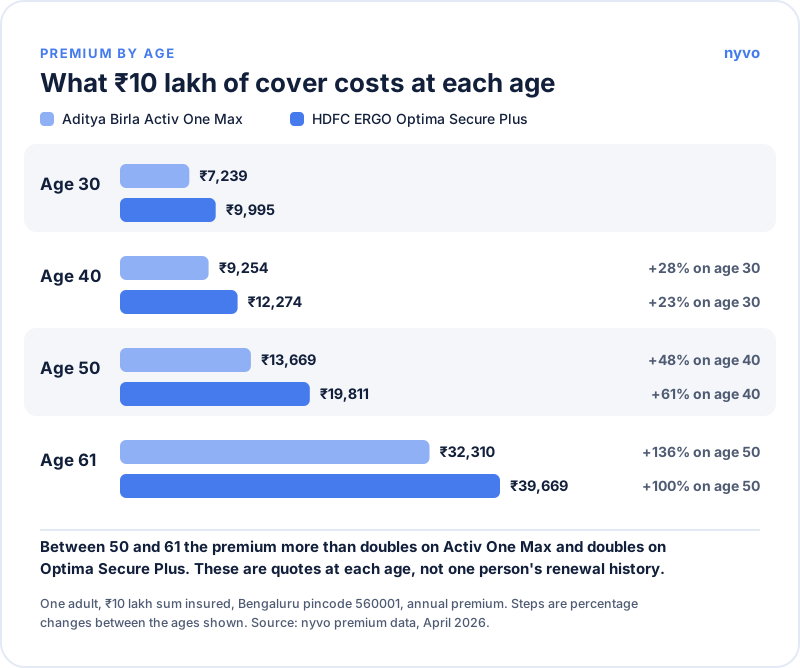
On nyvo's own premium data (April 2026), ₹10 lakh of cover for one adult at a Bengaluru pincode costs ₹7,239 a year at 30 and ₹32,310 at 61 on Aditya Birla Activ One Max, and ₹9,995 and ₹39,669 on HDFC ERGO Optima Secure Plus. The largest step is between 50 and 61, where the premium more than doubles on Activ One Max (up 136%) and doubles on Optima Secure Plus (up 100%).
| Age | Activ One Max | Change | Optima Secure Plus | Change |
|---|---|---|---|---|
| 30 | ₹7,239 | ₹9,995 | ||
| 40 | ₹9,254 | +₹2,015 (+28%) | ₹12,274 | +₹2,279 (+23%) |
| 50 | ₹13,669 | +₹4,415 (+48%) | ₹19,811 | +₹7,537 (+61%) |
| 61 | ₹32,310 | +₹18,641 (+136%) | ₹39,669 | +₹19,858 (+100%) |
Annual premium, one adult, ₹10 lakh sum insured, Bengaluru pincode 560001, nyvo premium data, April 2026. Each change is against the row above. Over the whole span, Activ One Max costs 4.5 times as much at 61 as at 30, and Optima Secure Plus 4.0 times.
Two cautions on reading this. These are quotes for a buyer at each age, not one person's renewal bills, and our data holds four ages only, so it cannot show in which year between 50 and 61 a plan steps up. And the ratios are not a forecast: a plan-wide revision or a lost discount comes on top of the age step.
What is an insurer not allowed to do at renewal?
At renewal an insurer may not load your premium for your own claims, refuse to renew because you claimed, or put you through fresh medicals unless you raise the sum insured. For anyone aged 60 or more it may not revise the premium by more than 10% a year without first consulting IRDAI. Each rule below is quoted from the IRDAI instrument named beside it.
| An insurer may not | Instrument |
|---|---|
| Load your renewal premium because of your own claims. Loadings on individual products "shall be at portfolio and not based upon any individual policy claim experience" | IRDAI (Insurance Products) Regulations, 2024, Schedule III, 9.4 |
| Refuse to renew because you made a claim in an earlier year | Master Circular on Health Insurance Business, 29 May 2024, Chapter I, 10(b); Regulations, Schedule III, 9.2 |
| Underwrite you afresh at renewal, unless you ask to raise the sum insured, and then only on the increase | Master Circular, Chapter I, 10(c); Regulations, Schedule III, 9.5 |
| Change the premium during the policy term. The premium "shall remain unchanged for the policy term" | Regulations, Schedule III, 4.1 |
| Revise the premium of a policyholder aged 60 or above by more than 10% a year without prior consultation with IRDAI | IRDAI circular IRDAI/HLT/CIR/MISC/27/1/2025, 30 January 2025 |
| Refuse renewal except for established fraud, non-disclosure or misrepresentation, or because the product is withdrawn | Master Circular, Chapter I, 10(a) |
Three more protections are worth knowing. If a product is withdrawn, you get a one-time option to renew it when your renewal falls within 90 days of the withdrawal, or you can migrate to another product with your credits (Master Circular, Chapter II, section D.II, 5). If you renew within the grace period, which is 30 days for an annual premium, every credit you have built is protected (Master Circular, Chapter I, 8). And where your health has improved since a loading was applied, the insurer "may endeavour to recognize that for removal of loadings at the point of renewal" (Regulations, Schedule III, 9.5), so it is worth asking.
What the 10% rule for senior citizens covers
IRDAI's circular of 30 January 2025 applies to indemnity-based individual health insurance sold to senior citizens, which it describes as people aged 60 years and above, and it took effect immediately. It directs that insurers "shall not revise the premium for senior citizens by more than 10% per annum", and that they must consult IRDAI first if they propose more, or if they plan to withdraw an individual product offered to senior citizens.
The circular speaks of revising the premium and does not mention age bands. If a parent's renewal notice shows a rise above 10%, ask the insurer in writing to break the increase into its parts and to explain how it complies with the circular. Every insurer must run a separate channel for senior citizens' claims and grievances, with its details on the insurer's website (Regulations, Schedule III, 11), and that is where the question goes.
What should you do when the renewal premium jumps?
Get the breakdown first, then compare the same cover elsewhere, and only then decide between staying, cutting the premium with a deductible or super top-up, and porting. Every option below keeps your cover continuous. None of them requires you to let the old policy lapse, and you should not until a replacement has been issued.
- Ask for the breakdown in writing. Age step, plan-wide revision, discount lost, or a change you made. Compare the premium before tax, for the GST reason above.
- Check what the plan gives you at the new price. A higher premium on a plan with no room-rent cap, no co-pay and a restoration benefit can still be good value. Our free policy check walks through your plan's strengths and gaps in three screens.
- Compare plans at your new age, and port if one is clearly better. Porting moves you to a new insurer at renewal and carries your served waiting periods with you, up to your existing sum insured and bonus (Master Circular, Chapter I, 12(d)). nyvo research (September 2026) suggests applying 45 to 60 days before the renewal date. The full process is in our health insurance portability guide.
- Take a deductible. You agree to pay the first slice of each year's claims, and the premium falls. On Optima Secure Plus, a ₹25,000 aggregate deductible takes up to 22.5% off the premium on a base sum insured of ₹20 lakh or below (HDFC ERGO brochure, UIN HDFHLIP26058V082526, read 19 October 2026). Ask whether your own plan lets you add one at renewal.
- Keep a modest base and add a super top-up for the big bills. A super top-up pays only above a yearly deductible, so the insurer carries less of each year's bills than on the same amount of base cover. It is a new policy with its own waiting periods, so add it alongside the base rather than in place of it. For parents, see our guide to a super top-up for parents; the mechanics are in base plan vs super top-up.
- Lock the premium for longer. A 2- or 3-year policy keeps its premium unchanged for the whole term (Regulations, Schedule III, 4.1). Optima Secure Plus adds a long-term discount of up to 6% for 2 years and up to 8% for 3 years or more (HDFC ERGO brochure, read 19 October 2026).
- Ask for a loading to be reviewed if one was applied for a risk that has since improved, such as weight or a test result. Our guide to premium loading covers what evidence helps.
When is switching to a cheaper plan a bad idea?
Switching is a bad idea whenever the new cover would restart waiting periods you have already served. A fresh policy starts the pre-existing-disease wait again, up to 36 months under the IRDAI (Insurance Products) Regulations, 2024, and the 60-month moratorium on non-disclosure disputes from zero (Master Circular on Health Insurance Business, 29 May 2024). Porting avoids that, but only up to your existing sum insured and bonus.
Hold off, or port rather than buy fresh, if any of these apply:
- A parent has a declared condition that is still inside its waiting period, or recently out of it. A new policy puts that condition back behind a wait.
- You are close to five years of continuous cover. After 60 months the policy and its claims cannot be contested for non-disclosure or misrepresentation, except for established fraud. A fresh policy throws that away; see the moratorium period.
- The cheaper plan is cheaper because it covers less: a room-rent cap, a co-pay, disease sub-limits or no restoration. Price the same cover, not the same sum insured.
- You would take more cover with the new insurer. The extra amount is fresh cover, with fresh waiting periods on that slice.
- The new insurer has not yet accepted you. Porting is a right to apply, and the new insurer underwrites you afresh. Keep the old policy alive until the new one is issued.
The waiting periods themselves are explained in our guide to waiting periods in health insurance.
FAQs
Can my insurer increase my premium because I made a claim?
Not by loading it. Under the IRDAI (Insurance Products) Regulations, 2024, loadings on the renewal premium of an individual policy are applied at portfolio level and not on any individual policy's claim experience. A claim can still cost you a claim-free discount, because the same rule lets insurers reward a good claims record.
Is there a limit on how much a health insurance premium can increase?
For policyholders aged 60 and over, yes. IRDAI's circular of 30 January 2025 says insurers shall not revise their premium by more than 10% a year, and must consult IRDAI before proposing more. For younger policyholders the instruments set no percentage limit, but any revision of rates must rest on credible underlying experience.
Why did my parents' premium go up when they never claimed?
Because the common causes have nothing to do with claims. A move into an older age, a revision of the whole plan's rates or a discount that ended all raise the premium for a claim-free policyholder too. Ask the insurer for the breakdown in writing.
Does the 10% limit for senior citizens cover a move into an older age band?
The circular speaks of revising the premium for senior citizens and does not mention age bands. If a parent's renewal notice shows more than 10%, ask the insurer in writing to break the increase into its parts and explain how it complies with the circular of 30 January 2025.
Can the insurer change my premium in the middle of the policy year?
No. The 2024 product regulations say the premium shall remain unchanged for the policy term. A 2- or 3-year policy therefore fixes the premium for the whole term.
Will I need fresh medical tests at renewal?
No, unless you ask to raise the sum insured. The insurer may then underwrite only the increase, under IRDAI's Master Circular on Health Insurance Business of 29 May 2024.
Should I port to a cheaper insurer when my premium goes up?
Only if the new plan covers at least as much and the new insurer accepts you with your credits intact. Porting carries your served waiting periods up to your existing sum insured and bonus; buying a fresh policy restarts them. Keep the old policy alive until the new one is issued.
Did GST change my renewal premium?
If anything it lowered it. Individual health insurance has been exempt from GST since 22 September 2025, down from 18%, so a receipt from before that date included tax that a later one does not.
Related guides:
Sources:
- IRDAI (Insurance Products) Regulations, 2024, notified 20 March 2024, in force from 1 April 2024: regulation 6(3)(c); Schedule III, paragraphs 4.1, 7, 8, 9.2, 9.4, 9.5 and 11
- IRDAI Master Circular on Health Insurance Business, Reference IRDAI/HLT/CIR/PRO/84/5/2024, 29 May 2024: Chapter I, paragraphs 8, 10, 12 and 13; Chapter II, section D
- IRDAI circular "Review of revision in premium rates under health insurance policies for senior citizens", IRDAI/HLT/CIR/MISC/27/1/2025, 30 January 2025
- Ministry of Finance, recommendations of the 56th meeting of the GST Council, 3 September 2025 (exemption of individual health insurance from 22 September 2025)
- nyvo premium data, April 2026 (one adult, ₹10 lakh, pincodes 560001 and 110001)
- HDFC ERGO my: Optima Secure brochure, UIN HDFHLIP26058V082526; ACKO Health III prospectus and policy wording, UIN ACKHLIP27040V012627
Renewal premiums at a glance
| Why it rises | an older age on the premium table, a plan-wide revision of rates, a dearer zone, or a discount that ended |
|---|---|
| Loading for your own claims | not allowed. Renewal loadings on individual products are set at portfolio level, not on any individual policy's claim experience (IRDAI (Insurance Products) Regulations, 2024, Schedule III, 9.4) |
| Discount for a good claims record | allowed (Regulations, 2024, Schedule III, 9.4), so a claim can still cost you a discount |
| Policyholders aged 60 and over | insurers shall not revise the premium by more than 10% a year, and must consult IRDAI before proposing more (IRDAI circular IRDAI/HLT/CIR/MISC/27/1/2025, 30 January 2025) |
| Renewal after a claim | cannot be refused because you claimed (Master Circular on Health Insurance Business, 29 May 2024, Chapter I, 10(b)) |
| Fresh medicals at renewal | only if you raise the sum insured, and only on the increase (Master Circular, 29 May 2024, 10(c)) |
| During the policy term | the premium stays unchanged (Regulations, 2024, Schedule III, 4.1) |
| GST | individual health insurance exempt since 22 September 2025, down from 18% (56th GST Council meeting, 3 September 2025) |
These rules limit how an insurer prices you as an individual. They do not freeze a plan's age table or stop a revision that applies to every policyholder of the plan.
Book a call for advice on the best policy for you and your family
A salaried, IRDAI-certified nyvo advisor will look at your cover, flag the gaps that matter, and tell you plainly what to fix. No commission, no pressure.
A first in India
Buy policy from nyvo insurance with Claim Support Guarantee, otherwise money back.

16+ years in financial services. Former investment banker at Bank of America, Kotak Investment Banking, and SBICaps, and ex-CFO of slice. Founder of nyvo and Principal Officer – IRDAI Certified.