First in India
Claim Support Guarantee, otherwise your money back.
Buy through nyvo and we get your claim passed, otherwise refund your premium. We are putting our money on our claim service.
NPS Swasthya vs Super Top-Up Plans: Cover, Waits and Who Should Buy
NPS Swasthya is PFRDA's pension scheme that comes with a mandatory super top-up health policy. What PFRDA's own rules say about its cover, deductibles, waiting periods and age limits, how it compares with retail super top-ups, and who it suits.

NPS Swasthya is a pension scheme from PFRDA, the pension regulator, that comes with a mandatory super top-up health insurance policy. You open an NPS Swasthya account with a pension fund, and the fund arranges a standard super top-up policy for you, your spouse and up to two dependent children through an IRDAI-registered insurer. Under PFRDA's Operational Guidelines of 18 September 2026, the policy offers four fixed pairs of deductible and cover, from ₹10,000 with ₹1 lakh to ₹3 lakh with ₹30 lakh, a 12-month wait for pre-existing diseases, and subscriber entry from 18 to 70. Parents cannot be on the family policy.
Every fact about NPS Swasthya on this page comes from PFRDA's own documents: the Operational Guidelines, its April 2026 sandbox circular, and its scheme page and FAQs, all read on 19 October 2026. The retail plans it is compared with are taken from each insurer's own policy wording, matched by UIN.
What is NPS Swasthya?
NPS Swasthya is a specific-purpose pension scheme under the National Pension System, introduced under Regulation 4A of the PFRDA (Exits and Withdrawals under the National Pension System) Regulations, 2015. It has two parts that PFRDA keeps "legally and operationally distinct": an NPS Swasthya investment account, and a separate super top-up group health insurance policy that is mandatory for enrolment.
The pension fund offering the scheme arranges the policy through an IRDAI-registered insurer, under a master policy, and the insurer cannot be part of the pension fund's own group. The insurance side stays governed by IRDAI: PFRDA's guidelines leave the insurer's product terms, premium, underwriting and claims to insurance law (Operational Guidelines, clause 2.2). PFRDA's FAQ puts it plainly: NPS Swasthya is not a health insurance product, it is a pension scheme that provides access to one.
A super top-up pays hospital bills only after the year's admissible bills cross a deductible. If that is new to you, our guide to base plans and super top-ups explains the mechanics.
Can you buy NPS Swasthya yet?
NPS Swasthya began as a test in PFRDA's regulatory sandbox and now has final operating rules. PFRDA introduced it as a proof of concept by circular on 27 January 2026, under which the "ICICI PF NPS Swasthya Equity Plus" scheme was launched. A revised proof of concept followed on 7 April 2026, and PFRDA issued the Operational Guidelines on 18 September 2026, in force immediately.
The sequence, from PFRDA's own circulars:
| Date | PFRDA document | What it did |
|---|---|---|
| 27 January 2026 | Circular PFRDA/2026/07/SUP-CRA/02 | Introduced the NPS Swasthya Pension Scheme as a proof of concept in the regulatory sandbox |
| 7 April 2026 | Circular PFRDA/2026/22/SUP-CRA/03 | Allowed a second proof of concept, for a limited duration and with restricted enrolment, with a minimum initial contribution of ₹25,000 |
| 18 September 2026 | Circular PFRDA/2026/49/NPS-SWASTHYA/01 | Issued the Operational Guidelines for NPS Swasthya, in force immediately |
The guidelines say the sandbox schemes will be discontinued once the guidelines are implemented, with existing sandbox subscribers given the option to move into a scheme under the guidelines or into an ordinary NPS account. If you have read that NPS Swasthya needs ₹25,000 to start, that figure belongs to the sandbox's second proof of concept, not to the final rules.
PFRDA's scheme page says to enrol through npscentral.in. None of the PFRDA documents we read names the insurer, or a pension fund offering the scheme under the final guidelines, and none gives a premium. The pension fund must disclose the sum insured, deductible, exclusions, waiting periods, premium and renewal terms before you enrol (Operational Guidelines, clause 29.7), and that disclosure is the document to read.
What does the NPS Swasthya health policy cover?
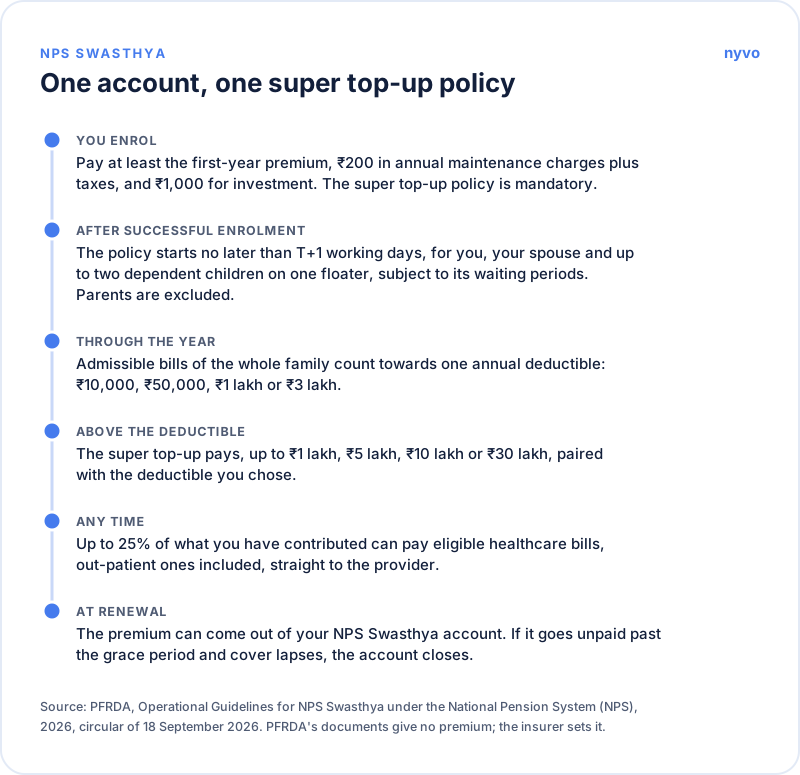
PFRDA prescribes one standard super top-up policy that every pension fund must use, and no fund may offer an insurer-specific version that differs from it. It covers a family floater of the subscriber, spouse and up to two dependent children, with subscriber entry from 18 to 70 and renewal up to and including age 85, against a single annual deductible for the whole family. The policy must start no later than T+1 working days from successful enrolment and receipt of the minimum initial contribution (Operational Guidelines, clause 29.4), after which its waiting periods apply. These are PFRDA's standard terms; each stays subject to the insurer's final policy wording.
| Term | PFRDA's standard policy (Operational Guidelines, clause 30) |
|---|---|
| Who is covered | Subscriber, spouse and up to two dependent children, as one family floater. Parents are excluded |
| Subscriber entry age | 18 to 70 (the guidelines state no entry age for dependent children) |
| Renewal | Up to and including age 85, subject to premium, policy terms and law |
| Deductible and cover | ₹10,000 with ₹1 lakh · ₹50,000 with ₹5 lakh · ₹1 lakh with ₹10 lakh · ₹3 lakh with ₹30 lakh |
| How the deductible works | Annual aggregate: the admissible bills of every covered family member in the policy year count towards it, not each claim separately |
| Room | Single private room; ICU at actuals |
| Co-payment and sub-limits | No co-payment and no disease-specific sub-limit |
| Pre and post hospitalisation | 30 days before, 60 days after |
| Road ambulance | Up to ₹2,500 per emergency hospitalisation |
| Also covered | Day care, in-patient care, domiciliary hospitalisation, AYUSH, prescribed modern treatments and organ-donor expenses |
| Initial waiting period | 30 days, except accidents |
| Pre-existing disease wait | 12 months |
| Specified disease or procedure wait | 12 months |
| Fresh underwriting at renewal | None, unless the sum insured is raised |
Enrolment is ordinarily based on a Good Health Declaration. You answer for yourself, your spouse and your children against a list of 15 conditions, including heart attack, stroke, cancer, kidney disease, liver disease and Type 1 diabetes or insulin treatment. A "yes" can bring a premium loading based on the declaration, without formal medical reports, or a decline with the specific reason given; one family member's decline does not by itself disqualify the others. Controlled Type 2 diabetes, hypertension, hyperlipidaemia and asthma that do not trigger enhanced underwriting are covered after 12 months. Answer the declaration fully: our guide to declaring pre-existing conditions explains why.
On service, the guidelines set minimums: a cashless decision within one hour of a complete request, final discharge approval within three hours, and a reimbursement target of 15 calendar days from the last necessary document, or any stricter IRDAI timeline.
What does it cost?
PFRDA's documents give no premium; they say the insurer sets it under the IRDAI framework. For comparison between schemes, the insurer must quote premiums for three entry-age groups: 18 to 40, above 40 to 60, and above 60 to 70, based on completed age at first entry. The premium is shown separately from the account's charges, and renewal premium changes "shall not be imposed merely because an individual subscriber made a claim" (Operational Guidelines, clause 31.3).
nyvo holds no NPS Swasthya quotes, so this page gives no price, and we have found no PFRDA figure behind claims that it is cheaper than a retail super top-up. Compare the premium the pension fund discloses with a retail quote for the same deductible and cover.
How does the NPS Swasthya account work?
The account is an NPS pension account with healthcare withdrawals built in, and it can pay the insurance premium. You start with at least the first-year premium including taxes, ₹200 in annual maintenance charges plus taxes, and ₹1,000 for investment; after that, the minimum contribution is ₹10. Your contributions are invested in line with the investment pattern for the Central Government Scheme, and returns are market-linked and not guaranteed.
- Charges. The usual NPS All Citizen Model charges apply, plus up to 0.08% a year of the NPS Swasthya corpus and ₹200 a year in maintenance charges, each plus taxes.
- Healthcare withdrawals. You can withdraw up to 25% of the contributions you have made, for eligible out-patient and in-patient healthcare bills, as often as you like and with no waiting period. The money goes to the hospital or provider, not to you, and a bill the insurance policy did not pay can still be considered.
- The deductible. You can pay it from the NPS Swasthya account, from your own money, or from another policy, and you can move money from an existing NPS All Citizen Model account into NPS Swasthya up to the amount of the deductible.
- A large hospital bill. If a single in-patient bill exceeds what partial withdrawal allows, you can exit early: the whole corpus goes first to that bill, the rest moves to an ordinary NPS account, and the NPS Swasthya account closes. A policy already in force runs to the end of its term.
- Renewal. The renewal premium can be paid from the corpus. If the balance may be short, the pension fund is to warn you, where practicable, 90, 60 and 30 days before renewal. If the premium is still unpaid after the grace period and the cover lapses, the NPS Swasthya account closes and merges into an ordinary NPS account.
The one thing to plan around: before exit, only 25% of what you put in can reach a healthcare bill. The rest is retirement savings, so NPS Swasthya does not replace an emergency fund.
How does NPS Swasthya compare with retail super top-ups?
NPS Swasthya's standard policy matches the shortest waiting periods among the retail super top-ups compared here, but covers a smaller family, stops at ₹30 lakh, and fixes the deductible-and-cover pairs. The table sets PFRDA's standard terms beside two retail super top-ups whose policy wordings we read by UIN: Niva Bupa Health Recharge, with deductibles from ₹10,000, and Bajaj Extra Care Plus, which matches NPS Swasthya's 12-month waits.
| Term | NPS Swasthya (PFRDA standard policy) | Niva Bupa Health Recharge | Bajaj Extra Care Plus |
|---|---|---|---|
| How you buy it | Only with an NPS Swasthya account | A retail policy on its own | A retail policy on its own |
| Who can be covered | Self, spouse, up to 2 dependent children; no parents | Individual, or a floater of self, spouse and children (up to 6, at most 4 children) | Individual, or a floater of self, spouse, dependent children and dependent parents (up to 6) |
| Adult entry age | 18 to 70 (subscriber) | 18 to 65 | 18 to 80 |
| Renewal | Up to and including 85 | Lifelong | Lifelong for self, spouse and parents; children to 35 |
| Deductible | ₹10,000, ₹50,000, ₹1 lakh or ₹3 lakh, each tied to one cover amount | ₹10,000, ₹25,000 or ₹50,000 on E-saver; ₹1 lakh to ₹10 lakh | ₹2 lakh, ₹3 lakh, ₹5 lakh or ₹10 lakh |
| Cover above the deductible | ₹1 lakh to ₹30 lakh | ₹2 lakh to ₹95 lakh | ₹3 lakh to ₹50 lakh |
| Deductible basis | Annual aggregate | Annual aggregate | Annual aggregate |
| Pre-existing disease wait | 12 months | 36 months | 12 months |
| Specified disease wait | 12 months | 24 months | 12 months |
| Room | Single private room; ICU at actuals | Up to 1% of sum insured a day below ₹5 lakh; single private room from ₹5 lakh | No room-rent limit listed |
| Co-payment | None | None listed | None |
| Pre and post hospitalisation | 30 / 60 days | 60 / 90 days | 60 / 90 days |
| Premium | Set by the insurer; none in PFRDA's documents | nyvo holds no quote | nyvo holds no quote |
Sources: PFRDA Operational Guidelines for NPS Swasthya, 18 September 2026, clauses 30 and 31. Niva Bupa Health Recharge policy wording, prospectus and Customer Information Sheet, UIN NBHHLIP22156V032122. Bajaj Extra Care Plus policy wording, Customer Information Sheet and brochure, UIN BAJHLIP23069V032223. All read on 19 October 2026. Niva Bupa's Customer Information Sheet also lists a sub-limit on specified mental disorders and on some modern treatments; Bajaj's lists road ambulance at up to ₹3,000 per hospitalisation and no other limits.
Every super top-up in the table pays only after a deductible, so each is meant to sit above a base policy or an employer's cover. How to match the deductible to the cover you already hold is in our comparison of the best super top-up plans.
Who should consider NPS Swasthya, and who should not?
NPS Swasthya suits someone aged 18 to 70 who wants a top-up layer for themselves and their spouse above existing cover, and who is happy to hold retirement savings in NPS alongside it. It does not suit anyone buying for a parent, anyone who needs more than ₹30 lakh of top-up cover, or anyone who needs the money back for anything other than healthcare before retirement.
Consider it if:
- You already have base or employer cover, and want a second layer that starts at a deductible matched to it.
- You want short waits. Both the pre-existing and specified-disease waits are 12 months, and the pre-existing disease wait is a third of the 36-month maximum the IRDAI (Insurance Products) Regulations, 2024 allow for that wait.
- You also want to build an NPS corpus, and like the idea of drawing on it for out-patient and in-patient bills the policy does not pay.
Look elsewhere if:
- You are buying for a parent. Parents are excluded from the standard floater. A parent aged 70 or under could be covered only by enrolling as a subscriber in their own right, subject to NPS eligibility. Retail plans such as Bajaj Extra Care Plus take dependent parents, with entry up to 80; our guide to a super top-up for parents compares the options.
- You need more than ₹30 lakh above your deductible, or a deductible-and-cover pair PFRDA does not offer, such as a ₹5 lakh deductible.
- You want the cover without the pension account. The policy cannot be bought on its own, and if its premium lapses the account closes.
- You expect to need the savings back early. Before exit, healthcare withdrawals are capped at 25% of your contributions.
If you hold a policy with an insurer already and are weighing NPS Swasthya as a cheaper replacement, read our guide to a premium increase at renewal first: a new policy restarts waiting periods, while porting carries them across.
FAQs
What is NPS Swasthya?
NPS Swasthya is a pension scheme under the National Pension System that comes with a mandatory super top-up health insurance policy. PFRDA issued its Operational Guidelines on 18 September 2026. The pension account and the insurance policy are legally and operationally separate.
Is NPS Swasthya a health insurance policy?
No. PFRDA describes it as a pension scheme that gives access to a separate super top-up group health insurance policy, arranged by the pension fund through an IRDAI-registered insurer. Insurance terms, premium and claims are governed by IRDAI and the policy wording.
Can I cover my parents under NPS Swasthya?
No. The standard family floater covers the subscriber, spouse and up to two dependent children, and PFRDA's rules exclude parents. A parent aged 70 or under would have to enrol as a subscriber in their own right, subject to NPS eligibility.
What deductible and cover does NPS Swasthya offer?
Four fixed pairs: a ₹10,000 deductible with ₹1 lakh of cover, ₹50,000 with ₹5 lakh, ₹1 lakh with ₹10 lakh, and ₹3 lakh with ₹30 lakh. The deductible applies once a year to the whole family's admissible bills combined.
What is the waiting period for pre-existing diseases under NPS Swasthya?
Twelve months under PFRDA's standard policy, with a 30-day initial wait and a 12-month wait for specified diseases. Controlled Type 2 diabetes, hypertension, hyperlipidaemia and asthma that do not trigger enhanced underwriting are covered after 12 months.
What is the age limit for NPS Swasthya?
The subscriber must be 18 to 70 to enter the insurance policy, and the policy can be renewed up to and including age 85, subject to premium, policy terms and insurance law.
How much does NPS Swasthya cost?
PFRDA's documents give no premium. The insurer sets it, quoted for three entry-age groups: 18 to 40, above 40 to 60, and above 60 to 70. To start, you pay at least the first-year premium, ₹200 in annual maintenance charges plus taxes, and ₹1,000 for investment.
Is NPS Swasthya cheaper than a retail super top-up?
That cannot be checked yet. PFRDA's documents give no premium, and nyvo holds no NPS Swasthya quotes. Compare the premium the pension fund discloses before enrolment with a retail quote for the same deductible and cover.
Can I withdraw money from NPS Swasthya for medical bills?
Yes, up to 25% of the contributions you have made, for eligible out-patient and in-patient healthcare bills, with no limit on the number of withdrawals. The money is paid to the hospital or provider, not to you.
What happens if I cannot pay the NPS Swasthya renewal premium?
If the premium is unpaid after the grace period and the cover lapses, the NPS Swasthya account is closed and merged into an ordinary NPS All Citizen Model account. The pension fund is to warn you, where practicable, 90, 60 and 30 days before renewal if the balance may be short.
Related guides:
Sources:
- PFRDA circular PFRDA/2026/49/NPS-SWASTHYA/01, 18 September 2026: Operational Guidelines for NPS Swasthya under the National Pension System (NPS), 2026
- PFRDA circular PFRDA/2026/22/SUP-CRA/03, 7 April 2026: NPS Swasthya Pension Scheme, Proof of Concept (PoC 2) under the Regulatory Sandbox Framework (which cites circular PFRDA/2026/07/SUP-CRA/02 of 27 January 2026)
- PFRDA, NPS Swasthya scheme page and NPS Swasthya FAQs, pfrda.org.in, read 19 October 2026
- IRDAI (Insurance Products) Regulations, 2024, Schedule III, paragraph 7 (36-month maximum pre-existing disease wait)
- Niva Bupa Health Recharge, UIN NBHHLIP22156V032122; Bajaj Extra Care Plus, UIN BAJHLIP23069V032223: each insurer's policy wording and Customer Information Sheet
NPS Swasthya at a glance
| What it is | a specific-purpose NPS pension scheme with a separate, mandatory super top-up group health policy from an IRDAI-registered insurer (PFRDA Operational Guidelines, 18 September 2026, clauses 4.2 and 4.3) |
|---|---|
| Who is covered | you, your spouse and up to two dependent children on one floater; parents are excluded (PFRDA Operational Guidelines, 18 September 2026, clause 30.1(ii)) |
| Subscriber entry and renewal age | subscriber entry 18 to 70; renewal up to and including 85 (PFRDA Operational Guidelines, 18 September 2026, clause 30.1(iii)) |
| Deductible and cover | ₹10,000 with ₹1 lakh, ₹50,000 with ₹5 lakh, ₹1 lakh with ₹10 lakh, or ₹3 lakh with ₹30 lakh, as one annual aggregate deductible for the family (PFRDA Operational Guidelines, 18 September 2026, clause 30.1(iv)) |
| Waiting periods | 30 days initial; 12 months for pre-existing diseases; 12 months for specified diseases (PFRDA Operational Guidelines, 18 September 2026, clause 30.2) |
| Room and sub-limits | single private room, ICU at actuals, no co-payment, no disease sub-limit (PFRDA Operational Guidelines, 18 September 2026, clause 30.1) |
| Pre and post hospitalisation | 30 days before, 60 days after (PFRDA Operational Guidelines, 18 September 2026, clause 30.1(vi)) |
| Minimum to start | the first-year premium with taxes, ₹200 annual maintenance charges plus taxes, and ₹1,000 for investment (PFRDA Operational Guidelines, 18 September 2026, clause 5.1) |
| Healthcare withdrawals | up to 25% of your contributions, paid to the provider, out-patient bills included (PFRDA Operational Guidelines, 18 September 2026, clause 8) |
| If the premium is not paid | cover lapses after the grace period and the NPS Swasthya account closes into an ordinary NPS account (PFRDA Operational Guidelines, 18 September 2026, clause 14) |
| Premium | set by the insurer; none in PFRDA's documents (read 19 October 2026) |
Every insurance term above is PFRDA's standard and stays subject to the insurer's final policy wording, which the pension fund must disclose before you enrol.
Book a call for advice on the best policy for you and your family
A salaried, IRDAI-certified nyvo advisor will look at your cover, flag the gaps that matter, and tell you plainly what to fix. No commission, no pressure.
A first in India
Buy policy from nyvo insurance with Claim Support Guarantee, otherwise money back.

16+ years in financial services. Former investment banker at Bank of America, Kotak Investment Banking, and SBICaps, and ex-CFO of slice. Founder of nyvo and Principal Officer – IRDAI Certified.