First in India
Claim Support Guarantee, otherwise your money back.
Buy through nyvo and we get your claim passed, otherwise refund your premium. We are putting our money on our claim service.
Guaranteed Income Plans: The Real Return, Worked Out
The 8% or 11% in a guaranteed income plan's pitch can be a share of the sum assured, not your return. We work out the annual return (IRR) of nine options from five guaranteed plans, using each insurer's own illustration with every input stated, and set it beside the PPF and an SBI fixed deposit.

What is the real return on a guaranteed income plan?
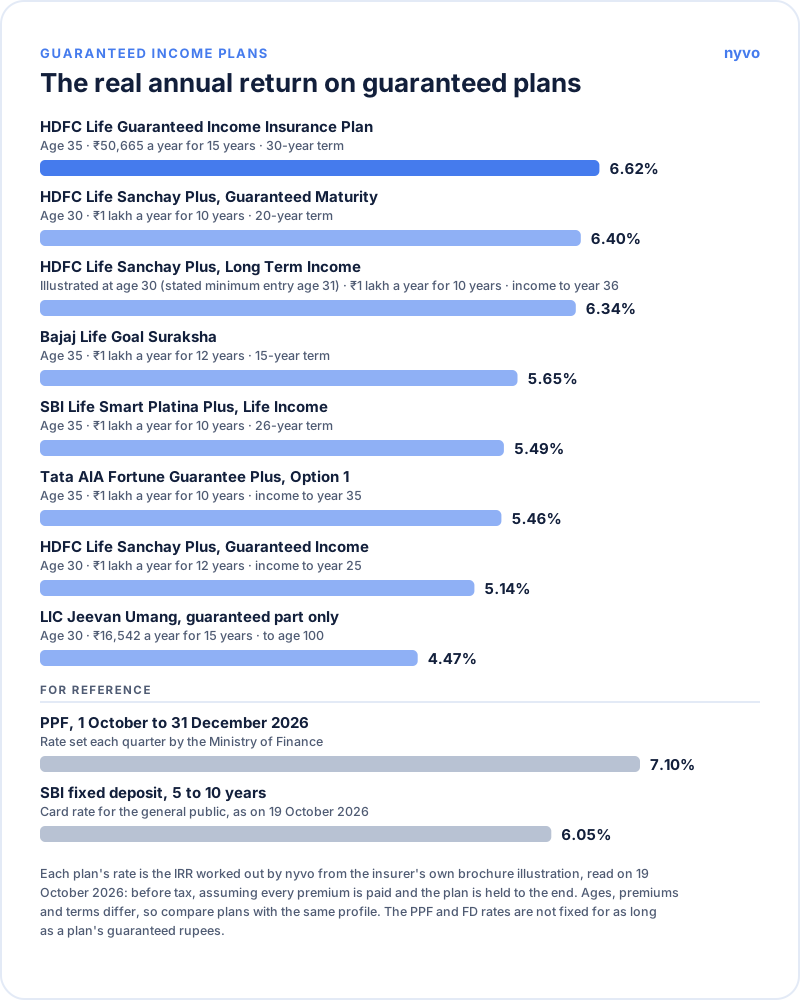
The real return is the annual rate a plan's own cash flows work out to, its internal rate of return (IRR). On the guaranteed savings plans we checked, it is 5.1% to 6.6% a year. We worked it out on 19 October 2026 from the insurers' current brochure illustrations, for five non-participating plans from HDFC Life, SBI Life, Tata AIA and Bajaj Life, each with its own inputs stated below.
In the two plans below that are sold on an "11%" and an "8%", that percentage is the yearly income as a share of the sum assured, which is a different number.
Every rupee in a non-participating plan is in the contract, so its rate can be worked out exactly before you sign. That is what this page does, plan by plan, with the inputs beside each figure.
What does "11% guaranteed" actually mean?
On HDFC Life's Guaranteed Income Insurance Plan, "11% guaranteed" means the yearly income is 11% of the sum assured, not an 11% return on your money. The brochure (UIN 101N146V11) lists "Guaranteed income of 11% to 12% per annum" as a key benefit; on its own example of a 35-year-old paying ₹50,665 a year for 15 years, the return works out to 6.62% a year.
| From HDFC Life's example | |
|---|---|
| Age at entry | 35 |
| Premium | ₹50,665 a year, paid at the start of each policy year for 15 years |
| Total premiums | ₹7,59,975 |
| Policy term | 30 years |
| Guaranteed income | ₹1,02,884 a year, from the end of year 16 to the end of year 30 (15 payments) |
| Maturity benefit | ₹9,35,310, paid with the last income at the end of year 30 |
| Total received | ₹24,78,570, or 3.26 times the premiums |
| Annual return (IRR) | 6.62% |
The brochure describes the ₹1,02,884 as "equivalent to 11% of the Sum Assured", and the arithmetic agrees: ₹1,02,884 is 11.0% of ₹9,35,310. So the 11% is the income measured against the sum assured. Measured against the money you pay in, over the 30 years it takes, the plan returns 6.62% a year. That is the highest rate of the plans on this page, and it is still not 11%.
Does LIC Jeevan Umang's "8% every year" mean an 8% return?
No. LIC's policy document for Jeevan Umang (Plan 745, UIN 512N312V03) pays a survival benefit of 8% of the basic sum assured every year from the end of the premium-paying term, and the sum assured plus any bonuses at maturity, at age 100. It is 8% of the cover, not 8% of what you pay.
On LIC's own sample premium for a 30-year-old with a ₹2,00,000 sum assured and a 15-year premium-paying term:
- You pay ₹16,542 a year for 15 years, ₹2,48,130 in total.
- You receive ₹16,000 a year (8% of ₹2,00,000) from the end of year 15 until age 99: 55 payments, ₹8,80,000.
- At age 100 you receive the ₹2,00,000 sum assured, plus bonuses if LIC declares them.
The guaranteed money back is ₹10,80,000, or 4.35 times what you paid, spread over 70 years. As an annual rate that is 4.47%. Jeevan Umang is a participating plan, so bonuses can add to the maturity payout, but they are declared by LIC each year and are not in the contract. Our Jeevan Umang review looks at what the bonuses could add.
What do the main guaranteed plans really return?
The main guaranteed plans we checked return between 5.14% and 6.62% a year on their insurers' own examples, read on 19 October 2026: HDFC Life's Guaranteed Income Insurance Plan is highest at 6.62% and Sanchay Plus Guaranteed Income lowest at 5.14%. Ages, premiums and terms differ, so compare rows only within the same profile.
Each row below is the insurer's own illustration from its current brochure, with the IRR worked out by script. Premiums are paid at the start of each policy year and benefits at the end of the year shown.
Age 35, ₹1,00,000 a year
| Plan and option | Premiums | Policy term | What comes back | Multiple | IRR |
|---|---|---|---|---|---|
| SBI Life Smart Platina Plus, Life Income (UIN 111N133V06) | 10 years, ₹10,00,000 | 26 years | ₹93,460 a year, years 12 to 26, plus ₹11,00,000 at year 26 | 2.50 | 5.49% |
| SBI Life Smart Platina Plus, Guaranteed Income | 10 years, ₹10,00,000 | 26 years | ₹90,720 a year, years 12 to 26, plus ₹11,00,000 at year 26 | 2.46 | 5.37% |
| Tata AIA Fortune Guarantee Plus, Option 1 (UIN 110N158V15) | 10 years, ₹10,00,000 | 10 years, then a 25-year income period | ₹80,980 a year for 25 years, years 11 to 35, plus ₹10,00,000 at the end | 3.02 | 5.46% |
| Tata AIA Fortune Guarantee Plus, Option 2, with critical-illness benefit | 10 years, ₹10,00,000 | 10 years, then a 25-year income period | ₹80,540 a year for 25 years, years 11 to 35, plus ₹10,00,000 at the end | 3.01 | 5.44% |
| Bajaj Life Goal Suraksha (UIN 116N155V20) | 12 years, ₹12,00,000 | 15 years | ₹20,59,000 at the end of year 15 | 1.72 | 5.65% |
Age 30, ₹1,00,000 a year
| Plan and option | Premiums | Policy term | What comes back | Multiple | IRR |
|---|---|---|---|---|---|
| HDFC Life Sanchay Plus, Guaranteed Maturity (UIN 101N134V30) | 10 years, ₹10,00,000 | 20 years | ₹26,57,500 at the end of year 20 | 2.66 | 6.40% |
| HDFC Life Sanchay Plus, Long Term Income (illustrated at age 30; the option's stated minimum entry age is 31) | 10 years, ₹10,00,000 | 11 years, then a 25-year income period | ₹1,05,000 a year, years 12 to 36, plus ₹10,00,000 at year 36 | 3.63 | 6.34% |
| HDFC Life Sanchay Plus, Guaranteed Income | 12 years, ₹12,00,000 | 13 years, then a 12-year income period | ₹2,01,750 a year, years 14 to 25 | 2.02 | 5.14% |
Age 35, ₹50,665 a year for 15 years, 30-year policy term: HDFC Life Guaranteed Income Insurance Plan, 6.62%, as set out above.
Two notes on the rows. Tata AIA's yearly income is two columns in its table, a guaranteed annual income and an income booster (₹40,490 each on Option 1, ₹40,270 each on Option 2), which its brochure says are added together; its policy document starts the income at the end of the policy year after maturity, so the first of 25 payments comes at the end of year 11. On Sanchay Plus, the brochure illustrates Long Term Income at age 30, although the option's stated minimum entry age in the same brochure is 31; we use the brochure's own illustration as printed. The brochure's fourth option, Life Long Income, is illustrated at age 50 (₹79,750 a year from year 12 to age 99, plus ₹10,00,000), which works out to 5.36% but is not comparable with the age-30 rows.
Why does a plan that triples your money pay only about 6%?
Because a multiple ignores how long your money is tied up. On its own example for a 35-year-old paying ₹50,665 a year for 15 years, HDFC Life's Guaranteed Income Insurance Plan pays back 3.26 times the premiums, but over a 30-year policy, which is 6.62% a year.
Inside Sanchay Plus, on the brochure's own age-30 illustrations (Long Term Income's stated minimum entry age is 31), the Long Term Income option pays back 3.63 times and returns 6.34%, while Guaranteed Maturity pays back only 2.66 times and returns more, 6.40%, because it finishes 16 years sooner.
The longer a plan runs, the bigger its multiple looks and the less that multiple tells you. The rate is the only number that lets you compare one plan with another, or with anything else you could do with the money. Our guide to reading a benefit illustration shows how to work it out yourself.
How do these returns compare with a PPF or a fixed deposit?
As of 19 October 2026, the Public Provident Fund pays 7.1% a year and SBI's fixed deposit card rate for 5 to 10 years is 6.05% for the general public. Every guaranteed plan on this page pays less than the PPF's current rate, and the plans' 5.1% to 6.6% sits on either side of the SBI deposit rate.
| Rate | Source and date | |
|---|---|---|
| PPF | 7.1% a year | Ministry of Finance (Department of Economic Affairs) office memorandum of 30 September 2026, keeping small savings rates for 1 October to 31 December 2026 unchanged; National Savings Institute lists PPF at 7.1% from 1 April 2020 |
| SBI fixed deposit, 5 years up to 10 years | 6.05% (7.05% for senior citizens, including the 0.50% SBI We-care premium) | SBI rates for retail deposits below ₹3 crore, effective 15 December 2025, as shown on SBI's rate page on 19 October 2026 |
| Guaranteed plans on this page | 5.14% to 6.62% | Insurers' own illustrations, worked out by nyvo |
The comparison is not exactly like for like, and the differences cut both ways:
- A plan's guaranteed rupees are fixed for its whole term, 15 to 36 years for the plans in the tables above. The PPF rate is set by the government every quarter, and an SBI deposit rate is fixed only for the deposit's own term, at most 10 years here.
- A PPF takes at most ₹1,50,000 in a financial year, matures after 15 complete financial years, allows a loan from the 3rd to the 6th year and withdrawals from the 7th, and its interest is free of income tax (National Savings Institute).
- A plan carries some life cover; a deposit and a PPF do not. A term plan buys far more cover for far less, which is the case set out in life insurance vs term insurance.
- Whether a plan's payouts are tax-free depends on the tax law and on your total premiums; our benefit illustration guide covers the conditions.
So the honest case for a guaranteed plan is a rate fixed for decades, not a high rate. If you value that certainty, the rate you are paying for it is the gap between the plan's IRR and what the alternatives pay today.
What about participating plans like LIC Jeevan Labh?
On a participating plan, only the guaranteed column is a promise. LIC's own benefit illustration for Jeevan Labh (Plan 736, UIN 512N304V03) shows a 30-year-old with a ₹2,00,000 sum assured, a 25-year policy and a 16-year premium-paying term, paying ₹10,025 a year, ₹1,60,400 in total:
| What you get at year 25 | Amount | Multiple | IRR |
|---|---|---|---|
| Guaranteed only (the sum assured) | ₹2,00,000 | 1.25 | 1.26% |
| LIC's 4% scenario, with bonuses | ₹2,20,000 | 1.37 | 1.80% |
| LIC's 8% scenario, with bonuses | ₹3,70,000 | 2.31 | 4.76% |
The 4% and 8% are the gross investment returns IRDAI currently requires insurers to illustrate (Master Circular on Protection of Policyholders' Interests, 5 September 2024, Schedule B). LIC's own illustration says they are not guaranteed and are not the upper or lower limits of what you might get. Even the 8% scenario works out to 4.76% a year on the premiums you pay: the 8% is an assumed investment return, not the rate your money earns.
If you already hold a Jeevan Labh, Jeevan Umang or New Jeevan Anand policy, our guide to surrendering or making an LIC policy paid-up works through the three ways out on LIC's own numbers.
How do you work out the return on a plan you are being sold?
To work out the return on a plan you are being sold, get the benefit illustration for your own age, premium and term, list every premium and every payout in the year it falls, and run the IRR function on the guaranteed figures, keeping any non-guaranteed scenarios separate. Then state the entry age, annual premium, premium-paying term and policy term beside the result. Five steps:
- Ask what the headline percentage is a percentage of. If it is the sum assured or the annual premium, it is not your return.
- Get the benefit illustration for your own age, premium and term. It is part of the sale: the insurer must give you a customised illustration, signed by you and the seller, and it forms part of the policy document (IRDAI Master Circular on Life Insurance Products, 12 June 2024).
- List every premium and every payout by year, premiums as negatives, payouts as positives, and zero in the years nothing happens.
- Use the IRR function, minding the offset: a premium due at the start of year 1 is in the first row, and a payout at the end of year 20 is 20 rows below it.
- On a participating plan, use the guaranteed column only. Bonus columns are illustrations.
Then set the rate beside what else that money could do for the same number of years. If the seller cannot give you the rate, the illustration they have already handed you can.
What if you have already signed?
Check whether you are still in the free-look period: 15 days for most policies and 30 days for policies sold electronically or through distance marketing, counted from the day you receive the policy document. Inside it you can cancel for a refund; our free-look period guide explains how.
If you bought a market-linked plan at a bank branch, our guide to a bank-sold ULIP covers the exits and the complaint route.
Outside the window, early exit is where savings plans lose the most, because the surrender value in the first years is well below what you have paid. Compare surrendering with making the policy paid-up before you decide.
Want a second pair of eyes on an illustration before you sign? A nyvo advisor can work out the rate on your own quote and price the term cover alongside it. nyvo is an IRDAI-registered corporate agent (composite), licence CA1085.
FAQs
Is an 11% guaranteed return from an insurance plan real?
Not as a return on your money. In HDFC Life's own example for its Guaranteed Income Insurance Plan, the 11% is the yearly income as a share of the sum assured. A 35-year-old paying ₹50,665 a year for 15 years on a 30-year policy and receiving ₹1,02,884 a year for 15 years plus ₹9,35,310 at the end gets 6.62% a year.
What is the IRR of HDFC Life Guaranteed Income Insurance Plan?
6.62% a year on HDFC Life's own brochure example (UIN 101N146V11): age 35, ₹50,665 a year for 15 years, a 30-year policy term, ₹1,02,884 a year from the end of year 16 to year 30, and ₹9,35,310 at maturity. You pay ₹7,59,975 and receive ₹24,78,570, which is 3.26 times the premiums.
Does LIC Jeevan Umang give an 8% return?
No. Jeevan Umang pays 8% of the basic sum assured each year, not 8% of your premiums. On LIC's sample premium for age 30 and a ₹2,00,000 sum assured, ₹16,542 a year for 15 years buys ₹16,000 a year until age 99 and ₹2,00,000 at age 100, which is a guaranteed 4.47% a year on a policy running to age 100. Bonuses can add to the maturity payout but are not guaranteed.
Are guaranteed income plans better than PPF?
Not on return. The PPF pays 7.1% a year for October to December 2026, against 5.1% to 6.6% on the guaranteed plans we checked. A plan fixes its rupees for its whole term and carries some life cover; the PPF rate is reset each quarter and deposits are capped at ₹1,50,000 a financial year.
Are guaranteed plans better than a fixed deposit?
They are close, before tax. SBI's card rate for 5 to 10 year deposits is 6.05% for the general public as of 19 October 2026, and the guaranteed plans we checked return 5.1% to 6.6%. A plan fixes its rupees for its whole term, 15 years or more for the plans we checked; an SBI deposit's rate is fixed only for its own term, at most 10 years.
Why do different illustrations show different returns for the same plan?
Because the rate depends on your age, the premium, the premium-paying term, the policy term and the option you choose. Sanchay Plus alone ranges from 5.14% to 6.40% across its options on HDFC Life's own age-30 examples, each with ₹1,00,000 a year of premium. Ask for the illustration built on your own details and work out the rate from that.
Is the return on a guaranteed plan really guaranteed?
On a non-participating plan, yes: every rupee in the illustration's guaranteed columns is in the contract, provided you pay every premium and hold the policy to the end. Exiting early pays the surrender value instead, which is lower in the early years. On a participating plan only the guaranteed column is promised; bonuses are declared each year.
Related guides:
Sources:
- HDFC Life Guaranteed Income Insurance Plan brochure, UIN 101N146V11 (hdfclife.com, read 19 October 2026)
- HDFC Life Sanchay Plus brochure, UIN 101N134V30, sample illustration (hdfclife.com, read 19 October 2026)
- SBI Life Smart Platina Plus brochure and policy document, UIN 111N133V06 (sbilife.co.in, read 19 October 2026)
- Tata AIA Fortune Guarantee Plus brochure and policy document, UIN 110N158V15 (tataaia.com, read 19 October 2026)
- Bajaj Life Goal Suraksha brochure, UIN 116N155V20 (bajajlifeinsurance.com, read 19 October 2026)
- LIC's Jeevan Umang (Plan 745, UIN 512N312V03) policy document and sales brochure; LIC's Jeevan Labh (Plan 736, UIN 512N304V03) sales brochure benefit illustration (licindia.in, read 19 October 2026)
- Ministry of Finance, Department of Economic Affairs, office memorandum F.No.1/4/2019-NS, 30 September 2026; National Savings Institute, Public Provident Fund interest rate history and scheme rules
- State Bank of India, interest rates on retail domestic term deposits below ₹3 crore (sbi.bank.in, last updated 19 October 2026)
- IRDAI Master Circular on Life Insurance Products, Ref. IRDAI/ACTL/MSTCIR/MISC/89/6/2024, 12 June 2024 (customised benefit illustration)
- IRDAI Master Circular on Protection of Policyholders' Interests, Ref. IRDAI/PP&GR/CIR/MISC/117/9/2024, 5 September 2024, Schedule B (4% and 8% illustration returns)
Real returns at a glance
| HDFC Life Guaranteed Income Insurance Plan (UIN 101N146V11) | Pitched as guaranteed income of 11% to 12% a year. Brochure example: age 35, ₹50,665 a year for 15 years, 30-year policy term: 6.62% a year (HDFC Life brochure, read 19 October 2026). |
|---|---|
| HDFC Life Sanchay Plus (UIN 101N134V30), ₹1,00,000 a year | Guaranteed Maturity, age 30, 10 years of premiums, 20-year policy term: 6.40%. Long Term Income, illustrated at age 30 although the option's stated minimum entry age is 31, 10 years of premiums, 11-year policy term, income years 12 to 36: 6.34%. Guaranteed Income, age 30, 12 years of premiums, 13-year policy term, income years 14 to 25: 5.14% (HDFC Life brochure, read 19 October 2026). |
| SBI Life Smart Platina Plus (UIN 111N133V06) | Age 35, ₹1,00,000 a year for 10 years, 26-year policy term: Life Income 5.49%, Guaranteed Income 5.37% (SBI Life brochure, read 19 October 2026). |
| Tata AIA Fortune Guarantee Plus (UIN 110N158V15) | Age 35, ₹1,00,000 a year for 10 years, 10-year policy term, income years 11 to 35: Option 1 5.46%, Option 2 5.44% (Tata AIA brochure and policy document, read 19 October 2026). |
| Bajaj Life Goal Suraksha (UIN 116N155V20) | Age 35, ₹1,00,000 a year for 12 years, 15-year policy term: 5.65% (Bajaj Life brochure, read 19 October 2026). |
| LIC Jeevan Umang (Plan 745), guaranteed part only | 8% of the sum assured each year. Age 30, ₹2,00,000 sum assured, ₹16,542 a year for 15 years, policy term to age 100: 4.47% a year (LIC sample premium and policy document, read 19 October 2026). |
| PPF, 1 October to 31 December 2026 | 7.1% a year (Ministry of Finance, office memorandum of 30 September 2026). |
| SBI fixed deposit, 5 to 10 years | 6.05% for the general public, 7.05% for senior citizens (SBI rate page, 19 October 2026). |
Each plan rate is the internal rate of return worked out by nyvo from the insurer's own brochure illustration, read on 19 October 2026: before tax, assuming every premium is paid and the policy is held to the end. It is arithmetic on the insurer's figures, not a projection or a promise, and your own illustration will differ with age, premium and term.
Book a call for advice on the best policy for you and your family
A salaried, IRDAI-certified nyvo advisor will look at your cover, flag the gaps that matter, and tell you plainly what to fix. No commission, no pressure.
A first in India
Buy policy from nyvo insurance with Claim Support Guarantee, otherwise money back.

16+ years in financial services. Former investment banker at Bank of America, Kotak Investment Banking, and SBICaps, and ex-CFO of slice. Founder of nyvo and Principal Officer – IRDAI Certified.