First in India
Claim Support Guarantee, otherwise your money back.
Buy through nyvo and we get your claim passed, otherwise refund your premium. We are putting our money on our claim service.
Sold a ULIP at Your Bank? Keep It, Cancel It or Stop Paying
Signed a ULIP while opening an account, applying for a locker or moving a loan along? What you get back if you cancel in the free-look period, stop paying inside the five-year lock-in, or keep going, and how to complain if it was mis-sold.

Can you get out of a ULIP you signed at your bank?
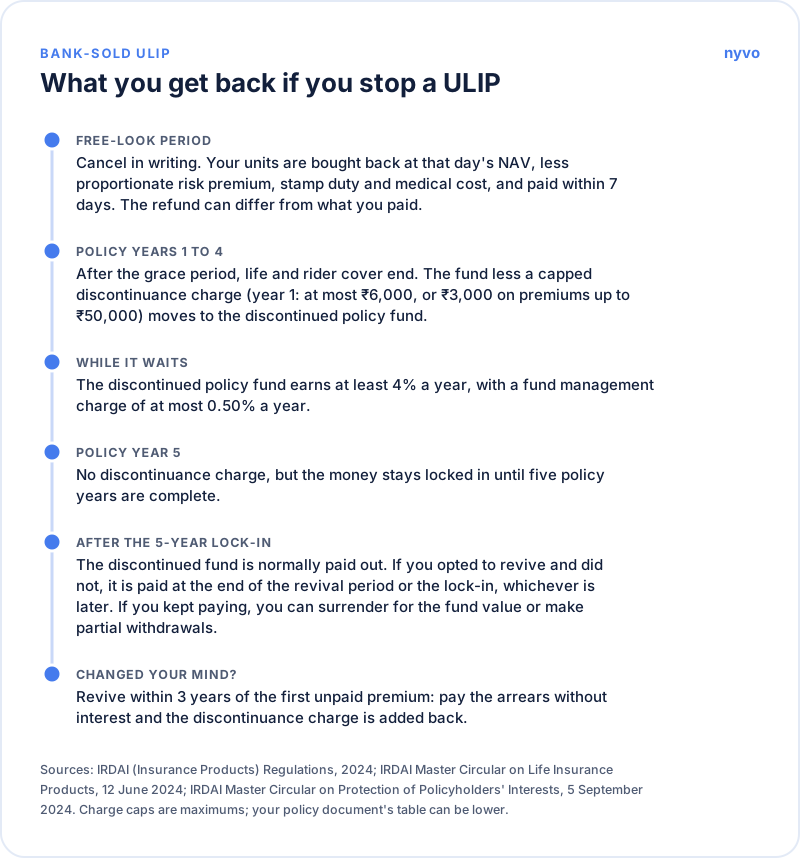
Yes, but what you get back depends on when you act. In the free-look period you can cancel for a refund at that day's NAV, less permitted deductions. After it, a ULIP is locked in for five completed policy years: stop paying and your fund, less a capped charge, waits in a discontinued policy fund earning at least 4% a year, normally until the lock-in ends; then you can surrender for the fund value.
The rest of this guide takes each exit in turn, with the figures from the regulation that sets them, and ends with how to complain if the policy was sold to you as something it was not.
Was your ULIP sold as part of an account, a locker or a loan?
A ULIP is a separate contract between you and an insurance company, which the bank sells as the insurer's distributor; your account, locker or loan is a different arrangement with the bank. If a ULIP proposal was put in front of you and you were told one depended on the other, that is a complaint about how the policy was sold, and there is a route for it (below).
Two rules matter here. Before selling a savings-type life insurance product, the insurer must assess whether it suits you, using your age, income, goals and the insurance you already hold, and must have a Board-approved policy to curb mis-selling and force-selling (IRDAI Master Circular on Protection of Policyholders' Interests, 5 September 2024, Chapter II, para 5). And the benefit illustration you were shown must be signed by you and by the person who sold the policy, and it forms part of the policy document (IRDAI Master Circular on Life Insurance Products, 12 June 2024). What that signed paper says is your best evidence of what you were told.
What should you check before you decide?
Before deciding what to do with a bank-sold ULIP, check four things in the papers the insurer sent you: the date you received the policy document, the annual premium, the policy year you are in, and the discontinuance charge table.
The insurer must send those papers within 15 days of accepting your proposal, including a copy of your proposal form, the benefit illustration, the customer information sheet and any need-analysis document (IRDAI Master Circular on Protection of Policyholders' Interests, 5 September 2024).
- The date you received the policy document. The free-look clock runs from that day, not from the day you paid.
- The annual premium. It decides which discontinuance-charge band applies: up to ₹50,000, or above it.
- The policy year you are in. Years 1 to 5 are the lock-in. The policy year counts from the policy's start date, not the calendar year.
- The discontinuance charge table in your policy document. IRDAI sets the ceiling; your insurer's own table can be lower.
Then ask the insurer, in writing, for today's fund value and the discontinuance charge that would apply if you stopped now. Those two numbers are the whole calculation.
How do you cancel a ULIP in the free-look period?
To cancel a ULIP in the free-look period, send the insurer a written cancellation request within the window, 15 days for most, and 30 days for policies sold electronically or through distance marketing, counted from the date you receive the policy document, and keep the acknowledgement. The insurer must pay the refund within 7 days of your request (IRDAI Master Circular on Protection of Policyholders' Interests, 5 September 2024).
A phone call does not count. Our free-look period guide covers the general rules.
On a ULIP the refund works slightly differently from other policies. The insurer deducts a proportionate risk premium for the days you were covered, stamp duty and any medical examination cost, and pays the rest by buying back your units at the NAV on the date of cancellation. It must pay within 7 days of your request, or add interest at the bank rate plus 2% (IRDAI Master Circular on Protection of Policyholders' Interests, 5 September 2024, Part A, III.2). Because the refund depends on the NAV on the cancellation date and the permitted deductions, it can differ from the premium you paid. Ask the insurer for its calculation of the refund rather than assuming a near-full one.
Whatever reason you give, the insurer must accept the request. If you are inside the window and you did not want the policy, this is the exit to take.
What happens if you stop paying a ULIP in the first five years?
If you stop paying a ULIP inside its five-year lock-in, the policy is discontinued once the grace period ends: life and rider cover stop, and the fund value less a capped discontinuance charge moves to the discontinued policy fund, earning at least 4% a year. The money is normally paid out when the lock-in ends (IRDAI Master Circular on Life Insurance Products, 12 June 2024, para 40.1).
Stopping does not put money back in your account sooner. Under the IRDAI (Insurance Products) Regulations, 2024, the lock-in period is five consecutive completed years from the policy's start, during which the proceeds cannot be paid out except on death or another covered event.
Here is what happens if a premium stays unpaid after the grace period (30 days on annual, half-yearly or quarterly premiums, 15 days on monthly):
- The life cover and any rider cover end.
- The fund value, less the discontinuance charge, moves to the discontinued policy fund.
- The insurer must write to you within three months of the first unpaid premium, offering the option to revive.
- The money is normally paid out when the five-year lock-in ends. If you choose to revive but then do not, it is paid at the end of the three-year revival period or the lock-in, whichever is later.
Surrendering inside the lock-in, instead of just stopping, leads to the same place: the fund value less the charge goes into the discontinued policy fund, and the proceeds are paid at the end of the lock-in or on the date of surrender, whichever is later (IRDAI Master Circular on Life Insurance Products, 12 June 2024, para 40.1).
How much is the discontinuance charge?
IRDAI caps the ULIP discontinuance charge by policy year and by the size of the annual premium. The charge can be no more than a percentage of the annual premium or of the fund value, whichever is lower, and never more than a rupee ceiling (IRDAI (Insurance Products) Regulations, 2024, Schedule I, clause 2(A)(vi)(c)(V)):
| Policy year you stop in | Annual premium up to ₹50,000 | Annual premium above ₹50,000 |
|---|---|---|
| Year 1 | 20%, at most ₹3,000 | 6%, at most ₹6,000 |
| Year 2 | 15%, at most ₹2,000 | 4%, at most ₹5,000 |
| Year 3 | 10%, at most ₹1,500 | 3%, at most ₹4,000 |
| Year 4 | 5%, at most ₹1,000 | 2%, at most ₹2,000 |
| Year 5 onwards | Nil | Nil |
Worked example. The maximum is the lowest of three numbers: the percentage of the annual premium, the same percentage of the fund value, and the rupee ceiling. On a ULIP with an annual premium of ₹1,00,000, if you pay the first year and stop at the second, the charge cannot exceed the lowest of 4% of ₹1,00,000 (₹4,000), 4% of your fund value, and ₹5,000, so it is at most ₹4,000 and less if your fund value is below ₹1,00,000. On an annual premium of ₹45,000 stopped at the second year, it cannot exceed the lowest of 15% of ₹45,000 (₹6,750), 15% of your fund value, and ₹2,000, so it is at most ₹2,000 and less if 15% of your fund value is under ₹2,000. Your policy's own charge can be lower than either cap.
The discontinuance charge is not the only cost. Depending on the policy, the fund may already have paid a premium allocation charge (capped at 12.5% of the annual premium in any year), a policy administration charge (capped at ₹500 a month), mortality charges for the life cover, and a fund management charge (capped at 1.35% a year on each fund), all under the same Schedule I. That is why the fund value after a year or two can be below what you paid in, and why your fund statement and the policy's charge schedule, not the premium total, are what to check.
What does the discontinued policy fund earn?
The discontinued policy fund carries a minimum guaranteed interest rate of 4% a year (IRDAI Master Circular on Life Insurance Products, 12 June 2024, para 40.1.5). Only a fund management charge can be taken from it, capped at 0.50% a year, and any income it earns above the 4% minimum also belongs to the discontinued policies, not the insurer's shareholders (IRDAI (Insurance Products) Regulations, 2024, Schedule I).
Can you change your mind?
You can revive a discontinued ULIP within three years of the first unpaid premium. To revive, you pay the premiums you missed, with no interest or fee, the insurer adds back the discontinuance charge it took, and your life cover is restored (IRDAI Master Circular on Life Insurance Products, 12 June 2024, para 40.1.4).
The insurer can take the allocation and administration charges that would have applied while the policy was discontinued.
What can you do with a ULIP once the five-year lock-in ends?
Once a ULIP's five-year lock-in is complete, you can surrender it for at least the fund value on that day with no discontinuance charge, take partial withdrawals, or stop paying, which makes it a reduced paid-up policy with a smaller sum assured and no rider cover (IRDAI (Insurance Products) Regulations, 2024, Schedule I; IRDAI Master Circular on Life Insurance Products, 12 June 2024, paras 40.1.6 and 42.1). In more detail:
- Surrender pays at least the fund value on the date you surrender, and the discontinuance charge is nil from year 5 (IRDAI (Insurance Products) Regulations, 2024, Schedule I).
- Partial withdrawals are allowed after the lock-in (IRDAI Master Circular on Life Insurance Products, 12 June 2024, para 42.1).
- If you stop paying after the lock-in, the policy becomes a reduced paid-up policy without rider cover: the sum assured is cut to the original sum assured multiplied by the years of premium you paid over the years you were meant to pay. Charges continue during the three-year revival period, with mortality charges on the reduced sum assured only, and at the end of that period the fund is paid out if you have not revived. You can also surrender at any time and take the fund.
How to choose between stopping now and paying on to year 5 comes down to two separate questions. For the money already in, stopping means it sits in the discontinued policy fund at a minimum of 4% a year, normally until the lock-in ends; carrying on means it stays in the funds you chose, with their charges. For the money not yet paid, the question is the one you would ask of any new investment: would you choose this product, with these charges, for that money today? What you have already paid is the same either way, so it should not decide the second question.
If the plan was sold to you as an investment, our comparison of term vs ULIP vs endowment sets out why bundling cover and savings makes each half harder to judge, and our guide to reading a benefit illustration shows how to express any savings policy as an annual rate. On a guaranteed savings plan, the same arithmetic is done for you in the real return on guaranteed income plans.
What if the ULIP is your only life cover?
If a ULIP is your only life cover and someone depends on your income, buy term insurance first and stop the ULIP second. In the lock-in, discontinuing after the grace period ends the life and rider cover; after it, stopping leaves a reduced paid-up policy with a smaller sum assured and no rider cover (IRDAI Master Circular on Life Insurance Products, 12 June 2024, paras 40.1.1 and 40.1.6).
The order matters because your age and health on the day you apply decide whether you can get term cover and what it costs. How much cover you need sizes it, and our guide to surrendering a life insurance policy covers the same order of steps for endowment and money-back plans.
Not sure whether to cancel, stop or stay? A nyvo advisor can go through your policy document and fund statement with you and price the term cover that would replace it. nyvo is an IRDAI-registered corporate agent (composite), licence CA1085.
How do you complain about a mis-sold ULIP?
To complain about a mis-sold ULIP, write to the insurer first, which must resolve the complaint within 14 days, then register it on IRDAI's Bima Bharosa portal, then take it to the Insurance Ombudsman, which is free and whose order binds the insurer (IRDAI Master Circular on Protection of Policyholders' Interests, 5 September 2024; Insurance Ombudsman Rules, 2017).
Keep copies of everything; the first step is the one that opens the others.
1. Write to the insurer. You can complain to the insurer, to the bank that sold the policy, or to both, by email, letter, the insurer's website or a branch. The insurer must acknowledge it at once and resolve it within 14 days, giving reasons if it does not accept the complaint (IRDAI Master Circular on Protection of Policyholders' Interests, 5 September 2024, Part A, VI). Say plainly what you were told at the branch, when, and by whom, and what you want: for example, cancellation and a refund of the premiums. Attach the proposal form, the signed benefit illustration and the need-analysis document if there was one.
2. Register it on Bima Bharosa. IRDAI's grievance portal at bimabharosa.irdai.gov.in registers the complaint with the insurer and lets you track it. It puts the complaint on the insurer's record; it does not decide your case. More on the portal in our Bima Sugam and Bima Bharosa guide.
3. Take it to the Insurance Ombudsman. The Ombudsman decides the case, and its order binds the insurer. Its remit includes misrepresentation of policy terms and grievances against an insurer's agents and intermediaries (Insurance Ombudsman Rules, 2017, rule 13). As our Insurance Ombudsman guide explains, you must have complained to the insurer first and given it 30 days, then file within one year of its final reply. Filing is free, and you can file online at cioins.co.in.
FAQs
Can I cancel a ULIP that my bank sold me?
Yes, if you are still inside the free-look period: 15 days for most policies and 30 days for policies sold electronically or through distance marketing, counted from the day you received the policy document. Cancel in writing. The insurer buys back your units at that day's NAV and refunds the proceeds less a proportionate risk premium, stamp duty and any medical cost within 7 days (IRDAI Master Circular on Protection of Policyholders' Interests, 5 September 2024), so the amount can differ from what you paid.
What happens if I stop paying ULIP premiums before 5 years?
Once the grace period ends, your life cover ends and your fund value, less a capped discontinuance charge, moves to the discontinued policy fund, which earns at least 4% a year. The money is normally paid when the lock-in ends; if you opt to revive and do not, at the end of the revival period or the lock-in, whichever is later (IRDAI Master Circular on Life Insurance Products, 12 June 2024). You can revive within three years of the first unpaid premium by paying the missed premiums, without interest.
How much is the ULIP discontinuance charge?
Under the IRDAI (Insurance Products) Regulations, 2024, it is at most 6% of the annual premium or fund value, whichever is lower, capped at ₹6,000, if you stop in year 1 on an annual premium above ₹50,000, falling to 2% and ₹2,000 in year 4. For premiums up to ₹50,000 the year-1 cap is 20%, at most ₹3,000. From year 5 there is no charge.
Can I withdraw money from a ULIP before 5 years?
No. During the five-year lock-in set by the IRDAI (Insurance Products) Regulations, 2024, the proceeds cannot be paid out except on death or another event the policy covers, and partial withdrawals are allowed only after the lock-in. Surrendering inside the lock-in moves the money to the discontinued policy fund, where it waits until the lock-in ends.
What interest does the discontinued policy fund pay?
A minimum guaranteed 4% a year, set by IRDAI's Master Circular on Life Insurance Products (12 June 2024). Only a fund management charge of at most 0.50% a year can be deducted, and any income above the 4% minimum is added to the discontinued policies rather than kept by the insurer.
Can I complain if the bank said the ULIP was compulsory?
Yes. Complain in writing to the insurer, the bank or both; the insurer must resolve it within 14 days (IRDAI Master Circular on Protection of Policyholders' Interests, 5 September 2024). If it rejects the complaint, does not reply, or you are unhappy with the answer, register it on Bima Bharosa and take it to the Insurance Ombudsman, which hears complaints about misrepresentation and about insurers' intermediaries, free of charge.
Do I lose my life cover if I stop paying my ULIP?
Inside the five-year lock-in, yes: once the grace period ends unpaid, the policy is discontinued and its life and rider cover stop. After the lock-in, stopping makes it a reduced paid-up policy with a smaller sum assured and no rider cover (IRDAI Master Circular on Life Insurance Products, 12 June 2024). Either way, buy term insurance before you stop the ULIP if anyone depends on your income.
Related guides:
Sources:
- IRDAI (Insurance Products) Regulations, 2024, F. No. IRDAI/Reg/8/202/2024: Schedule I, clause 1.24 (lock-in), clause 2(A)(vi)(c) (charge caps, including the discontinuance charge table), clause 2(A)(vii) and (viii) (discontinued policy fund), clause 4(B) (linked surrender values)
- IRDAI Master Circular on Life Insurance Products, Ref. IRDAI/ACTL/MSTCIR/MISC/89/6/2024, 12 June 2024: Chapter 1 Section I paras 3 and 8 (benefit illustration, grace period); paras 40 to 42 (discontinuance, revival, the 4% minimum, partial withdrawals)
- IRDAI Master Circular on Protection of Policyholders' Interests, Ref. IRDAI/PP&GR/CIR/MISC/117/9/2024, 5 September 2024: Section 1 Part A, II.8 (documents within 15 days), III.2 (free-look refund on linked products), VI (complaints, 14 days, Ombudsman); Section 2 Chapter II para 5 (suitability, mis-selling)
- Insurance Ombudsman Rules, 2017, as amended up to 9 November 2023 (rules 13 and 14), Council for Insurance Ombudsmen
Your ULIP exits at a glance
| Free-look period | 15 days for most policies and 30 days for policies sold electronically or through distance marketing, counted from the day you receive the policy document. Cancel in writing. |
|---|---|
| Free-look refund on a ULIP | Premium less proportionate risk premium, stamp duty and any medical examination cost, paid by buying back your units at the NAV on the cancellation date, within 7 days (IRDAI Master Circular on Protection of Policyholders' Interests, 5 September 2024). |
| Lock-in | Five completed policy years from the start of the policy (IRDAI (Insurance Products) Regulations, 2024). |
| Stop paying in years 1 to 5 | After the grace period, life and rider cover end and the fund value less a capped discontinuance charge moves to the discontinued policy fund. Normally paid out when the lock-in ends; if you opt to revive and do not, at the end of the revival period or the lock-in, whichever is later (IRDAI Master Circular on Life Insurance Products, 12 June 2024, para 40.1). |
| Charge cap, annual premium above ₹50,000 | Year 1: 6%, at most ₹6,000. Year 2: 4%, at most ₹5,000. Year 3: 3%, at most ₹4,000. Year 4: 2%, at most ₹2,000. Year 5 onwards: nil (IRDAI (Insurance Products) Regulations, 2024, Schedule I). |
| Charge cap, annual premium up to ₹50,000 | Year 1: 20%, at most ₹3,000. Year 2: 15%, at most ₹2,000. Year 3: 10%, at most ₹1,500. Year 4: 5%, at most ₹1,000. Year 5 onwards: nil (IRDAI (Insurance Products) Regulations, 2024, Schedule I). |
| Discontinued policy fund | Minimum guaranteed interest of 4% a year, and a fund management charge of at most 0.50% a year (IRDAI Master Circular on Life Insurance Products, 12 June 2024). |
| Revival | Within 3 years of the first unpaid premium. Arrears are collected without interest or fee and the discontinuance charge is added back (IRDAI Master Circular on Life Insurance Products, 12 June 2024, para 40.1.4). |
| After the lock-in | Surrender pays at least the fund value on that date and partial withdrawals are allowed; stopping premiums makes the policy reduced paid-up (IRDAI (Insurance Products) Regulations, 2024, Schedule I; IRDAI Master Circular on Life Insurance Products, 12 June 2024, paras 40.1.6 and 42.1). |
| Complaint route | The insurer (14 days to resolve), then IRDAI's Bima Bharosa portal, then the Insurance Ombudsman (free, within one year of the insurer's reply) (IRDAI Master Circular on Protection of Policyholders' Interests, 5 September 2024; Insurance Ombudsman Rules, 2017, rule 14). |
The charge caps are percentages of the annual premium or the fund value, whichever is lower, and they are maximums: your policy document's own table can be lower. They come from the IRDAI (Insurance Products) Regulations, 2024; a ULIP filed under earlier rules follows the table in its own policy document.
Book a call for advice on the best policy for you and your family
A salaried, IRDAI-certified nyvo advisor will look at your cover, flag the gaps that matter, and tell you plainly what to fix. No commission, no pressure.
A first in India
Buy policy from nyvo insurance with Claim Support Guarantee, otherwise money back.

16+ years in financial services. Former investment banker at Bank of America, Kotak Investment Banking, and SBICaps, and ex-CFO of slice. Founder of nyvo and Principal Officer – IRDAI Certified.