First in India
Claim Support Guarantee, otherwise your money back.
Buy through nyvo and we get your claim passed, otherwise refund your premium. We are putting our money on our claim service.
What Is Term Insurance? Meaning, Benefits and a ₹1 Crore Example
Term insurance in plain words: what it pays, why a plain plan pays nothing if you outlive it while refund versions cost more, what ₹1 crore costs at 30, the tax rules and who needs it.

Term insurance is life cover for a fixed number of years. If you die within that time, the insurer pays your family the amount you chose when you bought the policy. If you're still alive when the term ends, a plain term plan stops and pays nothing; return-of-premium versions hand back your premiums, at a higher price.
In rupees, it looks like this. A 30-year-old non-smoking man who buys ₹1 crore of cover to age 60 pays ₹8,856 to ₹10,440 a year across the five plans we rate, a median of ₹9,528 (nyvo premium data, May 2026). A woman of the same age pays ₹7,536 to ₹8,880, a median of ₹8,100. If he dies at 38, or at 59, his family receives ₹1 crore. If he reaches 60 on a plain plan, the cover ends and nothing comes back.
Read it in Hindi: यह पेज हिंदी में
Back to: Term Insurance guide
What does term insurance mean?
Term insurance means pure life cover for a set period, such as 30 years or until you turn 60. You pay a premium every year. If you die during the term, the insurer pays the sum assured to the person you named, your nominee. If you outlive the term, a plain policy ends with no payout. Term plan, term policy and term life insurance are all names for the same thing.
Insurers file these as "pure risk" plans, and the label is honest: there is no savings pot inside. Axis Max Life's prospectus for its Smart Term Plan Plus (UIN 104N132V01) puts it plainly for its standard variants: "No maturity benefit shall be payable upon survival of the life insured till the end of the policy term."
Four words on any term quote carry most of the meaning:
| On the quote | What it means | In the ₹1 crore example |
|---|---|---|
| Sum assured | What your family receives if you die within the term | ₹1 crore |
| Policy term | How long the cover lasts | 30 years, from age 30 to 60 |
| Premium | What you pay each year to keep the cover running | ₹9,528 a year, the median for a man |
| Nominee | The person who receives the money | Whoever you name, such as your spouse |
How does a term plan work? A ₹1 crore example
A term plan trades a small, fixed yearly premium for a large payout that happens only if you die within the term. On the median plan in nyvo's premium data (May 2026), a 30-year-old man pays ₹9,528 a year, ₹2,85,840 over 30 years, for ₹1 crore of cover that stays the same from 30 to 60. A woman pays a median ₹8,100 a year, ₹2,43,000 in all.
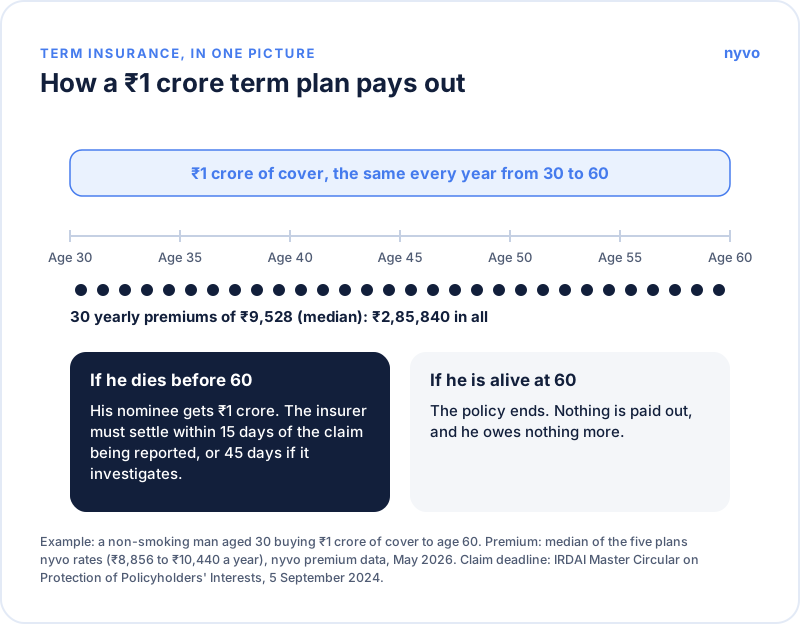
| ₹1 crore of cover to age 60, non-smoker, aged 30 | Man | Woman |
|---|---|---|
| Yearly premium across the five plans we rate | ₹8,856 to ₹10,440 | ₹7,536 to ₹8,880 |
| Median yearly premium | ₹9,528 | ₹8,100 |
| Paid in total by 60, at the median | ₹2,85,840 | ₹2,43,000 |
| If death happens before 60 | ₹1 crore to the nominee | ₹1 crore to the nominee |
| If alive at 60 | Cover ends, nothing paid | Cover ends, nothing paid |
nyvo premium data, May 2026: Bajaj Life eTouch II, Tata AIA Sampoorna Raksha Promise, Axis Max Life Smart Term Plan Plus, ICICI Pru iProtect Smart Plus and HDFC Life Click 2 Protect Supreme Plus, regular pay, non-smoker and non-diabetic, salaried graduate on ₹10 lakh income. These are the full premiums: individual life insurance has carried no GST since 22 September 2025 (56th GST Council meeting).
Two things about that example catch first-time buyers out. On a level plan the cover neither grows nor shrinks: it's ₹1 crore at 31 and ₹1 crore at 59. And the premium is set when you buy, not raised as you age the way a health premium is. Axis Max Life's prospectus, for one, says its premium rates are guaranteed "for the entire policy term". What changes with age is the rate you start at. The same cover bought at 35 costs a man a median ₹11,880 a year, and that figure then holds for the rest of his term.
Our data stops at ₹1 crore of cover to age 60, for non-smokers aged 25 to 45. For every age in that range, see what ₹1 crore of term cover costs by age. For your own number, get term insurance quotes on your age, your health and the cover you actually need.
What are the benefits of term insurance?
The main benefit of term insurance is a large amount of cover for a small premium: ₹1 crore for a median ₹9,528 a year at 30, which is less than 0.1% of the cover each year. The rest are smaller but real: a tax deduction if you file under the old regime, a tax-free payout for your family, optional riders, and a deadline the regulator sets for paying a claim.
Does term insurance save tax?
Yes, under the old tax regime. Premiums count towards the Section 80C deduction (section 123 of the Income-tax Act, 2025, from tax year 2026-27), up to ₹1.5 lakh a year in total with your PF, PPF, ELSS and other 80C items. The new regime, which applies unless you opt out of it, gives no deduction for the premium.
The payout is treated differently. The death benefit your family receives is tax-free under Section 10(10D) of the 1961 Act (Schedule II, item 2 of the 2025 Act), under both regimes. Our guides to term insurance tax benefits under 80C and whether the term payout is taxable go through the conditions.
What do riders add?
Riders are add-ons you buy with the plan, each for an extra premium: critical illness cover, accidental death or disability cover, and waiver of premium, which stops future premiums falling due if a listed illness or disability strikes while the cover carries on. A critical illness rider pays a lump sum when you're diagnosed with an illness on its list, but on all five plans we rate nothing is paid if the diagnosis comes within 90 days of the cover starting (180 days for minor conditions on Axis Max Life's rider), and you have to survive a set period after it, 14 to 30 days on most of them (each plan's rider terms, nyvo policy database). Our page on term insurance riders says which are worth the money.
How fast does a term claim get paid?
IRDAI's Master Circular on Protection of Policyholders' Interests (5 September 2024) gives the insurer 15 days from the day it is told of a death to settle the claim, or 45 days if the claim needs investigating. If it pays late, it owes interest at the bank rate plus 2% from the date it was told. The same circular says a claim cannot be rejected or closed only because documents are missing or because it was reported late.
The claim settlement ratios of the five insurers we rate run from 98.5% to 99.6% (IRDAI published data, weighted average of the last three financial years, latest available as of March 2026). If you buy through nyvo, we help your nominee with the claim form and documents, and follow up with the insurer, the ombudsman or IRDAI if anything is delayed. The term insurance claims guide lists the documents.
What does term insurance not do?
A plain term plan pays nothing if you outlive it, builds no savings and pays nothing towards hospital bills. Each of those gaps is part of why it costs so little, so know them before you buy rather than after.
There is no money back at the end. Return-of-premium versions refund your premiums if you survive the term, and they cost more for it. On Axis Max Life's own prospectus rates, a 30-year-old buying ₹1 crore of cover to 70 pays ₹26,190 a year for the return-of-premium version against ₹12,970 for plain cover on regular pay, about twice as much; paying over 10 years, it's ₹43,412 against ₹30,502, about 42% more. The refund comes back with no interest on it. Our return of premium guide weighs that against buying plain cover and investing the difference.
It isn't health cover. A term plan pays nothing towards a hospital bill while you're alive, and a critical illness rider pays a fixed sum on a listed diagnosis, not your treatment bills. That job belongs to a health policy.
It needs its premiums paid on time. They fall due on the schedule you chose, monthly or yearly, for the whole term or a limited number of years, and if you miss one you get a grace period to pay it: 30 days if you pay yearly, half-yearly or quarterly, 15 days if you pay monthly (IRDAI Master Circular on Life Insurance Products, 12 June 2024). Don't lean on it. A term plan that lapses is cover your family no longer has.
Who needs term insurance, and how much cover?
You need term insurance if someone would struggle without your income: a spouse, children, parents who rely on you, or family who would be left with your loan. If nobody depends on your income, the case for it is weak. A retired parent living on a pension, for example, usually needs health cover far more, as our page on term insurance for parents explains.
Work the amount out from what your family owes and spends, not from a round number. Our guide to how much term cover you need adds your loans, 10 to 15 years of household expenses and goals such as your children's education, then takes off your liquid savings, any life cover you already hold and a working spouse's income. A quick example, with made-up numbers: say you take home ₹12 lakh a year, spend ₹6 lakh of it at home, owe ₹40 lakh on a home loan and want ₹20 lakh kept for your child's education, with ₹10 lakh in savings. That's ₹40 lakh + ₹90 lakh (15 years of expenses) + ₹20 lakh − ₹10 lakh = ₹1.4 crore.
The shortcut of 15 times your take-home pay would have said ₹1.8 crore, which is why the worksheet is the number to trust. For most salaried buyers our term insurance guide puts the answer between ₹1 crore and ₹2 crore, and the term insurance calculator runs the sum with your own figures. As for how long: until your youngest child is independent and your last loan is paid, which for most people means cover to 60 or 65. Our term tenure guide works through the choice.
Is term insurance different from life insurance?
Term insurance is one kind of life insurance: the kind that pays only on death. Endowment, money-back, ULIPs and guaranteed savings plans are life insurance too, but they also pay out if you survive, and that part is funded from your own premium. The gap in cover per rupee is wide. LIC's own illustration for Jeevan Labh (Plan 736) has a 30-year-old paying ₹10,025 a year, for 16 years, for a basic sum assured of ₹2 lakh over 25 years; ₹9,528 a year buys a 30-year-old man ₹1 crore of term cover to 60. Our page on the difference between life insurance and term insurance sets out the rest.
Do I need term insurance or health insurance?
They do different jobs, so one can't stand in for the other. Health insurance pays your hospital bills while you're alive; a term plan pays your family if you die. If someone depends on your income, you need both. Term insurance vs health insurance compares the two line by line, with what both cost together at 30.
FAQs
What happens if I survive the term?
The policy ends and a plain term plan pays nothing. That is the trade that keeps the premium low. Return-of-premium versions refund your premiums at the end, at a higher price: on Axis Max Life's own illustration, about 42% more when premiums are paid over 10 years.
Is term insurance worth it if I get nothing back?
Yes, if someone depends on your income, because what you pay for is the money your family would get, not a return. ₹1 crore of cover to 60 costs a 30-year-old man a median ₹9,528 a year. If nobody depends on you yet, it can wait.
How much does ₹1 crore of term insurance cost?
For a 30-year-old non-smoker with cover to 60, ₹8,856 to ₹10,440 a year for a man and ₹7,536 to ₹8,880 for a woman (nyvo premium data, May 2026). The price depends on the age you buy at: a man buying at 35 pays a median ₹11,880 a year.
Is the term insurance payout taxable?
No. The death benefit your nominee receives is tax-free under Section 10(10D) (Schedule II, item 2 of the Income-tax Act, 2025, from tax year 2026-27), under both the old and new regimes. Only the premium deduction under Section 80C depends on which regime you file under.
Is a term plan the same as term insurance?
Yes. Term plan, term policy, term insurance and term life insurance are names for the same product: life cover for a fixed period. A plain plan pays only if you die within it.
Term insurance at a glance
| What it is | life cover for a fixed term. A plain plan pays the sum assured to your nominee if you die within the term and nothing if you outlive it; return-of-premium versions refund the premiums and cost more (Axis Max Life Smart Term Plan Plus prospectus, UIN 104N132V01, maturity benefit clause and sample premium rates) |
|---|---|
| ₹1 crore to age 60, man aged 30 | ₹8,856 to ₹10,440 a year, median ₹9,528 (nyvo premium data, May 2026, five plans, non-smoker) |
| ₹1 crore to age 60, woman aged 30 | ₹7,536 to ₹8,880 a year, median ₹8,100 (nyvo premium data, May 2026) |
| GST | none on individual life insurance since 22 September 2025 (56th GST Council meeting, 3 September 2025) |
| Premium deduction | up to ₹1.5 lakh a year under Section 80C (section 123 from tax year 2026-27), old regime only, shared with your other 80C items |
| Death payout | tax-free under Section 10(10D) (Schedule II, item 2 from tax year 2026-27), under both regimes |
| Death claim deadline | 15 days from intimation, or 45 where the claim is investigated; interest at bank rate plus 2% if late (IRDAI Master Circular on Protection of Policyholders' Interests, 5 September 2024) |
| Grace period for a missed premium | 30 days on yearly, half-yearly or quarterly payment, 15 days on monthly (IRDAI Master Circular on Life Insurance Products, 12 June 2024) |
nyvo's premium data covers only ₹1 crore of cover to age 60, for non-smokers aged 25 to 45. Smoker rates, other cover amounts and longer terms are not in it, so this page does not quote them.
Book a call for advice on the best policy for you and your family
A salaried, IRDAI-certified nyvo advisor will look at your cover, flag the gaps that matter, and tell you plainly what to fix. No commission, no pressure.
A first in India
Buy policy from nyvo insurance with Claim Support Guarantee, otherwise money back.

Alumni of IIT Delhi and IIM Ahmedabad. Former consultant at BCG and part of the strategy team of slice. Founder of nyvo and IRDAI Certified Insurance Advisor.