First in India
Claim Support Guarantee, otherwise your money back.
Buy through nyvo and we get your claim passed, otherwise refund your premium. We are putting our money on our claim service.
Term Insurance vs Health Insurance: What Each Pays, and Do You Need Both?
The difference between term insurance and health insurance: what each pays, when and to whom, what a claim needs, the tax rules, what both cost at 30, what to buy first, and what a term plus health combo really is.

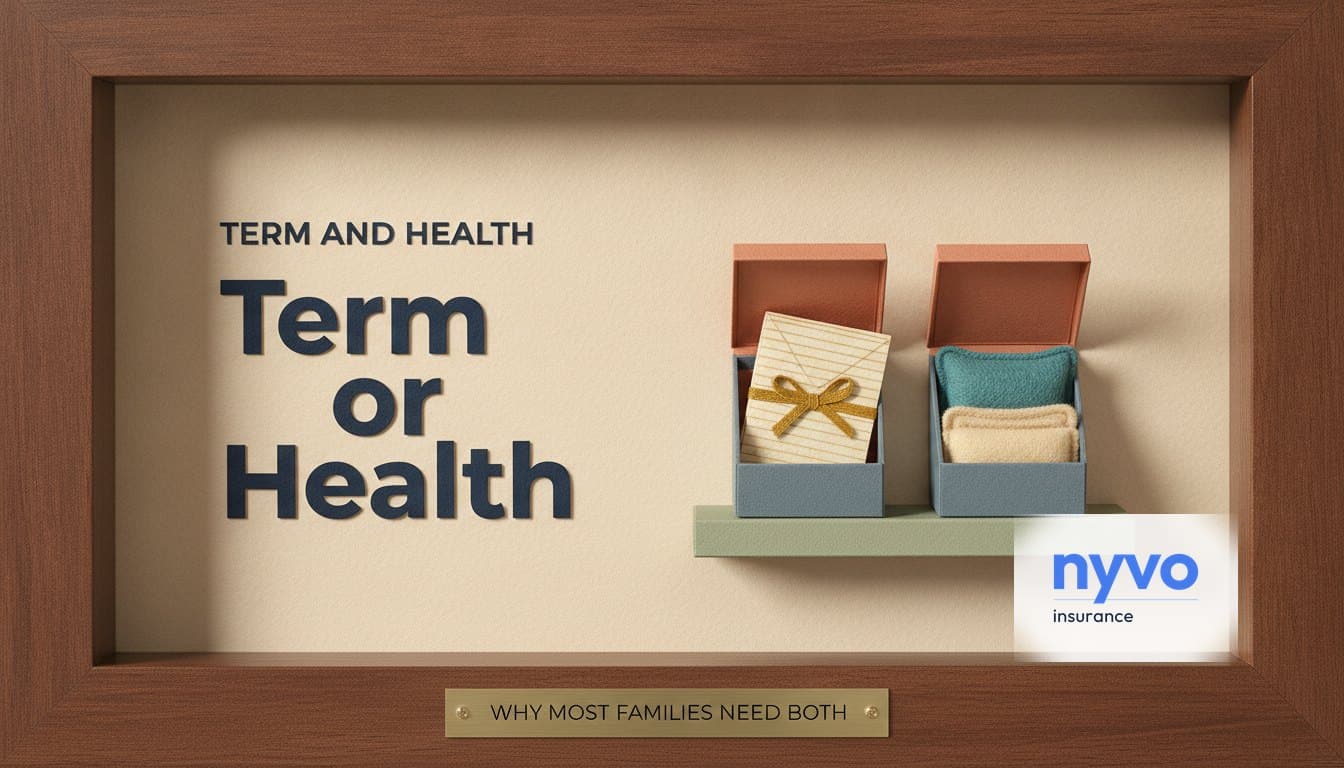
Health insurance pays your hospital bills while you're alive. Term insurance pays your family a lump sum if you die within the policy term. They cover different events, so one can't stand in for the other, and if anyone depends on your income you need both.
Here's what the pair costs at 30, as an example. A non-smoking man in Bengaluru buying ₹1 crore of term cover to age 60 pays a median ₹9,528 a year across the five term plans we rate (nyvo premium data, May 2026). ₹10 lakh of health cover for him alone costs ₹9,995 a year on HDFC ERGO Optima Secure Plus, or ₹7,239 on Aditya Birla Activ One Max (nyvo premium data, April 2026). Together, ₹16,767 to ₹19,523 a year.
Back to: Term Insurance guide
What is the difference between term insurance and health insurance?
Term insurance is life insurance: it pays a fixed sum to your nominee if you die within the policy term. Health insurance pays for hospital treatment while you're alive, up to the sum insured. They usually come from different companies, too: term cover from a life insurer, hospital cover from a general or standalone health insurer. HDFC Life and HDFC ERGO, for instance, are two separate insurers despite the shared name.
| Term insurance | Health insurance | |
|---|---|---|
| What it pays | A fixed sum you choose, such as ₹1 crore | Your hospital bills, up to the sum insured, less any co-pay, deductible or items the policy does not pay for |
| When it pays | Only if you die within the policy term | When you are treated in hospital for something the policy covers |
| Who gets the money | Your nominee | The hospital, on a cashless claim, or you, on a reimbursement claim |
| Who is covered | You, the life insured | You, and on a family floater the family members you add |
| What a claim needs | A claim form and the death certificate, plus documents such as a post-mortem report after an accident | Pre-authorisation at the hospital for cashless, or the bills, reports and discharge summary for reimbursement |
| Insurer's deadline | 15 days from intimation, or 45 if the claim is investigated | Cashless: 1 hour to decide, 3 hours for final authorisation at discharge. Reimbursement: 15 days from submission |
| Premium over time | Set when you buy and held for the term | Higher at older ages: ₹10 lakh on Optima Secure Plus in Bengaluru costs ₹9,995 at 30 and ₹12,274 at 40 |
| When the policy period ends | A plain term plan ends and pays nothing | You can keep renewing it, and a claim is no ground to refuse renewal |
| Tax on the premium | Section 80C (section 123 from tax year 2026-27), within ₹1.5 lakh a year, old regime only | Section 80D (section 126 from tax year 2026-27): up to ₹25,000 for you and your family, ₹50,000 if the insured is 60 or over, old regime only |
Sources: IRDAI Master Circular on Protection of Policyholders' Interests, 5 September 2024 (death claim deadline and documents, reimbursement deadline); IRDAI Master Circular on Health Insurance Business, 29 May 2024 (cashless deadlines, renewal); Axis Max Life Smart Term Plan Plus prospectus, UIN 104N132V01 (premium rates guaranteed for the policy term); Income-tax Act, 2025, sections 123 and 126; nyvo premium data, April 2026 (health premiums, one adult, pincode 560001).
Two more tax points. Your parents' health policy gets its own 80D deduction of up to ₹25,000 on top of yours, or ₹50,000 if a parent is 60 or over. And the term death benefit your family receives is tax-free under Section 10(10D) (Schedule II, item 2 of the Income-tax Act, 2025), under the old and new regimes alike. Our guides to Section 80D for health insurance and term insurance tax benefits have the details.
Can term insurance replace health insurance?
No. A term plan pays only when the insured person dies, so it pays nothing towards a hospital bill you survive, and a health policy has no lump sum to leave your family. So if someone depends on your income, you need both.
Walk through what can actually happen. Say you're admitted with a ₹3 lakh hospital bill (an example). Your health policy pays it, up to the sum insured, less any co-pay, deductible or items it doesn't cover. Your term plan pays nothing, because nobody has died. Now say you're diagnosed with a serious illness and recover. The health policy pays the treatment bills it covers. A plain term plan still pays nothing, though a critical illness rider on it would pay a lump sum if the illness is on the rider's list.
If you die within the term, the term plan pays its full cover, say ₹1 crore, to your nominee, and the insurer has 15 days from intimation to settle, or 45 if it investigates. The health policy has no lump sum to pay, only the hospital bills it covers. And if you reach the end of the term alive, the term plan ends with nothing paid, while the health policy carries on for as long as you renew it.
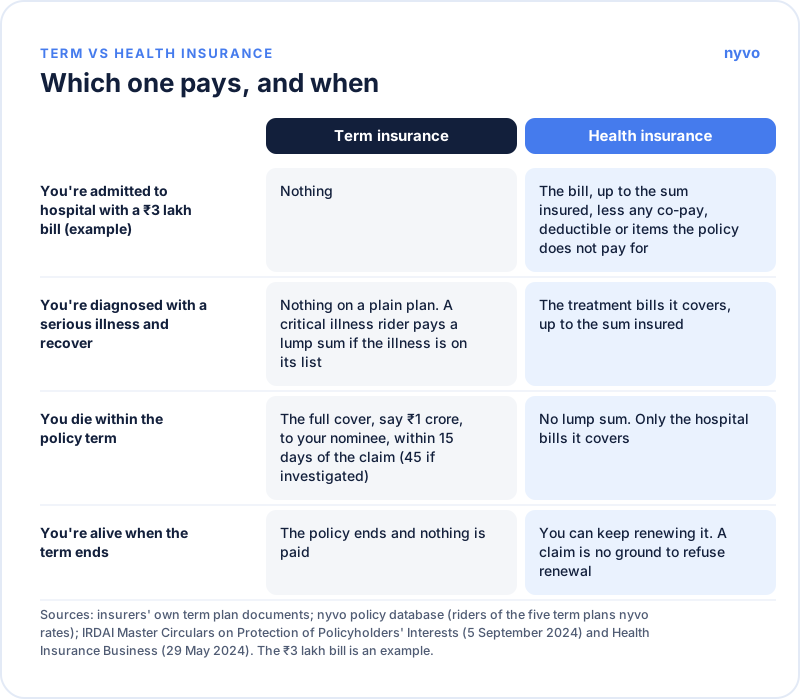
Holding only one leaves a predictable hole. With health cover and no term plan, a family can see the last hospital bill paid and then lose the income it lived on. With a term plan and no health cover, every hospital bill while you're alive comes out of your savings. Our guide to critical illness vs health insurance covers the third product people mix these up with.
How much do term and health insurance cost together?
For a 30-year-old non-smoking man in Bengaluru, ₹1 crore of term cover to 60 plus ₹10 lakh of health cover costs ₹16,767 to ₹19,523 a year in nyvo's premium data. The term part is the median of the five plans we rate (May 2026); the health part is HDFC ERGO Optima Secure Plus or Aditya Birla Activ One Max for one adult (April 2026).
| Example: man aged 30, non-smoker, Bengaluru | Cover | Yearly premium |
|---|---|---|
| Term insurance, median of the five plans we rate | ₹1 crore to age 60 | ₹9,528 (range ₹8,856 to ₹10,440) |
| Health insurance, HDFC ERGO Optima Secure Plus | ₹10 lakh, one adult | ₹9,995 |
| Health insurance, Aditya Birla Activ One Max | ₹10 lakh, one adult | ₹7,239 |
| Term plus health | ₹16,767 to ₹19,523 |
Term: nyvo premium data, May 2026, regular pay, non-smoker, salaried graduate on ₹10 lakh income. Health: nyvo premium data, April 2026, pincode 560001. A woman of 30 pays a median ₹8,100 a year for the same term cover. Neither premium carries GST: individual life and health insurance have both been exempt since 22 September 2025 (56th GST Council meeting).
Ten years on, the two premiums behave differently. The term premium is the one you locked in at 30. The health premium is not fixed in the same way: a 40-year-old buying the same ₹10 lakh pays ₹12,274 on Optima Secure Plus and ₹9,254 on Activ One Max in the same data, and our guide to why health premiums rise at renewal explains the other reasons a renewal can cost more.
For a family, the health side is usually a floater. A ₹10 lakh family floater for two adults and children, with the eldest aged 30, costs ₹13,000 to ₹28,000 a year across the cities and four health plans in nyvo's premium data (April 2026). Where you live and which plan you pick account for that spread, so price it on your own pincode.
Do I need both term and health insurance?
If anyone depends on your income, yes: health insurance for the hospital bills and term insurance for your family if you die. If nobody depends on your income yet, start with health insurance and add term cover when that changes.
| Where you are | Health insurance | Term insurance |
|---|---|---|
| First job, nobody depends on your income | Yes, a policy of your own. Employer cover ends when the job does | Not needed yet. If you expect dependants soon, buying young fixes a lower rate |
| Married, with children or a home loan | Yes, a family floater or individual policies | Yes, sized to your loans, 10 to 15 years of household expenses and your goals |
| Parents rely on your income | Yes, and a policy for your parents too | Yes |
| Retired, nobody depends on your income | Yes | Usually not needed |
On the first row, the rate matters more than it looks. On the median plan in nyvo's data, a man buying ₹1 crore of term cover at 35 pays ₹11,880 a year against ₹9,528 at 30, and whichever rate he starts at holds for his whole term (nyvo premium data, May 2026). A health problem that shows up before you buy can also mean a loading, a postponement or a refusal. Sizing guides: how much term cover you need and how much health cover you need.
What is a 'term plus health' or combined plan?
"Term plus health" usually means one of two things: a critical illness rider added to a term plan, or a combi product that a life insurer and a health insurer sell together. Neither turns one policy into both. The rider pays a fixed sum, not hospital bills, and in a combi product each insurer still carries and settles its own half.
A critical illness rider pays its own lump sum when you're diagnosed with an illness on its list. On the five term plans we rate, the lists differ: HDFC Life's rider covers 60 conditions and Tata AIA's Criticare 40, while Axis Max Life offers 22 or 64, ICICI Pru 20 or 60 and Bajaj Life 10, 25 or 60 (each plan's rider terms, nyvo policy database). All five exclude a diagnosis in the first 90 days of cover, and Axis Max Life's makes you wait 180 days for its minor conditions; the survival period after diagnosis runs from 14 to 30 days, longer for some conditions on ICICI Pru's rider. Some riders run for less than the base cover, too: HDFC Life's for at most 15 years, Tata AIA's for five years at a time. The money is yours to use as you like, which is useful, but it is not a health policy. Our page on term insurance riders weighs which riders are worth their premium.
A combi product is a single package from two insurers. IRDAI's Master Circular on Protection of Policyholders' Interests (5 September 2024) requires its documents to say that it is offered jointly by a general or standalone health insurer and a life insurer, that each insurer takes its own risk and settles its own claims, that you can carry on with either part and drop the other during the policy term, and that the health part keeps guaranteed renewability where the health plan allows it. We don't hold the wording of any combi product, so we don't name or rate one here. Buying the two separately lets you choose each one on its own terms, from any insurer.
FAQs
What is the difference between health insurance and life insurance?
Health insurance pays your hospital bills when you're treated for something the policy covers; life insurance, including term, pays a sum to your family when you die. They usually come from different insurers: hospital cover from general and standalone health insurers, life cover from life insurers.
Does term insurance cover hospitalisation?
No. A term plan pays only on death within the term, so it pays nothing towards a hospital bill. A critical illness rider pays a fixed lump sum on a listed diagnosis, though none of the five term plans we rate pays for a diagnosis in the first 90 days of cover, and it does not settle hospital bills.
Can I claim tax deductions on both term and health insurance?
Yes, both, but only under the old regime. The term premium counts under Section 80C (section 123 from tax year 2026-27) within the ₹1.5 lakh limit, and the health premium under Section 80D (section 126) up to ₹25,000 for you and your family, or ₹50,000 if the insured is 60 or over. The new regime allows neither, though the term death payout stays tax-free under both.
Which should I buy first, term or health insurance?
Health insurance first if nobody depends on your income; both together if someone does. Buying term young still helps if you expect dependants soon, because a man buying ₹1 crore of cover at 30 pays a median ₹9,528 a year against ₹11,880 at 35 (nyvo premium data, May 2026).
Is a combined term and health insurance plan a good idea?
Not by itself: it is two policies in one package. Under IRDAI's rules a combi product is offered jointly by a life insurer and a health insurer, each settles its own claims, and you can keep either part and drop the other. Compare each half with what you would get buying the two separately.
Term and health insurance at a glance
| Term insurance pays | a fixed sum to your nominee if you die within the policy term, and nothing if you outlive it (Axis Max Life Smart Term Plan Plus prospectus, UIN 104N132V01, maturity benefit clause) |
|---|---|
| Health insurance pays | the cost of hospital treatment the policy covers, up to the sum insured, while you are alive |
| Term death claim deadline | 15 days from intimation, or 45 where investigated (IRDAI Master Circular on Protection of Policyholders' Interests, 5 September 2024) |
| Health claim deadlines | cashless decision within 1 hour of the request and final authorisation within 3 hours of the discharge request (IRDAI Master Circular on Health Insurance Business, 29 May 2024); reimbursement within 15 days of submission (Master Circular on Protection of Policyholders' Interests, 5 September 2024) |
| Cost at 30, Bengaluru | ₹1 crore of term cover to 60, median ₹9,528 a year for a man (nyvo premium data, May 2026); ₹10 lakh of health cover, ₹7,239 on Activ One Max or ₹9,995 on Optima Secure Plus (nyvo premium data, April 2026) |
| Premium deductions | term under Section 80C (section 123 from tax year 2026-27), health under Section 80D (section 126 from tax year 2026-27), both old regime only |
| Term payout | tax-free under Section 10(10D) (Schedule II, item 2 from tax year 2026-27), under both regimes |
| Combi products | offered jointly by a life insurer and a health insurer, each settling its own part of a claim (IRDAI Master Circular on Protection of Policyholders' Interests, 5 September 2024) |
Term premiums are for a non-smoker buying ₹1 crore of cover to 60 across the five plans nyvo rates; health premiums are for one adult in Bengaluru (pincode 560001). nyvo's data holds no smoker rates and no term cover other than ₹1 crore to 60.
Book a call for advice on the best policy for you and your family
A salaried, IRDAI-certified nyvo advisor will look at your cover, flag the gaps that matter, and tell you plainly what to fix. No commission, no pressure.
A first in India
Buy policy from nyvo insurance with Claim Support Guarantee, otherwise money back.

Alumni of IIT Delhi and IIM Ahmedabad. Former consultant at BCG and part of the strategy team of slice. Founder of nyvo and IRDAI Certified Insurance Advisor.