First in India
Claim Support Guarantee, otherwise your money back.
Buy through nyvo and we get your claim passed, otherwise refund your premium. We are putting our money on our claim service.
Level vs Decreasing Term Cover: Which Shape to Buy
Level term pays the same sum assured throughout. Decreasing term falls each year, usually tracking a loan. Which shape protects your family rather than your lender.

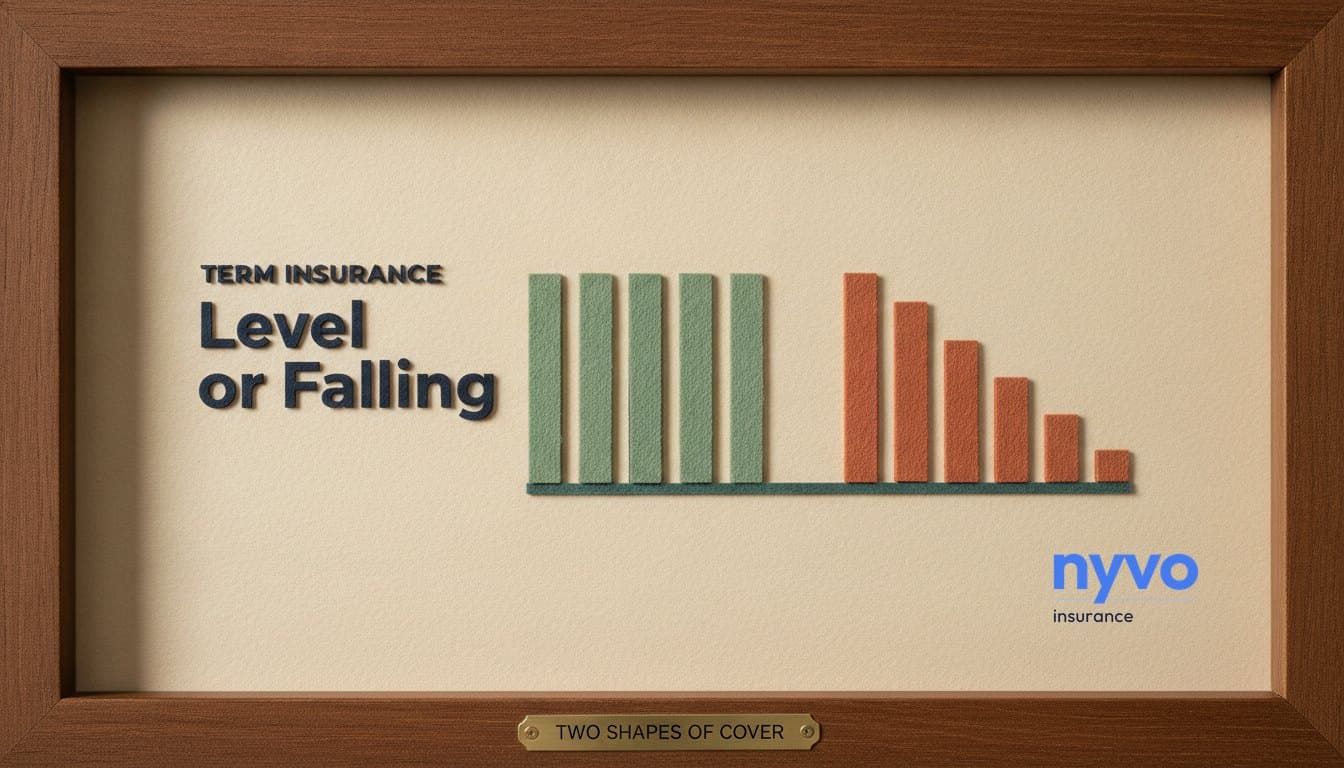
The three cover shapes
| Level cover | the sum assured stays the same for the whole term. Year twenty pays what year one pays. This is what most people mean by term insurance. |
|---|---|
| Decreasing cover | the sum assured falls each year, normally on a schedule that tracks a home loan amortising. |
| Increasing cover | the sum assured rises through the term, usually by a fixed percentage a year, to hold its value against inflation. |
| Where you meet decreasing cover | as a named plan option. HDFC Life Click 2 Protect Super sells three shapes, and its decreasing option is called Life Goal. |
| Who decreasing cover really protects | the lender's exposure, because it falls as the loan does. Your family's other costs do not fall on that schedule. |
| What the premium does | it does not fall with the cover. You pay a level premium for a benefit that shrinks. |
| The usual right answer | level cover, sized once against income, liabilities and goals together. |
| Source | plan options from the policy wordings held in nyvo's policy database, read September 2026. |
Cover shape is a plan option chosen at proposal, not something you can usually switch later. Price both shapes before you decide rather than accepting the default on the quote.
Level term cover pays the same sum assured whenever a claim arises, from the first year to the last. Decreasing term cover pays a sum that falls each year, normally on a schedule designed to track a home loan being repaid. Both are term insurance; the difference is the shape of the benefit over time.
For almost every salaried household the answer is level cover. The reason is not complicated: your family's need does not shrink on a bank's amortisation schedule.
What is the difference between level and decreasing term cover?
Level cover holds the sum assured constant for the policy term. Buy ₹1 crore for thirty years and a claim in year twenty-eight pays ₹1 crore, exactly as one in year two would. Decreasing cover reduces the sum assured through the term on a schedule fixed at outset, so a claim in year twenty-eight pays whatever the schedule has left by then, which on a loan-linked design is a fraction of where it started.
A third shape exists. Increasing cover raises the sum assured through the term, usually by a fixed percentage a year, to hold its real value against inflation.
| Level | Decreasing | Increasing | |
|---|---|---|---|
| Sum assured over the term | Constant | Falls on a set schedule | Rises on a set schedule |
| What it is sized against | Income, liabilities and goals together | Usually one amortising loan | Future income needs |
| Premium | Level | Level, for a shrinking benefit | Higher from day one |
| Who it protects best | Your family | The lender's exposure | A young earner with a long horizon |
| Typical right answer for salaried buyers | Yes | Rarely | Sometimes, if held long |
Why does decreasing cover exist?
Because a lender's exposure genuinely does fall as a loan is repaid, and a product priced against that exposure can be sold more cheaply than one priced against a constant sum. Insurers offer it as a named plan option rather than as a separate product. HDFC Life Click 2 Protect Super, for instance, is built around three cover shapes, and its decreasing option is sold as Life Goal.
Our own read of that option in nyvo's policy database is blunt, and worth repeating here: it is loan protection dressed as life cover. It falls as a mortgage amortises, so it protects the lender's exposure rather than your family's income.
That is not a criticism of the plan, which is a well-regarded one. It is a description of what the shape is for.
The comparison that misleads people
A decreasing quote sitting next to a level quote looks like a cheaper version of the same thing. It is not. The two are not selling the same amount of protection across the term, so the premium difference is not a saving, it is a price difference for different benefits.
The premium is also the part people assume wrongly. It does not fall as the cover falls. You pay a level premium throughout for a benefit that is shrinking every year, which means the cost per rupee of cover rises steadily over the policy's life.
If you want to compare honestly, ask for both quotes at the same starting sum assured and look at what each pays in year fifteen, not at what each costs in year one.
When does decreasing cover make sense?
Narrowly, and mostly when it is the only cover available to you. If your health means individual level term is heavily loaded or declined, a loan-linked decreasing cover with lighter underwriting can be the only protection on offer, and protection that shrinks beats none.
It can also make sense as a deliberate top-up alongside a level policy, where the level policy carries the family's income replacement and a small decreasing layer sits over a specific loan for its first years. That is a considered structure, not a default, and it only works if the level policy came first.
What does not make sense is buying decreasing cover instead of level cover because the quote was lower. That is the home loan protection plan trade in a different wrapper, and it produces the same outcome: a household covered for the bank's remaining exposure and nothing else.
What about increasing cover?
Increasing cover is the honest opposite, and it has a real case. Your family's costs will be higher in twenty years than they are now, and a fixed sum assured quietly loses purchasing power across a thirty-year term.
The cost is that you pay more from day one, and the benefit only compounds if you hold the policy for the long run. Someone who buys increasing cover at 32 and lapses it at 41 has paid the higher premium and collected almost none of the increase.
For most buyers the simpler route is to size level cover properly at the outset rather than buying a rising shape to fix an undersized start. Our cover-sizing method works the calculation through.
How to decide in one pass
- Size the cover first, against income, every outstanding liability and any goal you would want funded regardless. One number, not one number per loan.
- Get that number quoted as level cover.
- If someone has quoted you decreasing cover, ask for level at the same starting sum and compare what each pays in year fifteen.
- Only consider decreasing cover if level cover is unavailable to you on health grounds, or as a deliberate extra layer over a specific loan once level cover is already in place.
- Check the riders separately. Rider choice usually matters more to a real household than cover shape does.
FAQs
What is decreasing term insurance?
Decreasing term insurance is term cover whose sum assured falls each year on a schedule fixed at outset, normally designed to track a home loan being repaid. The premium stays level, so the cost per rupee of cover rises through the term.
Is level or decreasing term insurance better?
Level, for almost every salaried household. Your family's need for income replacement does not shrink on a lender's amortisation schedule, and a level policy sized once against income, liabilities and goals covers the loan alongside everything else.
Is decreasing term insurance cheaper?
The premium is usually lower, but it is not a saving, because you are buying less protection over the term. Compare the two at the same starting sum assured and look at what each pays in year fifteen rather than at the year-one premium.
Does the premium fall as decreasing cover falls?
No. The premium is level throughout while the benefit shrinks, which means every year you pay the same money for less cover. This is the part most buyers do not expect.
Which term plans offer a decreasing cover option?
It is sold as a plan option rather than a separate product. HDFC Life Click 2 Protect Super offers three cover shapes including a decreasing option called Life Goal, per the policy wordings held in nyvo's policy database, read September 2026.
Should I buy increasing cover instead?
Only if you will hold it for the long run. Increasing cover costs more from day one and the benefit compounds slowly, so someone who lapses after nine years has paid the higher premium for very little of the increase. Sizing level cover correctly at outset is usually the simpler answer.
Book a call for advice on the best policy for you and your family
A salaried, IRDAI-certified nyvo advisor will look at your cover, flag the gaps that matter, and tell you plainly what to fix. No commission, no pressure.
A first in India
Buy policy from nyvo insurance with Claim Support Guarantee, otherwise money back.

16+ years in financial services. Former investment banker at Bank of America, Kotak Investment Banking, and SBICaps, and ex-CFO of slice. Founder of nyvo and Principal Officer - IRDAI Certified.