First in India
Claim Support Guarantee, otherwise your money back.
Buy through nyvo and we get your claim passed, otherwise refund your premium. We are putting our money on our claim service.
Home Loan Insurance vs Term Insurance: Which to Buy 2026
Bank-bundled home loan cover pays the lender, shrinks as you repay, and usually ends if you refinance. Term insurance pays your family a level sum for every liability at once.

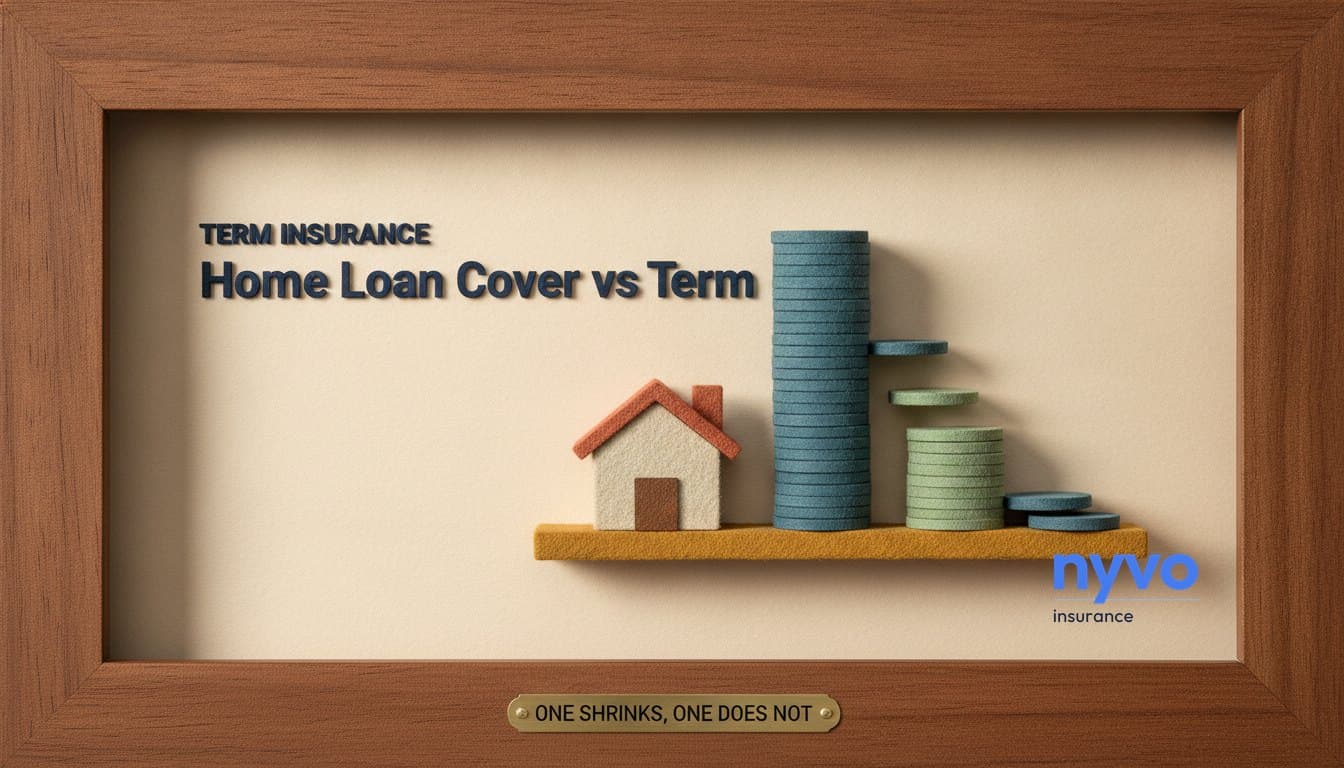
Home loan cover against term cover, at a glance
| What the bank sells you | a loan protection plan, sometimes called credit life or mortgage redemption. It is a life cover written around one debt. |
|---|---|
| Who gets paid | the lender. The policy clears the outstanding loan; whatever your family needs beyond that is not its job. |
| What happens to the cover | it falls as the loan falls. Twelve years into a twenty-year loan, most of what you insured has already been repaid, and the cover has shrunk with it. |
| What happens if you refinance | the cover is usually tied to that specific loan with that specific lender. Move the loan and the protection commonly does not move with it. |
| How it is paid for | often a single premium added to the loan itself, which means you also pay interest on the premium for the life of the loan. |
| What term insurance does instead | pays a level sum to your nominee, who decides what to settle first. It covers the loan, the income and everything else at once. |
| Is either one compulsory | no lender can require you to buy its insurance to get a loan. You may be asked. You are allowed to decline. |
| The honest exception | if your health makes individual term cover expensive or unavailable, a group loan cover with light underwriting may be the only protection on offer. |
Written from how these two products are structured rather than from any one lender's brochure. Premiums vary by lender, insurer, age and health, so price both before you decide.
A home loan sanction usually comes with an offer attached. Somewhere between the sanction letter and the disbursement, someone will suggest a loan protection plan, and the pitch is reasonable on its face: if something happens to you, the loan does not land on your family.
It is a real risk and it deserves cover. The question is only whether the product being offered at that desk is the one that covers it best.
What a loan protection plan actually is
The bank-bundled product goes by several names, including loan protection, credit life and mortgage redemption. Underneath, it is a life insurance policy built around one debt, and three features follow from that:
The lender is paid, not your family. The policy settles the outstanding loan. That is the whole job. Anything your household needs beyond clearing that one liability is outside its scope.
The cover shrinks as the loan does. The sum assured tracks the outstanding balance, so it falls every year. Twelve years into a twenty-year loan you have repaid most of the principal, and the protection has come down to match it.
It is tied to that loan with that lender. Refinance to a cheaper rate, or move the loan elsewhere, and the cover commonly does not follow. People discover this at the point they were trying to save money.
There is a fourth feature that is easy to miss. The premium is frequently a single payment added to the loan amount rather than paid separately. That is convenient, and it means the premium sits inside a balance you are paying interest on for the rest of the term.
What term insurance does with the same money
A term policy pays a fixed sum to your nominee. It does not know what the money is for, which is exactly the point: your family decides whether to clear the loan, keep the EMI running and preserve the corpus, or do something else entirely.
The sum stays level for the whole term. Year twelve pays the same as year one.
| Loan protection plan | Term insurance | |
|---|---|---|
| Who receives the payout | The lender | Your nominee |
| Cover over time | Falls with the outstanding loan | Level for the full term |
| What it covers | That one loan | The loan, the income and everything else |
| If you refinance | Usually ends with the loan | Unaffected |
| If you repay early | Usually ends | Continues |
| Typical payment | Single premium, often financed into the loan | Annual or monthly, paid separately |
| Portability | Tied to the lender | Yours |
Sizing it properly, which is where people go wrong
The instinct is to buy a policy per liability: one for the home loan, one for the car, one for the family. That produces several small covers, several sets of charges, and a household that is still underinsured.
Our cover-sizing method works the other way. Take fifteen times your annual income, add every outstanding liability including the home loan, add any goal you would want funded regardless, then subtract the cover you already hold. On ₹12 lakh of income that is ₹1.8 crore before you add a ₹40 lakh home loan, which is how a household with one mortgage arrives at ₹2.5 crore of need.
One policy at that size covers the loan and everything the loan was competing with. A loan protection plan covers the loan and nothing else.
No, it is not compulsory
You can be offered insurance at the sanction desk. You cannot be required to buy the lender's policy in order to get the loan. If the conversation starts to feel like a condition rather than an offer, that is worth naming out loud.
What a lender can reasonably ask is that the loan is protected. Your own term policy, already in force, answers that.
When the bank's product is the right answer
There is an honest case for it, and it is a narrower one than the pitch suggests.
Group loan cover is usually underwritten lightly, sometimes on a declaration alone. If your health history means individual term insurance carries a heavy loading or is declined outright, a group policy attached to the loan may be the only cover available to you. Protection that pays the lender still beats no protection at all.
That is a decision made on underwriting, not on convenience. Price the term policy first and find out whether you actually need the fallback.
What to do at the sanction desk
- Ask for the loan protection plan's premium, sum assured and term in writing, separately from the loan paperwork.
- Ask whether the premium is being added to the loan. If it is, work out what it costs across the full tenure, not on the day.
- Get a term quote for the same cover before you sign anything.
- If you already hold term cover, check whether it is large enough to absorb this loan. Often the right move is raising an existing policy rather than buying a second product.
FAQs
Is home loan insurance mandatory in India?
No. A lender may offer you a loan protection plan, and often will, but it cannot make buying its own insurance a condition of sanctioning the loan. You can decline and cover the loan through your own term policy instead.
Does home loan insurance pay my family or the bank?
The bank. A loan protection plan is written to clear the outstanding loan, so the lender receives the settlement. A term policy pays your nominee, who then chooses what to settle first.
What happens to home loan insurance if I refinance or prepay?
It usually ends with the loan it was attached to, because the cover is tied to that loan with that lender. This catches people out precisely when they are moving to a better rate. A term policy is unaffected by anything you do with the loan.
Why does the cover fall every year on a loan protection plan?
Because the sum assured tracks the outstanding balance rather than your family's need. The logic is that a smaller loan needs less cover. The gap is that your family's other costs do not shrink on the same schedule.
Should I buy a separate term policy for each loan?
No. Size one policy against everything at once: income, all outstanding liabilities and the goals you would still want funded. Several small policies mean several sets of charges and a household that is usually still short.
Is a loan protection plan ever the better choice?
When your health makes individual term cover expensive or unavailable. Group loan cover is often underwritten lightly, so it can be the only protection on offer. Get the term quote first and find out whether you need the fallback.
Book a call for advice on the best policy for you and your family
A salaried, IRDAI-certified nyvo advisor will look at your cover, flag the gaps that matter, and tell you plainly what to fix. No commission, no pressure.
A first in India
Buy policy from nyvo insurance with Claim Support Guarantee, otherwise money back.

16+ years in financial services. Former investment banker at Bank of America, Kotak Investment Banking, and SBICaps, and ex-CFO of slice. Founder of nyvo and Principal Officer - IRDAI Certified.