Domiciliary Hospitalisation: How to Claim It
Your father needed hospital-level treatment but couldn't be moved, or no bed was available, so the doctor treated him at home. Most families assume insurance won't pay for that. It often will, under a clause called domiciliary hospitalisation. Here is what it covers, the two conditions that unlock it, what insurers exclude, and exactly how to document a home-treatment claim so it isn't rejected.


Written by Kshitij JainReviewed by Harsh SoniUpdated nyvo insurance Services LLP, IRDAI Corporate Agent (Composite) CA1085Salaried advisors, no commission-based ranking
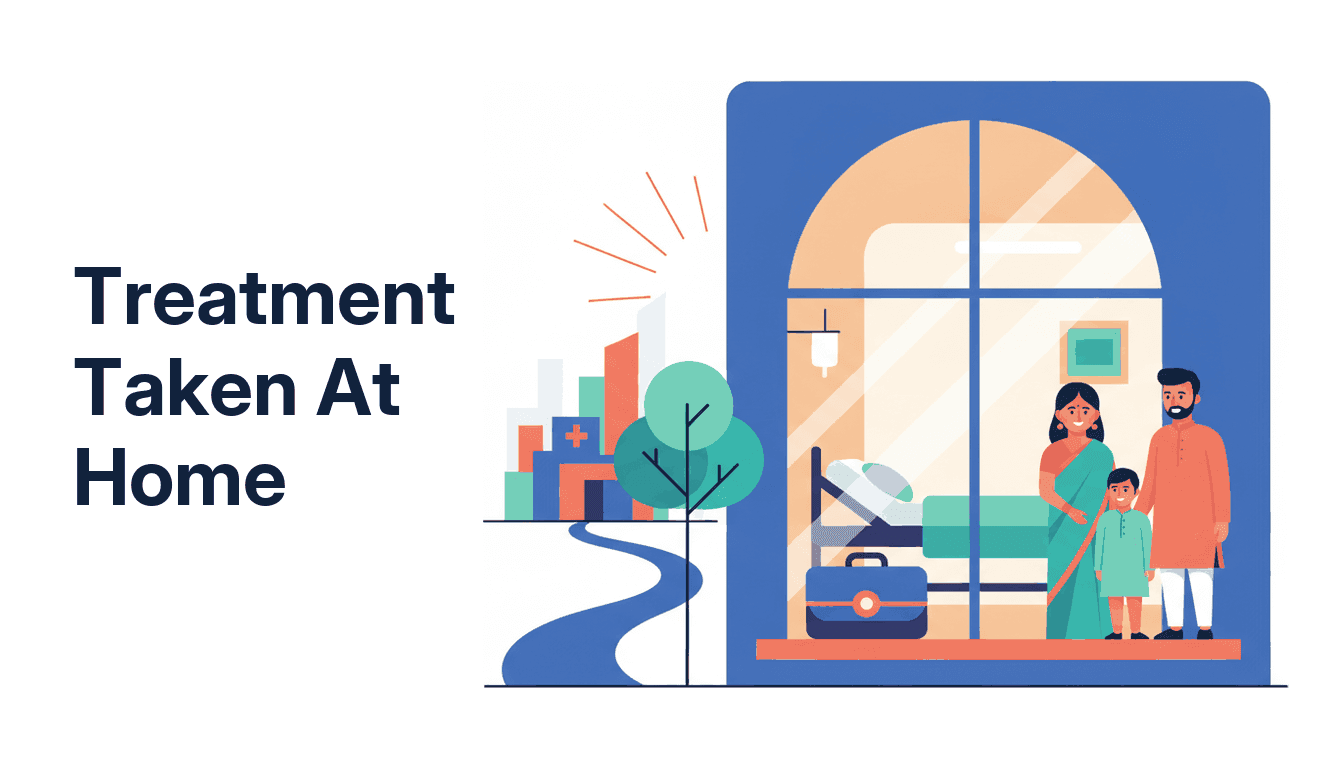
The doctor's advice was clear: this needs hospital-level care for ten days. The problem was equally clear. Your father is 78, partly immobile, and the treating physician said moving him to a hospital ward carried more risk than treating him at home with a nurse, a monitor and daily doctor visits. So that is what the family did. The bills still came, and they were not small.
When you sat down to file the claim, the assumption in the room was unanimous: insurers don't pay for treatment at home. That assumption is wrong often enough that it is worth knowing exactly when it is wrong.
The clause is called domiciliary hospitalisation, and most policyholders have never read it. It exists precisely for situations where the treatment is hospital-grade but the hospitalisation isn't possible.
The short answer
Domiciliary hospitalisation is also spelled domiciliary hospitalization; both refer to the same benefit and Indian policy wordings use either.
Domiciliary hospitalisation is treatment taken at home for a condition that would normally require hospital admission, and many health policies cover it under a specific clause. It is unlocked by one of two conditions: either the patient's medical state made it impossible to move them to a hospital, or a hospital bed was genuinely unavailable. It typically covers treatment that runs for at least three days and that would otherwise have needed inpatient care. Common exclusions apply (a defined list of chronic conditions, and care that is really just routine home nursing), and the cover is often capped below your full sum insured. The claim lives or dies on documentation: a treating doctor's certificate stating why hospitalisation was not possible, plus the usual prescriptions, bills and reports.
What domiciliary hospitalisation actually means
Ordinary health insurance pays when you are admitted to a hospital for 24 hours or more. Domiciliary hospitalisation is the carefully-bounded exception: the insurer agrees to treat your home as the hospital for billing purposes, because the illness needed inpatient-level care that, for a specific reason, could not happen in an inpatient setting.
The key word is necessity. This is not cover for choosing the comfort of home over a ward. It is cover for the cases where the ward was not an option.
The two conditions that unlock it
A domiciliary claim generally requires that the treatment would otherwise have needed hospitalisation, and that one of these was true:
- The patient could not be moved to a hospital. Their medical condition made transport unsafe or impossible. An elderly cardiac or stroke patient, someone in a fragile post-operative state, a patient on equipment that cannot travel.
- A hospital bed was not available. No bed could be arranged at the relevant hospital for the required treatment. This became far more familiar to Indian families during periods of acute bed shortage, and the clause is written to cover exactly that.
If neither applies, it is not domiciliary hospitalisation, it is home care, and that is usually a different (often uncovered) thing.
What is commonly excluded
Insurers fence this clause carefully, because home treatment is harder to audit than a hospital admission. Typical exclusions:
- A named list of chronic conditions treated at home, which varies by policy. Many policies exclude domiciliary claims for conditions like asthma, bronchitis, chronic nephritis, diabetes, hypertension and a few others when treated at home, on the logic that these are managed long-term rather than acutely.
- Treatment lasting under a minimum period, often three days.
- Routine nursing, attendant charges, or care that did not require a doctor's active treatment.
- Anything where hospitalisation was actually possible and home was simply preferred.
Read your own policy wording, because the excluded-condition list and the caps are where policies differ most.
Not sure if your policy covers home treatment? Send us your policy name and the situation. We'll read the domiciliary clause for you, tell you whether your case qualifies, and flag the exclusions before you file, not after a rejection.
How to document a domiciliary claim so it holds
This is the part families get wrong, because a home admission has no admission slip, no hospital UHID, no discharge summary in the usual form. You have to build the equivalent paper trail yourself:
- Get a treating-doctor certificate that states the diagnosis, that the condition required hospital-level treatment, the duration, and crucially the reason hospitalisation was not possible (could not be moved / no bed available). This single document is the spine of the claim.
- Keep every prescription with dates, showing active medical management, not just maintenance medicine.
- Retain all bills for medicines, the visiting doctor's fees, nursing, diagnostics and any equipment hire, each itemised and dated.
- Hold on to all diagnostic reports taken during the treatment period.
- Maintain a simple daily log of the treatment given, ideally counter-signed by the visiting doctor or nurse, to evidence continuity across the days.
- Intimate the insurer early, as you would for any claim, and ask specifically what their domiciliary documentation checklist requires.
A domiciliary claim filed with a vague prescription and a stack of pharmacy bills gets rejected. The same claim filed with a clear doctor's certificate explaining why hospitalisation was impossible usually gets paid.
A home-treatment claim already rejected? Don't accept the first no. If the rejection was for missing documentation rather than a policy exclusion, it is often recoverable. We'll review the wording against your file and help you represent it.
FAQs
Is treatment at home ever covered by health insurance?
Yes, under the domiciliary hospitalisation clause, when the treatment would otherwise have required hospital admission and either the patient could not be moved or no hospital bed was available. It is not cover for choosing home over hospital out of convenience.
What is the difference between domiciliary hospitalisation and home healthcare?
Domiciliary hospitalisation is hospital-level treatment delivered at home because admission was not possible, and it is covered under a specific clause. Home healthcare (routine nursing, attendant support) is a separate benefit that some policies offer as an add-on and many do not cover at all.
Are diabetes and hypertension covered under domiciliary treatment?
Often not. Many policies specifically exclude a list of chronic conditions, frequently including diabetes, hypertension, asthma and chronic nephritis, when treated at home, because these are long-term managed conditions rather than acute episodes. Check your policy's exclusion list.
How long must domiciliary treatment last to be claimable?
Most policies require the treatment to run for a minimum period, commonly three days, and to be for a condition that genuinely needed inpatient-level care. Shorter or routine treatment usually doesn't qualify.
What single document decides a domiciliary claim?
The treating doctor's certificate stating the diagnosis, that hospital-level care was required, and the specific reason hospitalisation was not possible (patient could not be moved, or no bed was available). Without it, the claim is very hard to win.
Related guides:
Sources:
- IRDAI Master Circular on Health Insurance Business, Reference No. IRDAI/HLT/CIR/PRO/84/5/2024, 29 May 2024
- IRDAI standardised definitions of "Domiciliary Hospitalisation" (Guidelines on Standardisation in Health Insurance)
- nyvo claims-support experience across 1,500+ Indian families

Alumni of IIT Delhi and IIM Ahmedabad. Former consultant at BCG and part of the strategy team of slice. Founder of nyvo and IRDAI Certified Insurance Advisor.