First in India
Claim Support Guarantee, otherwise your money back.
Buy through nyvo and we get your claim passed, otherwise refund your premium. We are putting our money on our claim service.
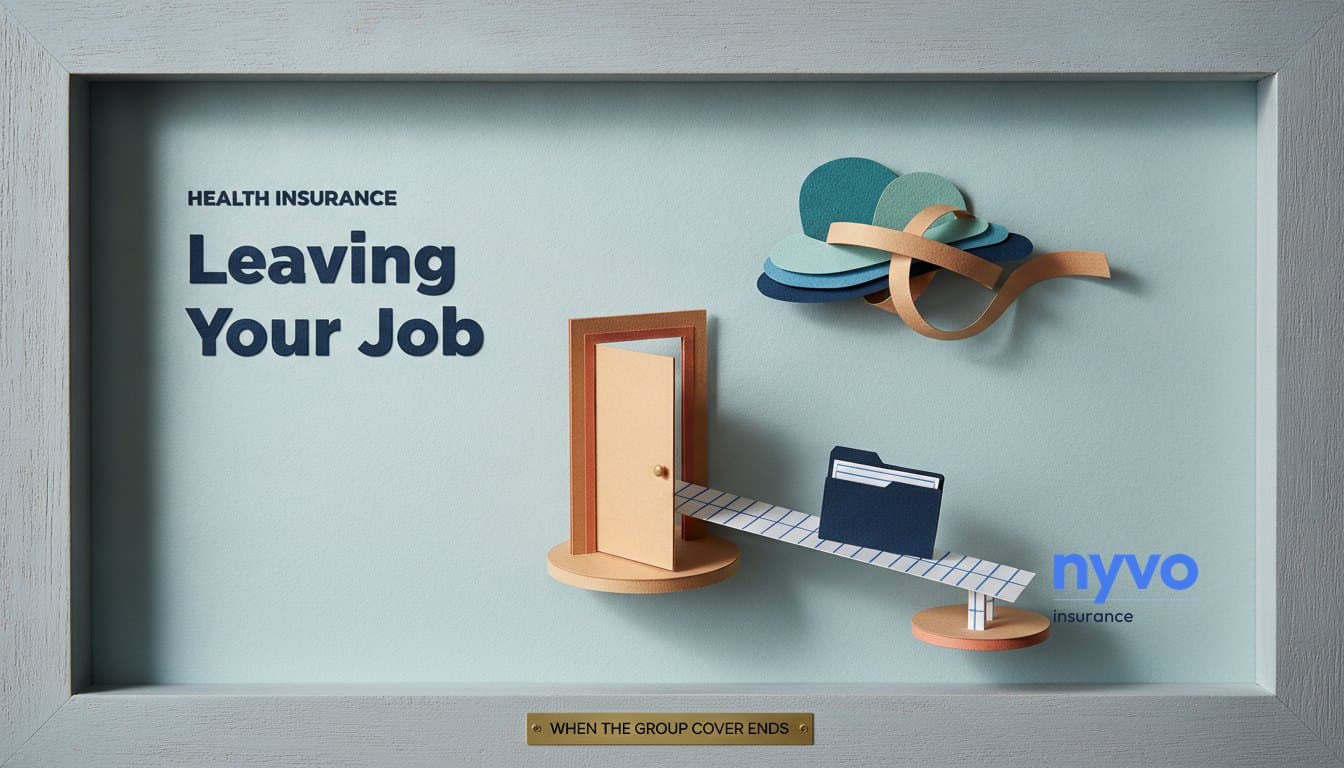
Leaving Your Job? What Happens to Your Health Cover
When your employment ends, your employer's group health cover usually ends with it – often with no grace period, so check the exact date with HR and the insurer – and the waiting periods you've already served move only if you migrate or port. Here is what really happens to corporate health insurance when you quit, switch jobs, are laid off or retire, how to carry your credit across, and how to bridge the gap so you're never uninsured for a single day.


Written by Harsh SoniReviewed by Shadab SayeedUpdated nyvo insurance Services LLP, IRDAI Corporate Agent (Composite) CA1085Salaried advisors, no commission-based ranking
Most people discover how their corporate health cover works on the day they no longer have it. They resign, serve notice, start the new job a few weeks later, and assume the insurance simply follows along like a transferred file. Then a parent is admitted during that gap, the hospital runs the policy number, and the screen says: not active.
Your employer's group health insurance is one of the best deals you will ever have – broad cover, pre-existing conditions often included from day one, your parents possibly added, all for little or no premium. It is also the most fragile, because you do not own it. Your employer does. The moment your employment ends, so does the protection, usually faster and more completely than anyone expects.
Here is exactly what happens, and how to make sure there is never a single day your family is exposed.
The short answer
When you leave a job, your employer's group health cover typically ends on your last working day – sometimes the day your full-and-final settlement is processed. There is usually no grace period, and the waiting periods you served under the group plan carry over only if you port or migrate: a fresh individual policy starts them again. Your options are: rely on your new employer's group cover (and check exactly when it starts), migrate to an individual policy with the group insurer before your membership ends (porting a group policy to another insurer is allowed at the policy's renewal, so do not count on your exit date as a porting point), or – best of all – own a personal health policy that you bought independently, so your protection never depended on your employer in the first place.
What ends, and when
The cover ends with the employment, not with a buffer. Most group policies cover you up to your last working day or the date of settlement. Unlike a personal policy, there is no 15 or 30-day grace window to keep it alive. One day you are covered; the next you are not.
The waiting-period credit travels only if you port or migrate. This is the part that costs families the most. Under your group plan, your diabetes or your parent's hypertension may have been covered from day one, with no pre-existing-disease waiting period. When you buy a fresh individual policy, you start those waiting periods over – up to three years for pre-existing conditions under current IRDAI rules. The convenience you enjoyed for years does not transfer just because you had it.
Your parents may lose cover entirely. If your group plan covered your parents, that is often the hardest cover to replace, because buying a senior-citizen policy fresh means new waiting periods, possible loadings, and medical underwriting at exactly the age it gets expensive. We cover that specific problem in Health Insurance for Parents and the Senior Citizen Guide.
The conversion right most people never use
Here is something insurers rarely advertise: IRDAI's Master Circular on Health Insurance Business (29 May 2024, Chapter I, para 11) lets members of group policies migrate to another policy of the same insurer and carry over the waiting-period credit they have accumulated, while the Master Circular on Protection of Policyholders' Interests (5 September 2024, para 24.1) allows group health policies to be ported at the time of renewal.
The catch is the clock. Migration needs the group cover still in force, because the credit rides on continuous cover, and neither circular gives a member leaving a group policy a separate deadline, so the insurer's own process decides: ask before your membership ends. Porting to another insurer is tied to the group policy's renewal, so do not count on your exit date as a porting point. Miss that, and you are back to buying fresh with new waiting periods.
The conversion is not always the cheapest option, and the individual version of a group plan can be priced quite differently. But for someone with pre-existing conditions or older parents on the policy, preserving the waiting-period credit can be worth far more than the premium difference. It is at minimum worth a quote before the group cover ends.
The four situations, and what to do in each
| Your situation | The risk | What to do |
|---|---|---|
| Switching jobs with a gap | Uncovered between last day and new cover starting | Confirm the exact start date of new cover; bridge any gap |
| Laid off | Cover ends immediately, income too | Exercise conversion right fast; price an individual policy |
| Retiring | Group cover gone at the age it's hardest to replace | Buy or convert before the last working day |
| Going freelance / starting up | No group cover at all from now on | Own a personal policy; see the founder and freelancer guides |
The thread running through all four: do not let your only health cover be one you do not control.
Changing jobs? Let's make sure there's no gap. Tell us your last working day and when your new cover starts. Our advisors will check whether you're exposed in between and set up a bridge – so your family is covered every single day.
The mistake almost everyone makes
The mistake is treating corporate cover as your health insurance plan, full stop. It is a benefit, not a plan. It is excellent while it lasts and gone the instant you change employers, get restructured out, or retire – and it is gone at the worst possible moments, because job loss and health crises have a cruel way of arriving together.
The fix is simple and we recommend it to nearly everyone: own a personal health policy in addition to your group cover, bought while you are young and healthy. Buy it early and the pre-existing-disease and other waiting periods are quietly running in the background, already served, for the day you actually need to lean on it. You keep the corporate cover as a top-up to your own base, not as your only line of defence. When you then change jobs, nothing happens to your real protection, because your real protection was never your employer's to take away. We make the full case in Why Your Corporate Insurance Isn't Enough.
If you are reading this because you have just resigned, do two things this week: confirm the precise date your new cover begins, and get a quote for either a conversion or a fresh individual policy before any window closes. Either is cheaper than the alternative, which is hoping nobody falls ill in the gap.
Own your cover, not just your employer's. A personal policy bought today means the waiting periods are already running for the day you change jobs, go solo, or retire. Our advisors will right-size one for your family – salaried, not commission-linked.
FAQs
Does my health insurance stop immediately when I resign?
Usually yes. Most group policies cover you up to your last working day or the date your full-and-final settlement is processed, with no grace period. Confirm the exact end date with your HR team in writing so you know precisely when you are exposed.
Do the waiting periods I served under my company plan carry to a new policy?
Only if you migrate or port. A fresh individual policy starts the waiting periods again. IRDAI's Master Circular on Health Insurance Business (29 May 2024) carries waiting-period credit for members of group policies who migrate to another policy of the same insurer, so ask the group insurer before your membership ends; porting a group policy to another insurer is allowed at the policy's renewal.
Can I convert my employer's group policy to a personal one?
Yes, by migrating, subject to the insurer's process. IRDAI's Master Circular on Health Insurance Business (29 May 2024) lets members of group policies migrate to another policy of the same insurer with their waiting-period credit; neither it nor the Master Circular on Protection of Policyholders' Interests (5 September 2024) sets a separate deadline for someone leaving, so ask the group insurer before your membership ends. Porting a group policy to another insurer is allowed at the policy's renewal.
My new employer offers health insurance. Isn't that enough?
It covers you while you are there, but check the start date – some employers add you only after a probation period or the first payroll cycle, leaving a gap. And it disappears again the next time you change jobs. A personal policy underneath your employer cover removes that fragility entirely.
Should I keep paying for a personal policy if my employer already covers me?
For most people, yes. The personal policy quietly serves its waiting periods while your group cover does the heavy lifting, so the day you leave, switch or retire, you already own claimable protection. It is the difference between a plan you control and a benefit that can be withdrawn.
Related guides:
Sources:
- IRDAI Master Circular on Protection of Policyholders' Interests, Reference No. IRDAI/PP&GR/CIR/MISC/117/9/2024, 5 September 2024 (Chapter VI, para 24.1: portability of group health policies); Master Circular on Health Insurance Business, 29 May 2024, Chapter I, para 11 (migration credits for members of group policies)
- IRDAI Master Circular on Health Insurance Business, Reference No. IRDAI/HLT/CIR/PRO/84/5/2024, 29 May 2024; IRDAI (Insurance Products) Regulations, 2024, effective 1 April 2024 (36-month cap on pre-existing-disease waiting periods)
- nyvo advisory experience helping families transition off corporate cover
Book a call for advice on the best policy for you and your family
A salaried, IRDAI-certified nyvo advisor will look at your cover, flag the gaps that matter, and tell you plainly what to fix. No commission, no pressure.
A first in India
Buy policy from nyvo insurance with Claim Support Guarantee, otherwise money back.

16+ years in financial services. Former investment banker at Bank of America, Kotak Investment Banking, and SBICaps, and ex-CFO of slice. Founder of nyvo and Principal Officer – IRDAI Certified.